

Many service business owners still question whether they truly need a website, viewing it as an optional expense rather than a fundamental business asset. This misconception costs them dearly. Research shows that customer trust increases by 75% when businesses have a professionally designed website. For healthcare providers and trades professionals in New Zealand, this trust translates directly into more bookings, higher client retention, and sustainable growth. This guide reveals why websites are no longer optional in 2026 and shows you exactly how to leverage them for maximum business impact.
Table of Contents
- Why A Website Matters For Service Businesses
- How Websites Act As 24/7 Marketing And Engagement Tools
- Key Website Features That Drive Client Attraction And Business Growth
- Choosing The Right Website Design Approach For Your Business
- Explore Professional Website Design Services Tailored For NZ Service Businesses
Key takeaways
| Point | Details |
|---|---|
| Trust drives decisions | Professional websites increase customer confidence by up to 75%, directly impacting conversion rates. |
| Always-on marketing | Websites work 24/7, providing essential information and engagement opportunities when clients need them most. |
| Information accessibility | Clients expect instant access to services, pricing, and contact details without making phone calls. |
| Sector-specific value | Healthcare and trades businesses see particularly strong returns from well-designed online presences. |
| Professional investment | Quality design and usability directly correlate with business growth and client acquisition. |
Why a website matters for service businesses
Your website serves as the digital storefront that potential clients encounter before they ever contact you. In healthcare and trades sectors, where trust and professionalism are paramount, this first impression shapes whether someone chooses your services or moves to a competitor. A professionally designed site increases customer trust by 75%, making it one of the most powerful tools in your business arsenal.
This trust factor becomes even more critical when you consider how clients make decisions in 2026. They research thoroughly online before committing to any service provider. A polished, informative website signals competence and reliability, whilst a poor or absent web presence raises immediate red flags. For trades professionals and healthcare providers, where clients are often making significant financial or personal health decisions, this credibility gap can mean the difference between a thriving practice and struggling to fill your schedule.
“In service industries, your website is your reputation made visible. Clients judge your professionalism, attention to detail, and trustworthiness based on what they see online before they ever speak with you.”
Even simple but well-executed websites dramatically outperform having no online presence. Consider these essential credibility elements:
- Clear service descriptions that address client pain points directly
- Professional photography showcasing your work or facilities
- Client testimonials providing social proof of quality
- Transparent pricing or service packages removing uncertainty
- Easy-to-find contact information and location details
The difference between websites for builders that work and those that fail often comes down to understanding what builds trust. Including comprehensive FAQs that build trust addresses common concerns proactively, reducing barriers to engagement. When potential clients can find answers to their questions immediately, they feel more confident moving forward with your services.
For healthcare providers, this trust element extends beyond general credibility to include compliance, privacy, and professional standards. Clients need reassurance that you take their wellbeing seriously. For trades professionals, demonstrating past projects, certifications, and transparent processes shows you deliver quality work. These trust signals convert browsers into paying clients.
How websites act as 24/7 marketing and engagement tools
Whilst you sleep, your website continues working to attract and inform potential clients. This 24/7 marketing advantage fundamentally changes how service businesses operate in 2026. Clients no longer wait for business hours to research services or make decisions. They browse on their phones during lunch breaks, evenings, and weekends, expecting immediate access to information.
Your website reduces repetitive administrative work by answering common questions automatically. Instead of fielding the same enquiries about pricing, availability, or service details repeatedly, you provide this information clearly online. This efficiency frees your time for actual client work whilst improving the client experience through instant information access. Professional services web design focuses specifically on this balance between automation and personal connection.
Mobile accessibility has become non-negotiable. Most potential clients discover and research service providers on smartphones, making responsive design essential rather than optional. A site that displays poorly on mobile devices loses clients before they ever contact you. Fast loading speeds, clear navigation, and thumb-friendly buttons ensure seamless mobile experiences that keep potential clients engaged.
Consider these continuous marketing functions your website performs:
- Showcasing your unique value proposition and competitive advantages
- Collecting contact information through strategically placed forms
- Enabling online booking or appointment scheduling
- Providing downloadable resources that demonstrate expertise
- Integrating with email marketing for ongoing client nurturing
- Supporting chatbots or automated responses for instant engagement
Pro Tip: Update your website content monthly with blog posts, project showcases, or industry insights to maintain search engine visibility and demonstrate ongoing expertise to returning visitors.
The marketing automation possibilities extend far beyond static information. Integration with booking systems lets clients schedule appointments without phone tag. Contact forms capture enquiries with relevant details, streamlining your response process. Email newsletter signups build your marketing list organically. These tools compound over time, creating marketing systems that drive consistent website design for company growth.
For healthcare practices, online booking reduces administrative burden whilst improving patient satisfaction. For trades businesses, project enquiry forms gather essential details upfront, letting you provide more accurate quotes faster. These efficiency gains directly impact your bottom line by reducing overhead costs and improving conversion rates.
Key website features that drive client attraction and business growth
Understanding which features actually convert browsers into clients helps you invest wisely in your web presence. Professional websites with essential features consistently outperform basic sites because they address specific client needs and remove friction from the decision-making process.
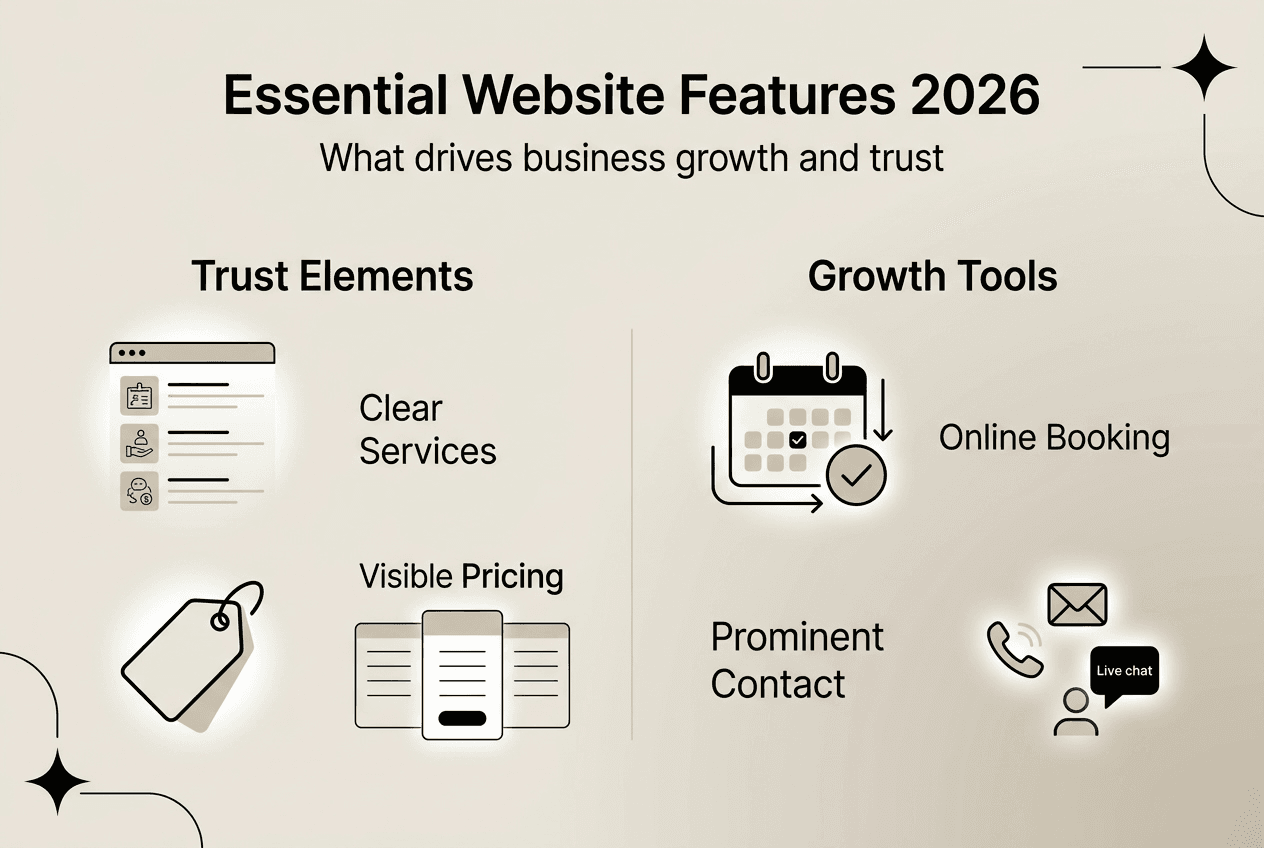
Clients expect transparency in 2026. Vague service descriptions or hidden pricing create suspicion and drive potential clients to competitors who provide clear information upfront. Whilst you needn’t publish exact prices for custom work, providing pricing ranges, package options, or starting costs sets realistic expectations and filters serious enquiries from casual browsers.
| Effective website | Basic website |
|---|---|
| Clear service packages with benefits outlined | Generic service lists without detail |
| Online booking or detailed contact forms | Simple email address only |
| Professional photography of actual work | Stock photos or no images |
| Client testimonials with specifics | No social proof |
| Mobile-optimised responsive design | Desktop-only layout |
| Fast loading under 3 seconds | Slow, image-heavy pages |
| Regular content updates and blog | Static, outdated information |
Follow these five steps to optimise your website for maximum client attraction:
- Audit your current site or competitors’ sites to identify gaps in information or functionality that frustrate potential clients
- Implement clear calls-to-action on every page, guiding visitors toward booking, calling, or requesting quotes
- Add high-quality images showcasing your work, team, or facilities to build visual trust and professionalism
- Create comprehensive service pages addressing common questions, benefits, and processes for each offering
- Test your site on multiple devices and browsers, ensuring consistent performance and appearance across platforms
Pro Tip: Use professional photography rather than stock images whenever possible, as authentic visuals of your actual work, team, or projects build significantly more trust with potential clients.
Exploring top design examples from 2026 reveals common patterns among high-converting service business sites. They prioritise user experience over flashy design, ensure information hierarchy matches client priorities, and remove unnecessary complexity. Understanding the website design workflow helps you appreciate how strategic planning creates these results.
Contact information deserves prominent placement on every page. Clients should never hunt for how to reach you. Phone numbers, email addresses, physical locations, and contact forms should be immediately visible. For local service businesses, including your service area and location prominently improves local search visibility and helps clients quickly determine if you serve their area.

Choosing the right website design approach for your business
Selecting the appropriate platform and design approach determines your website’s long-term success and scalability. Choosing the right platform impacts everything from initial costs to ongoing maintenance requirements, integration capabilities, and growth potential.
WordPress and Shopify represent the two dominant platforms for service businesses in New Zealand, each with distinct advantages. WordPress offers unmatched flexibility and customisation options, making it ideal for content-rich sites, complex service offerings, or businesses planning significant future expansion. WordPress website design provides the foundation for highly customised solutions that grow with your business.
Shopify excels when e-commerce functionality is central to your business model. For service businesses selling products alongside services, or those offering online courses, digital downloads, or merchandise, Shopify websites provide robust, integrated payment processing and inventory management. The platform’s built-in features reduce technical complexity whilst maintaining professional functionality.
Consider these platform characteristics when making your decision:
- WordPress: Highly customisable, extensive plugin ecosystem, requires more technical knowledge or professional support, excellent for SEO, scales to any size, lower platform costs but potentially higher development costs
- Shopify: Built for e-commerce, simpler learning curve, monthly subscription model, integrated payments and checkout, excellent mobile commerce, some customisation limitations, higher ongoing costs but lower development complexity
- Both platforms: Mobile responsive, professional themes available, integrations with booking systems and business tools, regular security updates, strong community support
Integration capabilities matter significantly for service businesses. Your website should connect seamlessly with your booking system, customer relationship management software, email marketing platform, and payment processors. WordPress typically offers more integration options through its extensive plugin library, whilst Shopify provides polished, built-in solutions for commerce-focused integrations.
Working with experienced Auckland web designers who understand the New Zealand market provides distinct advantages. They grasp local business requirements, understand regional search behaviour, navigate NZ-specific compliance and accessibility standards, and offer support during your business hours. This local expertise often delivers better results than offshore alternatives, despite potentially higher upfront costs.
Budget considerations extend beyond initial development. Factor in ongoing costs for hosting, security, updates, content management, and potential feature additions. WordPress sites typically have lower hosting costs but may require professional support for updates and maintenance. Shopify’s subscription model bundles these costs but increases monthly expenses. Evaluate your technical comfort level and available time honestly when weighing these options.
Explore professional website design services tailored for NZ service businesses
Transforming your online presence from basic to exceptional requires expertise in both design and the specific needs of service businesses. Virtual Innovation specialises in creating WordPress website design and Shopify websites that work as hard as you do, specifically tailored for healthcare providers and trades professionals throughout New Zealand.
Our Auckland-based team understands the unique challenges facing Kiwi service businesses in 2026. We don’t just build websites; we create digital tools that streamline your operations, attract quality clients, and grow your business. Whether you need a straightforward informational site or a complex platform integrating booking systems and client portals, we deliver solutions that match your goals and budget. Our Auckland web designers combine technical expertise with genuine understanding of how service businesses operate, ensuring your website becomes a true business asset rather than just an online brochure.
Frequently asked questions
How important is a website for small service businesses?
A website is essential rather than optional for service businesses in 2026. Professional sites increase customer trust by up to 75%, directly impacting whether potential clients choose your services over competitors. Even small businesses benefit enormously from the credibility and 24/7 accessibility websites provide.
What are the must-have features for a service business website?
Essential features include clear service descriptions, prominent contact information, mobile-responsive design, online booking or enquiry forms, client testimonials, and comprehensive FAQs. These elements work together to build trust, answer common questions, and make contacting you effortless. Professional photography and transparent pricing information further enhance conversion rates.
Which website platform suits healthcare and trades businesses best?
WordPress offers maximum flexibility and customisation, making it ideal for content-rich sites or businesses planning significant growth. Shopify excels when e-commerce functionality is important, providing integrated payment processing and product management. Your choice depends on specific business needs, technical comfort level, budget, and whether you prioritise customisation or simplicity.
How much should I budget for a professional service business website?
Professional service business websites typically range from $3,000 to $15,000 depending on complexity, features, and customisation requirements. Factor in ongoing costs for hosting, security, updates, and maintenance. Investing in quality design pays dividends through improved client attraction and conversion, making it a strategic business investment rather than an expense.
Can I manage website updates myself or do I need ongoing support?
Most modern platforms allow basic content updates like text changes, new photos, or blog posts without technical expertise. However, technical updates, security patches, feature additions, and troubleshooting typically benefit from professional support. Many businesses choose hybrid approaches, handling routine content whilst partnering with designers for technical needs.