

Your service business website isn’t just a digital brochure anymore. It’s your hardest-working team member, handling enquiries while you sleep, booking appointments automatically, and converting browsers into paying customers. Yet most Kiwi service businesses struggle to identify which website features genuinely drive growth versus expensive extras that gather dust. This guide cuts through the noise to reveal the essential elements your 2026 service website needs to thrive.
Table of Contents
- Selection Criteria: How To Choose Your Website Essentials
- Mobile-First Design And User Experience
- Fast Loading Speed
- Calls-To-Action And Conversion Optimisation
- Trust Signals And Testimonials
- Website Platforms Comparison For Nz Service Businesses
- Legal And Compliance Essentials
- Integration With Business Tools
- Local Seo Optimisation
- Security Essentials
- Summary Comparison And Situational Recommendations
- Why Choose Virtual Innovation For Your Nz Business Website
Key takeaways
| Point | Details |
|---|---|
| Mobile-first design | Over 60% of visitors use mobile devices, making responsive design non-negotiable for engagement. |
| Loading speed | Sites loading under 2.5 seconds retain more visitors and rank higher in search results. |
| Clear calls-to-action | Strategic CTAs can boost conversions by 30% when placed correctly. |
| Trust signals | 80% of consumers trust reviews as much as personal recommendations. |
| Platform choice | WordPress offers best scalability for services, whilst Wix suits simpler needs. |
Selection criteria: how to choose your website essentials
Before diving into specific features, you need a framework to evaluate what matters most for your service business. Not every shiny feature deserves your budget or attention.
User experience and mobile usability sit at the top of your priority list. If visitors can’t navigate your site effortlessly on their phones, they’ll bounce to competitors before reading past your homepage. Website speed and performance follow closely, as modern expectations demand near-instant loading.
Security and legal compliance aren’t optional extras. They’re essential foundations that build trust and protect you from penalties. Conversion drivers like clear CTAs and testimonials transform passive browsers into active customers. Platform flexibility ensures your website can grow with your business, integrating seamlessly with booking systems, CRMs, and payment tools.
Pro Tip: Create a simple scoring system rating each potential feature on three factors: impact on customer acquisition, implementation cost, and maintenance complexity. Focus resources on high-impact, low-maintenance essentials first.
When evaluating features, ask yourself: Does this directly help customers find me, trust me, or book me? If the answer isn’t a clear yes, it probably belongs further down your priority list. Start with our website features checklist nz service businesses 2026 to ensure you’re covering the fundamentals.
Mobile-first design and user experience
Your potential customers are scrolling through their phones right now, searching for services like yours. Mobile traffic accounts for over 60% of small business website visits, making mobile optimisation your highest priority, not an afterthought.
Mobile-first design means building for thumb-sized interactions and limited screen space from the ground up. Touch-friendly buttons need minimum 44px sizing so customers can tap accurately without frustration. Simplified navigation with clear hierarchies helps visitors find information quickly, whilst large, readable text prevents squinting and abandonment.
Your mobile experience directly impacts conversion rates and customer retention. A clunky mobile site signals unprofessionalism and sends potential customers straight to competitors. Design should prioritise fast loading and easy readability across diverse devices, from budget Android phones to latest-generation iPhones.
Pro Tip: Test your website on at least three different mobile devices, including an older model. What looks perfect on your new phone might be unusable on the device your customers actually carry.
Key mobile-first principles for NZ service businesses:
- Thumb-friendly touch targets (minimum 44px)
- Single-column layouts that eliminate horizontal scrolling
- Simplified menus with maximum three levels
- Click-to-call phone numbers prominently displayed
- Forms optimised for mobile keyboards and autofill
Refer to our comprehensive website features checklist nz service businesses 2026 for detailed mobile optimisation guidance.
Fast loading speed
Speed isn’t just about impatience. It’s about survival in competitive search rankings and customer retention. Websites loading in under 2.5 seconds see significantly lower bounce rates and higher user engagement.

Every second of delay costs you customers and search visibility. Google explicitly uses page speed as a ranking factor, meaning slow sites get buried where potential customers won’t find them. Target load times under 2.5 seconds for optimal visitor retention and search performance.
Image compression and browser caching form your first line of defence against bloated load times. Large, unoptimised photos are the usual culprits behind sluggish sites. Choose lightweight website themes and reliable NZ hosting providers that deliver content quickly to local visitors.
Performance improvements positively affect SEO rankings and session duration. Visitors who experience fast loading are more likely to explore multiple pages, read your content, and ultimately contact you. Regular speed audits and optimisation keep your site performing well as content and features evolve.
Pro Tip: Use Google PageSpeed Insights monthly to monitor performance. Set calendar reminders to compress new images before uploading, as this single habit prevents most speed issues.
Actionable speed optimisation steps:
- Compress all images to WebP format before uploading
- Enable browser caching through your hosting provider
- Minimise plugins and remove unused ones
- Choose hosting with NZ-based servers for local speed
- Implement lazy loading for below-the-fold images
Partner with providers offering proven wordpress hosting and caching solutions to maintain consistently fast performance.
Calls-to-action and conversion optimisation
Your website can have perfect design and lightning speed, but without clear calls-to-action, visitors won’t know what to do next. Clear calls-to-action on every page increase customer conversion likelihood by up to 30%.
CTAs should be clearly visible in your header, hero section, and footer. Visitors need obvious next steps whether they’re just discovering you or ready to book. Use simple, direct language that guides visitors to act: “Book your free consultation”, “Get your instant quote”, or “Schedule service today”.
Testing different CTA copy and placement can dramatically improve conversion rates. What works for one service business might flop for another, so experiment with button colours, text, and positioning. Balance urgency with value proposition for best engagement, avoiding pushy language that triggers scepticism.
Effective CTA placement follows the natural reading flow:
- Primary CTA in hero section (above the fold)
- Secondary CTAs after key benefit sections
- Sticky header CTA visible during scrolling
- Footer CTA as final conversion opportunity
- Service page CTAs contextual to specific offerings
Pro Tip: Create different CTAs for different visitor intent levels. “Learn more” works for early-stage researchers, whilst “Book now” suits ready-to-buy visitors. Match intensity to context.
Every service page needs a conversion path tailored to its content. General service overviews might encourage discovery calls, whilst specific service pages should drive immediate bookings. Review our website conversion features checklist for comprehensive CTA strategies.
Trust signals and testimonials
Building credibility online requires visible proof that you deliver what you promise. 80% of consumers trust reviews as much as personal recommendations, making testimonials essential trust-builders.
Display testimonials prominently on your homepage, service pages, and footer. Position them strategically near CTAs to reinforce confidence right when visitors consider taking action. Use authentic reviews that reflect real client experiences, including specific details about problems solved and results achieved.
Security badges and privacy notices reassure visitors about data protection. Display SSL certificates visibly, and explain how you protect customer information. Social proof reduces hesitation and improves contact and booking rates by addressing the natural scepticism people feel toward unfamiliar businesses.
Regularly update testimonials to keep content fresh and relevant. Stale reviews from 2022 suggest you haven’t helped anyone recently. Aim for testimonials less than 12 months old, rotating them seasonally to showcase current client success stories.
Key trust elements for service websites:
- Client testimonials with photos and business names
- Case studies showing specific results achieved
- Industry certifications and memberships displayed
- SSL certificate and security badges visible
- Privacy policy and data protection statements
- Google reviews widget showing star ratings
Combine multiple trust signals throughout your site rather than clustering them all in one section. Natural distribution feels more authentic than a dedicated “Why Trust Us” page. Explore additional strategies in our website trust signals checklist.
Website platforms comparison for NZ service businesses
Choosing the right platform foundation determines your website’s long-term flexibility, costs, and capabilities. WordPress offers unmatched flexibility and scalability for service businesses needing custom integrations and advanced SEO control.
Wix provides no-code ease and quick setup suited for simple service websites. It’s ideal if you want to manage everything yourself without technical knowledge. Shopify is best for e-commerce; service businesses should prefer platforms like WordPress or Wix for flexibility.
Costs range roughly from NZD $15 to $80+ monthly depending on platform and features. WordPress typically costs more upfront but offers superior long-term value through customisation. Choosing the right platform depends on your business complexity, budget, and growth plans.
| Platform | Best For | Monthly Cost (NZD) | SEO Capability | Customisation |
|---|---|---|---|---|
| WordPress | Growing service businesses | $25-80+ | Excellent | Extensive |
| Wix | Simple service sites | $20-45 | Good | Moderate |
| Shopify | E-commerce focus | $40-120+ | Good | Moderate |
| Squarespace | Creative services | $18-55 | Good | Moderate |
Key platform considerations:
- WordPress: Best for services requiring booking systems, client portals, or complex integrations
- Wix: Ideal for solo practitioners and simple service offerings
- Shopify: Only suitable if selling products alongside services
- Squarespace: Works well for creative professionals prioritising visual portfolios
Your platform choice should align with your technical comfort level and growth ambitions. A basic service business might thrive on Wix, whilst a growing firm needs WordPress’s extensibility. Check top NZ business directories to ensure your chosen platform integrates smoothly with local listing services.
Legal and compliance essentials
Legal compliance isn’t exciting, but it’s absolutely essential for protecting your business and building customer trust. Compliance with local laws, including privacy policies and cookie consent, builds trust and avoids legal risks for NZ small business websites.
Include a clear privacy policy and cookie consent banner complying with NZ Privacy Act and international data laws. Even if you primarily serve local customers, your website might receive international visitors subject to GDPR or similar regulations. Provide business disclosure information if legally required, including your business number, physical address, and contact details.
Keep legal pages updated regularly to reflect changes in regulations and your business practices. Outdated policies create liability risks if they don’t match your actual data handling. Legal compliance reinforces customer trust and protects your business from penalties, showing you take privacy and transparency seriously.
Essential legal pages:
- Privacy policy detailing data collection and usage
- Cookie consent banner with opt-in functionality
- Terms of service outlining customer obligations
- Refund and cancellation policies clearly stated
- Business disclosure (company details, registration numbers)
Ensure accessibility and transparency of legal information on your website. Don’t bury policies in tiny footer links; make them genuinely accessible. Review our legal and compliance features guide for detailed requirements.
Integration with business tools
Your website shouldn’t exist in isolation from your business operations. Smart integrations transform your site from a static brochure into an active business tool that saves time and captures opportunities.
Booking and contact forms help capture leads and automate appointment scheduling. Rather than playing phone tag, customers can book directly when it suits them, even outside business hours. CRM integrations centralise customer data for personalised service delivery and marketing, ensuring no enquiry falls through cracks.
Automation tools improve response time and reduce manual workload. Instant email confirmations, automated reminders, and follow-up sequences happen without your intervention. Common tools include Calendly for scheduling, HubSpot for CRM, and local NZ providers offering industry-specific solutions.
Proper integration ensures smooth workflows and better customer experience. Nothing frustrates customers more than booking online only to receive a phone call asking them to reschedule because systems weren’t synced.
Valuable integrations for service businesses:
- Online booking systems (Calendly, Acuity, SimplyBook.me)
- CRM platforms (HubSpot, Zoho, Salesforce)
- Email marketing tools (Mailchimp, ActiveCampaign)
- Payment processors (Stripe, PayPal, POLi)
- Accounting software (Xero, MYOB)
Start with one or two critical integrations rather than connecting everything at once. Identify your biggest operational bottleneck and solve that first. Our website tool integrations checklist prioritises integrations by business impact.
Local SEO optimisation
Ranking in local search results determines whether nearby customers find you or your competitors. Local SEO helps NZ service businesses attract customers actively searching for services in their area.
Use geographically relevant keywords and phrases in website content and meta tags. Instead of generic “plumbing services”, optimise for “emergency plumber Auckland CBD” or “plumbing services North Shore”. Set up and optimise your Google Business Profile for visibility in local map listings, which often appear before organic search results.
Structure website content to answer common local customer questions. Create service pages targeting specific suburbs or regions you serve. Ensure all contact details are consistent across listings and directories, as conflicting information confuses search engines and customers alike.
Regularly update content to maintain relevance and improve rankings. Fresh content signals active business operations to both search engines and potential customers.
Local SEO essentials:
- Claim and optimise Google Business Profile
- Include city and suburb names in page titles and headings
- Create location-specific service pages
- Build citations in NZ business directories
- Encourage and respond to customer reviews
- Add location schema markup to website code
Local search behaviour differs from general searches. People often search whilst mobile, need immediate solutions, and prefer nearby providers. Optimise for these intent signals. Follow our detailed google local SEO nz guide for comprehensive local optimisation strategies.
Security essentials
Website security protects both your business and your customers’ sensitive information. Robust security measures are essential features, not optional upgrades, in 2026.
SSL certificates are mandatory to secure data and improve Google rankings. They encrypt information transmitted between browsers and servers, protecting customer details from interception. Keep website software and plugins regularly updated to patch vulnerabilities that hackers actively exploit.
Implement protection against common web attacks like DDoS and SQL injection. Quality hosting providers offer built-in security measures, but you need active monitoring and response protocols. Display visible security badges or indicators to reassure visitors that their information is protected.
Backup data regularly to enable recovery from potential breaches or technical failures. Automated daily backups stored off-site ensure you can restore your website quickly if disaster strikes.
Critical security measures:
- SSL certificate (HTTPS) enabled site-wide
- Regular software and plugin updates
- Strong password policies and two-factor authentication
- Firewall and malware scanning
- Regular automated backups
- Limited user access and role-based permissions
Security isn’t a one-time setup but ongoing maintenance. Schedule monthly security audits and immediate updates when vulnerabilities are discovered. Reference our website security essentials checklist for comprehensive security protocols.
Summary comparison and situational recommendations
Different service businesses need different feature priorities based on their specific goals and constraints. Here’s how to match essentials to your situation.
| Business Type | Top Priority Features | Recommended Platform | Essential Integrations |
|---|---|---|---|
| Solo consultant | Mobile design, booking system, testimonials | Wix or WordPress | Calendly, email marketing |
| Service firm (5-20 staff) | CRM integration, team scheduling, local SEO | WordPress | HubSpot, Xero, booking system |
| Local trades | Local SEO, mobile CTAs, trust signals | WordPress or Wix | Google Business Profile, payment |
| Professional services | Security, compliance, client portal | WordPress | CRM, secure document sharing |
For lead generation focus, prioritise clear CTAs, conversion optimisation, and automated follow-up sequences. Local focus demands excellent local SEO, Google Business Profile optimisation, and location-specific content. Operational efficiency requires robust tool integrations, automated scheduling, and CRM synchronisation.
Balance cost, complexity, and benefit when choosing features. Start with mobile optimisation, fast loading, and clear CTAs as your foundation. Add security, trust signals, and basic SEO next. Layer on advanced integrations and custom features as your business grows and budget allows.
Pro Tip: Implement features in quarterly phases rather than all at once. This spreads costs and lets you measure each feature’s impact before adding more complexity.
Smaller businesses should master the fundamentals before pursuing advanced features. A simple, fast, mobile-friendly site with clear CTAs outperforms a feature-bloated slow site every time. Explore cost-saving website features nz to maximise value within tight budgets.
Why choose Virtual Innovation for your NZ business website
Implementing these essential features requires expertise, local knowledge, and ongoing support. Virtual Innovation specialises in customised WordPress websites tailored for NZ service businesses, ensuring every feature works together seamlessly.
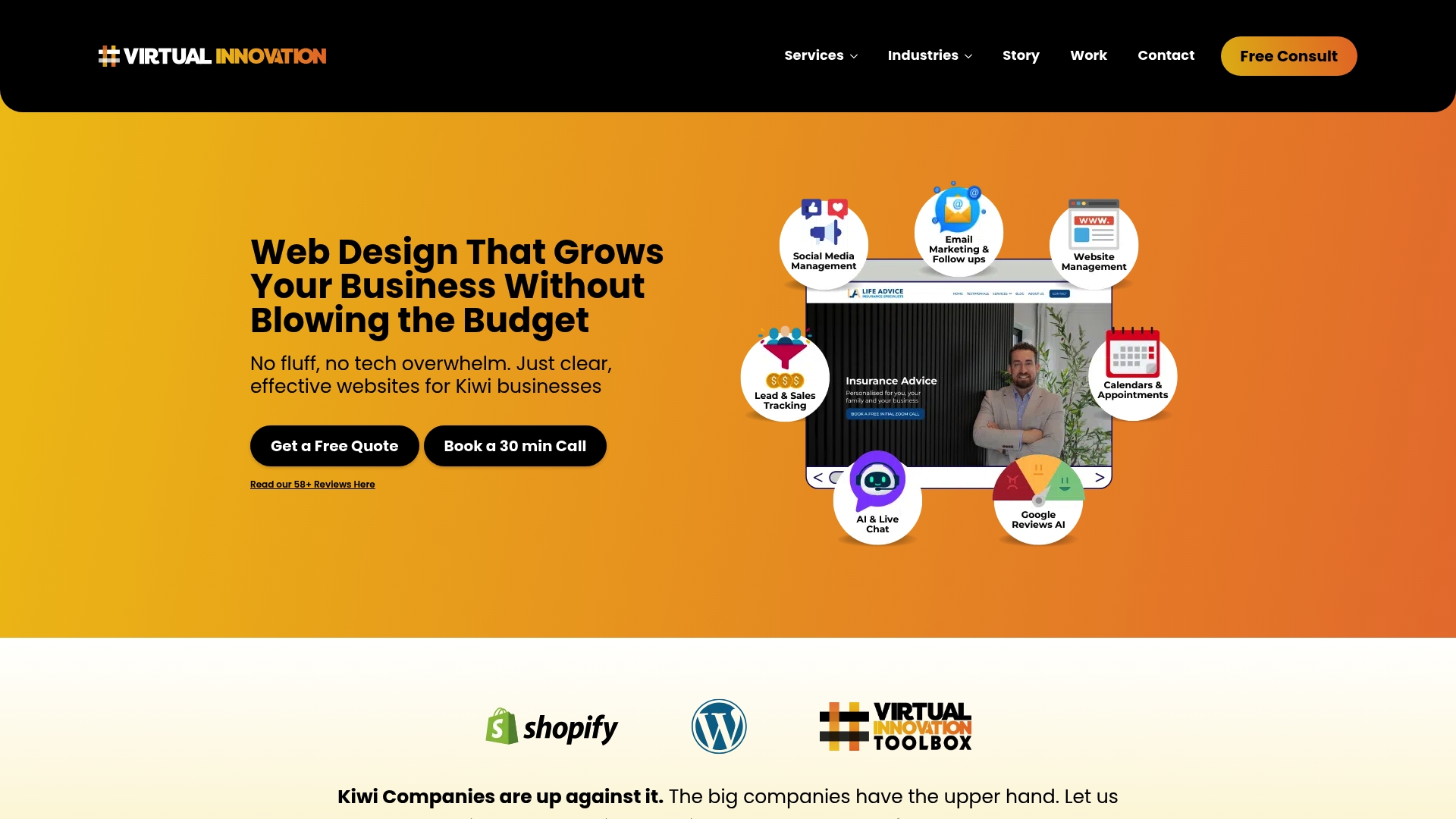
Our local hosting solutions ensure fast loading and strong security compliance specifically optimised for Kiwi visitors. Auckland-based designers focus on creating effective mobile-first, conversion-optimised sites that turn visitors into customers. We help integrate essential tools and maintain your site for ongoing success, handling technical complexities so you can focus on serving customers.
Partner with us to bring your website essentials to life with expert support and smooth workflows. Explore our WordPress website design services, reliable WordPress hosting and support, or discover how our web design Auckland team delivers results for service businesses like yours.
Frequently asked questions
What is mobile-first design and why is it important for my service business website?
Mobile-first design means creating your website primarily for mobile users, ensuring ease of use and faster loading on phones and tablets. This approach is vital because most visitors browse on mobile devices, directly impacting engagement and conversion rates.
How can clear calls-to-action improve my website’s performance?
Clear CTAs guide visitors to take specific actions like booking appointments or requesting quotes, boosting conversion rates by up to 30%. They transform passive browsing into active customer engagement, making your website more effective at generating business.
Which website platform is best for a small NZ service business in 2026?
WordPress is ideal for growing businesses needing scalability, advanced SEO, and custom integrations with booking systems or CRMs. Wix suits simpler service websites requiring quick setup and easy self-management. Shopify focuses primarily on e-commerce and is less suitable for pure service businesses.
What legal pages must NZ small businesses include on their websites?
Privacy policy and cookie consent are mandatory under NZ Privacy Act and international data protection regulations. Business disclosure pages showing company details and registration numbers may also be required depending on your industry sector and legal structure.