

Many small business owners in New Zealand assume web app development is only for large enterprises or tech companies. That’s simply not true. Local businesses are tapping into web app development to slash operational inefficiency by up to 60%, transforming how they schedule jobs, manage invoices, and serve customers. This guide explains what web apps are, how they’re built, and why security and scalability matter for your growth. You’ll discover practical steps to start your own web app journey and unlock the efficiency gains that Kiwi service providers are already enjoying.
Table of Contents
- What Is Web App Development And Why It Matters For Small Businesses
- Key Components And Stages Of Web App Development
- Security, Scalability And Performance Considerations For Your Web App
- Practical Steps And Tips To Start Your Web App Development Journey
- Discover Expert Web Design And Development Solutions In New Zealand
Key takeaways
| Point | Details |
|---|---|
| Efficiency gains | Web apps deliver operational efficiency improvements of 30-60% for NZ small businesses through automation and streamlined workflows. |
| Security essentials | Protecting business data requires input validation, multi-factor authentication, and addressing OWASP Top 10 security risks from day one. |
| Scalable architecture | Microservices and serverless computing enable growth without performance loss as your customer base expands. |
| MVP approach | Starting with a minimum viable product and Agile development reduces upfront costs and delivers faster time-to-value. |
| Local integration | NZ providers offer solutions that integrate seamlessly with Xero, CRMs, and other tools Kiwi businesses already use. |
What is web app development and why it matters for small businesses
Web app development creates software applications accessed through web browsers that deliver business services to your customers and staff. Unlike static websites that simply display information, web apps are interactive platforms where users input data, trigger actions, and receive dynamic responses. Think of the difference between reading a brochure online versus using an online booking system that checks availability, processes payments, and sends confirmation emails automatically.
For New Zealand small businesses, web apps support critical functions that drive revenue and reduce manual work. These include scheduling appointments, generating invoices, managing inventory, tracking customer interactions, and analysing performance data. The shift from spreadsheets and paper forms to web apps transforms how service companies operate daily.
Consider real examples from the NZ market. vWork, a job management platform, helped field service businesses cut dispatch to invoice times by 50% through automated workflows. Carepatron’s web app enables healthcare providers to manage patient records, appointments, and billing in one scalable platform. These aren’t tech giants; they’re solutions built for small operators who needed better tools.

The custom web development benefits extend beyond efficiency. Web apps improve customer experience by offering self-service options, real-time updates, and mobile access. Your clients can book services at midnight, check job status from their phones, and receive instant quotes without waiting for office hours. This convenience translates directly into competitive advantage.
Why does this matter now? Manual processes and legacy systems create bottlenecks that limit growth. When your team spends hours on data entry, invoice generation, or phone tag with customers, you’re losing time that could go toward delivering services and winning new business. Web apps automate repetitive tasks, centralise information, and free your people to focus on what humans do best: building relationships and solving complex problems.
Key reasons NZ small businesses adopt web apps:
- Automation of repetitive administrative tasks saves 10-20 hours per week
- Centralised data eliminates duplicate entry and reduces errors
- Mobile access enables field staff to update job status in real time
- Customer self-service reduces phone calls and improves satisfaction
- Integration with accounting software like Xero streamlines financial workflows
Key components and stages of web app development
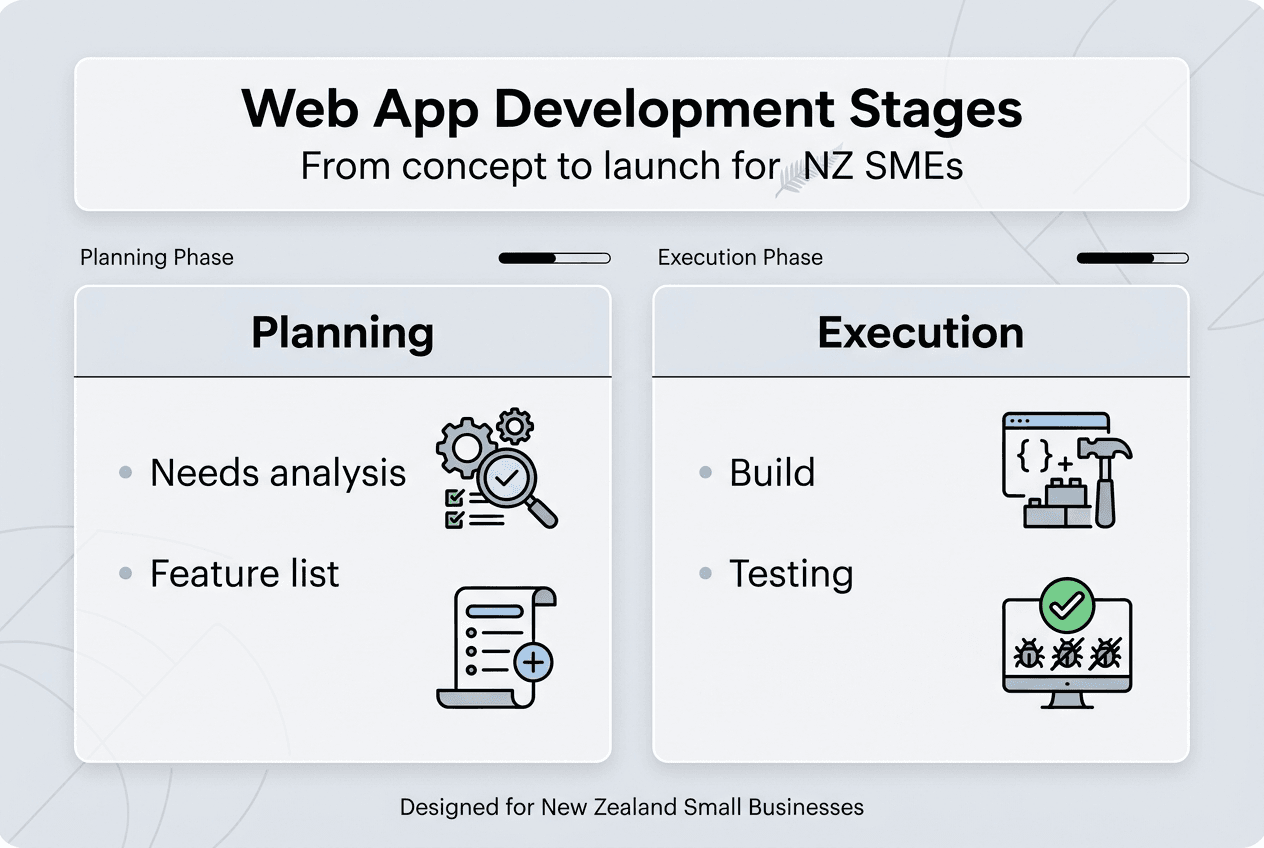
Understanding how web apps are built removes the mystery and helps you make informed decisions about your investment. The development process follows clear stages, each with specific goals and deliverables.
-
Planning and requirements gathering: You start by defining business goals and identifying the problems your web app will solve. Do you need to automate quoting, manage field staff schedules, or track customer interactions? This stage determines whether a custom solution or adapted platform suits your needs. Clear requirements prevent scope creep and keep budgets realistic.
-
Design and user experience: Designers create wireframes and prototypes showing how users will navigate your app. This includes both customer-facing interfaces and internal dashboards for staff. Good design prioritises simplicity and task completion. Your electricians shouldn’t need a manual to log job completion; your customers shouldn’t struggle to reschedule appointments.
-
Development and coding: Developers build the actual application using frameworks and tools suited to your requirements. Many NZ small businesses benefit from Agile methodology, which delivers working features in short cycles rather than waiting months for a complete product. Using MVP and Agile development helps avoid costly changes late in the project. Low-code platforms like Budibase can accelerate development for standard business functions.
-
Testing and quality assurance: Before launch, testers verify that every feature works as intended across different devices and browsers. They check for bugs, usability issues, and security vulnerabilities. This stage catches problems when they’re cheap to fix, not after customers encounter them.
-
Deployment and ongoing maintenance: Your web app goes live on hosting infrastructure, whether cloud-based or on-premises. Launch isn’t the end; it’s the beginning of continuous improvement. You’ll monitor performance, gather user feedback, fix bugs, and add features based on real-world use. Regular updates keep your app secure and aligned with changing business needs.
Pro Tip: Start with core features that solve your biggest pain point. A booking system that automates scheduling delivers immediate value, while nice-to-have features like advanced reporting can wait for version two. This approach gets you to revenue faster and validates assumptions before major investment.
The timeline varies based on complexity. A simple booking system might take 8-12 weeks from planning to launch. A comprehensive field service management platform could require 4-6 months. Working with developers experienced in building a business website and web apps helps set realistic expectations and avoid common pitfalls that delay projects.
Security, scalability and performance considerations for your web app
Building a web app that works today but fails tomorrow wastes money and damages your reputation. Three technical priorities separate robust platforms from fragile ones: security, scalability, and performance.
Security protects your business data and customer information from breaches that destroy trust and trigger legal liability. Common vulnerabilities include SQL injection attacks, cross-site scripting, and weak authentication. Addressing OWASP Top 10 security risks provides a framework for protection. Practical measures include input validation to prevent malicious code, multi-factor authentication for user accounts, HTTPS encryption for data transmission, and regular security audits. Don’t assume security can be added later; it must be designed into your app from the first line of code.
Scalability ensures your web app handles growth without performance degradation. When you win a major contract that doubles your customer base overnight, your booking system shouldn’t crash. Microservices architecture breaks applications into independent components that scale separately. If appointment booking experiences high demand, you can add resources to that service without upgrading your entire platform. Serverless computing automatically adjusts capacity based on traffic, eliminating the need to predict future loads. These approaches prevent the nightmare scenario where success overwhelms your infrastructure.
Performance directly impacts user experience and conversion rates. Studies show that page load delays beyond 3 seconds increase abandonment rates by 50%. Progressive web apps (PWAs) deliver app-like performance in browsers, working offline and loading instantly even on mobile networks. Optimising database queries, compressing images, and using content delivery networks all contribute to speed.
| Consideration | Traditional Approach | Modern Best Practice |
|---|---|---|
| Security | Added after development | Built in from design phase with input validation and MFA |
| Scalability | Fixed server capacity | Microservices and serverless auto-scaling |
| Performance | Reactive optimisation | Proactive PWA implementation and CDN use |
| Integration | Custom APIs for each tool | Pre-built connectors for Xero and common CRMs |
Integrating with legacy systems presents unique challenges for NZ small businesses. Your new web app needs to exchange data with existing accounting software, CRM platforms, and industry-specific tools. APIs (application programming interfaces) enable this communication, but older systems may lack modern API support. Working with developers who understand custom CRM solutions and local business tools reduces integration headaches.
Pro Tip: Prioritise integration with Xero if you use it for accounting. Real-time sync between your web app and Xero eliminates double entry, reduces errors, and gives you accurate financial visibility. Many NZ developers offer pre-built Xero connectors that slash integration time and cost.
The benefits of working with local providers extend beyond technical capability. They understand NZ business regulations, common workflows in industries like trades and professional services, and the tools Kiwi companies actually use. This context speeds development and reduces miscommunication that plagues offshore projects.
Practical steps and tips to start your web app development journey
Moving from interest to implementation requires a structured approach that balances ambition with pragmatism. These steps guide NZ small business owners toward successful web app adoption.
Identify your core business needs and operational pain points. Where do manual processes create bottlenecks? Which tasks consume staff time without adding value? Common candidates include appointment scheduling, quote generation, job tracking, inventory management, and customer communication. Prioritise problems that directly impact revenue or customer satisfaction. A web app that automates quoting might generate 20% more proposals by freeing sales time, delivering clear ROI.
Consider low-code platforms or Agile MVP approaches to test ideas quickly and affordably. Many NZ SMEs benefit from starting with an MVP that addresses one core function, then expanding based on user feedback. This validates assumptions before major investment and gets you to value faster. Low-code tools like Budibase enable rapid prototyping for standard business workflows, though custom development offers more flexibility for unique requirements.
Prioritise security and scalable design from the start to avoid costly rework. Retrofitting security after launch is expensive and risky. Insist on input validation, encrypted data transmission, and secure authentication in your initial requirements. Similarly, design for growth even if you’re starting small. Choosing cloud hosting over on-premises servers, implementing modular architecture, and planning for API integrations all support future expansion without rebuilding from scratch.
Engage local developers familiar with NZ tools and regulations. Developers who’ve integrated with Xero dozens of times will complete your project faster than those learning on your dime. They understand GST handling, privacy requirements, and industry-specific workflows that offshore teams miss. Check references from similar businesses and ask about experience with custom web development benefits specific to your industry.
Set realistic timelines and budgets; expect iteration based on user feedback. A functional MVP typically takes 2-3 months to develop and launch. Complex platforms require 4-6 months or more. Budget for ongoing maintenance and feature additions, not just initial development. Plan to gather user feedback after launch and refine the app based on real-world use. Your initial assumptions about workflow will evolve as staff and customers actually use the system.
Key actions to take this week:
- Document your top three operational bottlenecks and estimate time currently spent on each
- Research web apps used by competitors or similar businesses in other regions
- Schedule consultations with 2-3 local developers to discuss feasibility and rough costs
- Review your existing software stack and identify integration requirements
- Define success metrics so you can measure ROI after launch
Starting small doesn’t mean thinking small. Your initial web app can focus on one high-value function while being architected to expand. A booking system today becomes a comprehensive customer portal tomorrow when you add account management, service history, and self-service support. This incremental approach manages risk while building toward your vision.
Discover expert web design and development solutions in New Zealand
You’ve seen how web apps transform operations for NZ small businesses, cutting inefficiency and creating competitive advantages. Turning these insights into reality requires a development partner who understands Kiwi businesses and delivers solutions that actually work.
Virtual Innovation specialises in custom web development and WordPress website design tailored for New Zealand service companies. We focus on secure, scalable web apps that integrate seamlessly with Xero and CRM platforms you already use. Our team gets that you’re experts in your trade, not technology, so we speak plain English and deliver solutions that make sense for your business.

Whether you need a booking system, job management platform, or customer portal, we help small business owners turn ideas into digital growth engines. Our software development company in Auckland serves clients across New Zealand with down-to-earth service and practical solutions that boost efficiency and win more business. Ready to explore what’s possible? Let’s talk about your specific needs and build something that works for you.
What is web app development FAQ
What’s the difference between a web app and a website?
A website displays information for visitors to read, like an online brochure. A web app is interactive software accessed through a browser where users input data, trigger actions, and receive dynamic responses. Booking systems, project management tools, and online banking are web apps. Websites inform; web apps enable users to accomplish tasks.
How much does web app development typically cost for a small NZ business?
A basic web app with core features typically costs $15,000 to $40,000 for NZ small businesses. Complex platforms with extensive integration and custom workflows can reach $60,000 to $150,000 or more. Starting with an MVP approach reduces initial investment while delivering value quickly. Ongoing maintenance and hosting add $200 to $800 monthly depending on complexity and traffic.
Is it safe to develop custom web apps considering security risks?
Yes, when security is prioritised from design through deployment. Working with developers who implement input validation, HTTPS encryption, multi-factor authentication, and regular security audits protects your data. The risk comes from treating security as an afterthought, not from web apps themselves. Reputable developers follow established security frameworks and keep systems updated against emerging threats.
Can I integrate a web app with my existing tools like Xero or CRM?
Absolutely. Modern web apps use APIs to exchange data with accounting software, CRMs, and other business tools. Many NZ developers offer pre-built integrations with Xero that sync invoices, customers, and financial data automatically. Custom CRM solutions can be designed to work alongside your web app, centralising customer information and eliminating duplicate data entry across platforms.
What’s the best approach for a small business starting out with web apps?
Start with an MVP that solves your biggest operational pain point. Identify the one process that wastes the most time or frustrates customers, then build a focused solution addressing that problem. Use Agile development to deliver working features quickly and gather real user feedback. This approach validates your investment, demonstrates ROI to stakeholders, and creates a foundation for expanding functionality based on actual needs rather than assumptions.