

Most small business owners think custom web development is too expensive or complex. Yet 70% of NZ SMBs recover their investment within the first year through efficiency gains and increased revenue. With 97% of New Zealand consumers researching online before purchasing, your website serves as your primary business tool. Off-the-shelf solutions often fail to deliver the flexibility, integration capabilities, and unique branding required to compete in today’s digital marketplace.
Table of Contents
- The Digital Landscape For NZ Small Businesses
- Why Custom Web Development Matters For New Zealand Small Businesses
- Limitations Of Template Solutions Versus Custom Development
- Key Features Enabled By Custom Web Development
- Addressing Common Misconceptions About Custom Web Development
- Case Studies Demonstrating ROI And Efficiency Gains
- How To Plan And Implement Custom Web Development For Your NZ Business
- Explore Expert Custom Web Development Services In New Zealand
Key takeaways
| Point | Details |
|---|---|
| Custom development differentiates your brand | Tailored websites help you stand out in competitive NZ markets with unique features and branding |
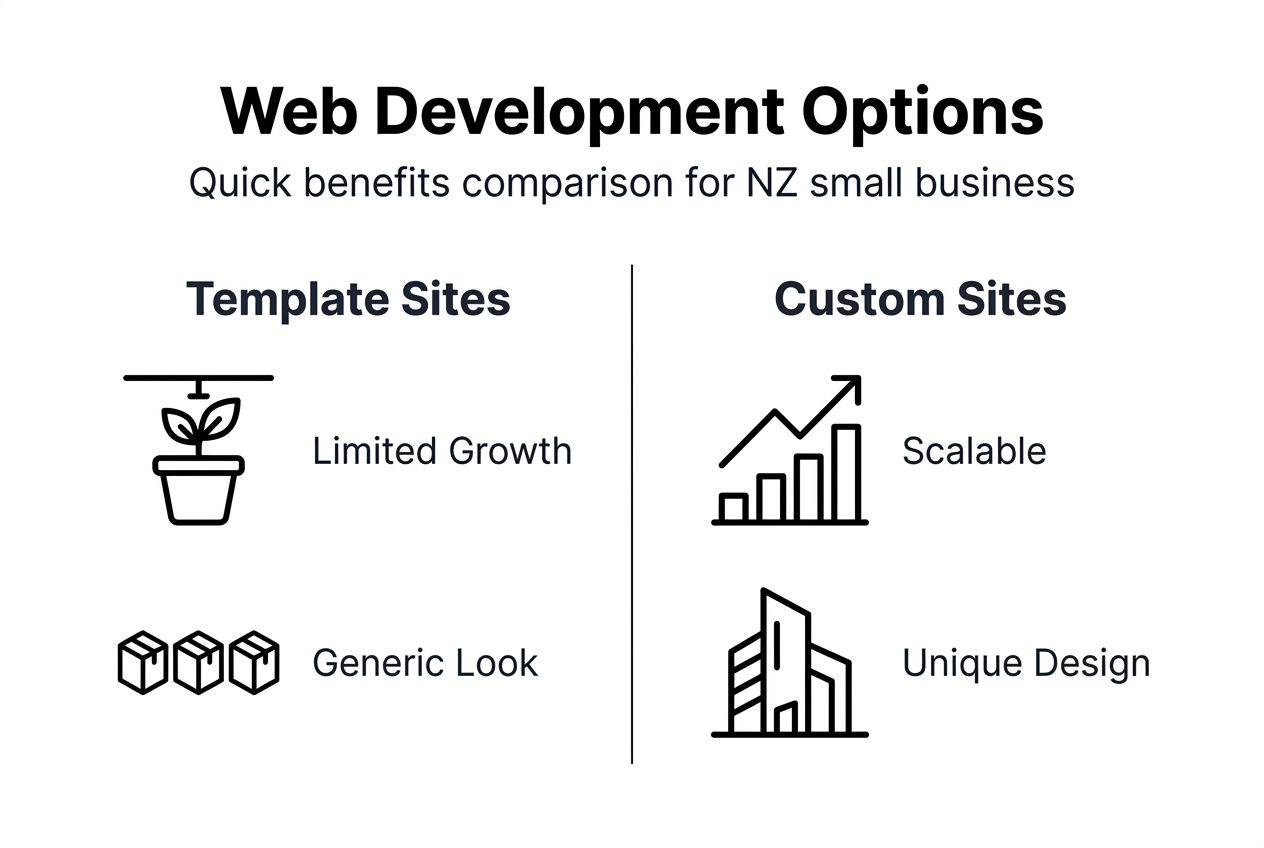
| Templates limit growth potential | Generic solutions create scalability issues and integration problems as your business expands |
| Phased implementation controls costs | Breaking development into stages makes custom websites affordable for small businesses |
| ROI materialises within 12 months | Most NZ SMBs see measurable returns through improved efficiency and customer engagement |
| Local expertise matters | Choosing experienced NZ developers ensures solutions fit local business needs and regulations |
The digital landscape for NZ small businesses
New Zealand’s digital marketplace demands more than basic online presence. With 97% of consumers researching online before making purchase decisions, your website functions as your most critical sales and marketing asset. Competition across local markets has intensified, requiring businesses to establish distinct digital identities that resonate with target audiences.
Generic website builders create significant limitations for growing businesses:
- They lack support for custom workflows specific to your operations
- Design templates appear identical across competitors
- Integration with existing business systems proves difficult or impossible
- Customer engagement tools remain basic and inflexible
- Scalability issues emerge as your business evolves
Small businesses operating with template solutions often find themselves constrained by predetermined features that don’t match their operational requirements. The result is manual workarounds, disconnected systems, and missed opportunities for automation. Your website should streamline operations and enhance customer experiences, not create additional administrative burden.
The challenge intensifies when you consider that New Zealand consumers expect seamless digital interactions. A generic website that looks and functions like dozens of competitors fails to build trust or communicate your unique value proposition effectively.
Why custom web development matters for New Zealand small businesses
Custom web development transforms your website from a digital brochure into a strategic business tool. 85% of NZ SMEs report improved brand differentiation after implementing custom solutions, directly impacting their ability to attract and retain customers in competitive markets.
The advantages extend across multiple dimensions:
- Unique branding: Custom design reflects your specific brand identity rather than generic templates
- Scalable architecture: Systems grow alongside your business without requiring complete rebuilds
- Tailored user experiences: Customer journeys optimised for your specific audience and offerings
- Workflow integration: Seamless connection with CRM, inventory, and accounting systems
- Competitive advantage: Features and functionality competitors cannot easily replicate
Building a website specifically for your business requirements enables automation of repetitive tasks, improved data accuracy, and faster response times. These operational improvements translate directly to cost savings and revenue growth. Understanding the key benefits of a WordPress developer helps clarify how custom solutions outperform templates.
Pro Tip: Start by identifying your three most time-consuming manual processes. Custom development that automates these tasks often delivers the fastest ROI.
The scalability factor proves particularly valuable for growing businesses. Template solutions require expensive migrations or complete rebuilds when you outgrow their capabilities. Custom development builds flexibility into your foundation, allowing features to be added or modified without disrupting existing functionality. This approach protects your initial investment whilst supporting long-term growth.
Limitations of template solutions versus custom development
Template-based websites initially appear cost-effective but create substantial limitations as businesses grow. 70% of expanding NZ businesses face scalability issues with template platforms, forcing expensive migrations or compromises in functionality.
| Aspect | Template solutions | Custom development |
|---|---|---|
| Scalability | Limited by platform constraints | Grows with business needs |
| Integration | Basic plugins only | Connects any system |
| Performance | Bloated code affects speed | Optimised for efficiency |
| Branding | Generic appearance | Unique identity |
| Cost long-term | Recurring fees plus limitations | Higher initial, lower ongoing |
The performance implications extend beyond slow loading times. Template platforms bundle features you don’t need, creating bloated code that impacts search rankings and user experience. Every second of delay reduces conversions and increases bounce rates, directly affecting revenue.
Common template limitations include:
- Predetermined navigation structures that don’t match your customer journey
- Fixed checkout processes that cannot accommodate your specific sales requirements
- Limited data collection preventing detailed customer insights
- Inflexible form builders that frustrate users
- Restricted access to underlying code preventing optimisations
These constraints become increasingly problematic as your business sophistication grows. What starts as a simple website requirement evolves into complex needs for automation, integration, and customisation. Implementing cost-saving website features becomes impossible when your platform restricts modifications.
The branding impact deserves particular attention. When your website looks similar to competitors using the same template, building trust and differentiation becomes significantly harder. Custom development creates visual and functional uniqueness that reinforces your brand identity.
Key features enabled by custom web development
Custom development unlocks advanced functionality that directly impacts business performance. With over 60% of New Zealand business traffic originating from mobile devices, responsive design optimised for various screen sizes proves essential rather than optional.
</div>Critical features achievable through custom development:
| Feature | Business impact | Performance metric |
|---|---|---|
| AI chatbots | 24/7 customer support | 50% faster response times |
| Mobile optimisation | Improved user experience | 30% higher mobile conversions |
| Custom integrations | Automated workflows | 40% reduction in manual data entry |
| Advanced SEO | Better search visibility | 30% increase in organic traffic |
| Fast loading speeds | Reduced bounce rates | 25% improvement in retention |
Page speed represents a crucial factor in both user experience and search rankings. Fast loading under 3 seconds contributes to higher organic traffic through improved SEO performance. Custom development optimises code, images, and server responses to achieve consistently fast performance.
AI-powered chatbots halve customer response times by handling common enquiries instantly. This automation frees your team to focus on complex customer needs whilst ensuring no enquiry goes unanswered. The technology integrates with your existing systems to provide personalised responses based on customer history and preferences.
Pro Tip: Prioritise mobile optimisation in your custom development roadmap. Mobile users who encounter poor experiences rarely return, regardless of your desktop site quality.
Custom integrations eliminate data silos by connecting your website with CRM, inventory management, accounting software, and marketing platforms. Information flows automatically between systems, reducing errors and providing real-time visibility across operations. Following a comprehensive website features checklist ensures you don’t overlook critical functionality.
Advanced analytics capabilities provide deeper insights into customer behaviour, campaign performance, and conversion patterns. This data drives informed decisions about marketing spend, product development, and customer service improvements.
Addressing common misconceptions about custom web development
Cost concerns often prevent small businesses from exploring custom development, yet phased implementation makes it surprisingly accessible. 70% of SMBs achieve ROI within their first year by prioritising features that deliver immediate value.
Common misconceptions clarified:
- Myth: Custom development requires massive upfront investment
- Reality: Phased approaches start with core features, adding functionality as budget allows
- Myth: Maintenance becomes too complex for small teams
- Reality: Quality developers provide training and documentation for straightforward updates
- Myth: Development takes too long to launch
- Reality: MVP approaches get you online quickly with planned enhancements
- Myth: You’re locked into expensive ongoing developer relationships
- Reality: Well-documented custom sites allow future work by different developers
Phased development strategies prioritise features based on business impact. Your initial launch might include core functionality like mobile-optimised design, contact forms, and basic content management. Subsequent phases add e-commerce, automation, or advanced integrations as revenue grows and requirements become clearer.
This approach provides several advantages beyond cost management. You gain time to understand how customers interact with your website before investing in advanced features. Early feedback informs later development priorities, ensuring resources focus on functionality that genuinely enhances user experience.
Maintenance requirements for custom websites often prove less demanding than template platforms. Without the bloat of unnecessary plugins and features, updates remain straightforward. Quality developers build documentation and provide training, enabling your team to handle routine content updates independently. Exploring WordPress website design expertise reveals how proper planning simplifies long-term management.
The flexibility of custom development means you’re never stuck with outdated functionality. As technology evolves or business needs change, your website adapts without requiring complete rebuilds or platform migrations.
Case studies demonstrating ROI and efficiency gains
Real New Zealand businesses demonstrate the tangible benefits of custom web development through measurable improvements in efficiency and customer engagement. 50% faster client response times and significant lead capture improvements represent typical outcomes for SMBs investing in tailored solutions.
A Wellington-based service company implemented custom CRM integration that automated lead qualification and follow-up scheduling. The result was 45% more qualified leads processed monthly with existing staff resources. Customer satisfaction scores improved as response consistency increased and no enquiries fell through administrative gaps.
An Auckland retailer developed a custom inventory management system connecting their physical store with online sales channels. Real-time stock updates prevented overselling whilst automated reordering maintained optimal inventory levels. The business reduced carrying costs by 30% whilst eliminating stockouts of popular items.
Key success factors across implementations:
- Clear definition of business objectives before development begins
- Phased rollout allowing staff training and process adaptation
- Integration with existing systems rather than complete replacement
- Ongoing optimisation based on user feedback and analytics
- Partnership with developers who understand New Zealand business contexts
“Our custom website paid for itself within eight months through improved conversion rates and reduced administrative overhead. We should have made the investment years earlier.” – Auckland Service Business Owner
These outcomes stem from addressing specific business challenges rather than implementing generic solutions. Custom development identifies bottlenecks in your current processes and builds targeted functionality to eliminate them. Learning from custom CRM solutions implemented by other New Zealand businesses provides valuable insights for planning your own project.
The efficiency gains compound over time as staff become proficient with new systems and you identify additional automation opportunities. Many businesses discover that initial custom development creates a foundation for ongoing improvements that continually enhance competitiveness. Working with trusted Auckland web designers ensures your investment delivers sustained value.
How to plan and implement custom web development for your NZ business
Successful custom web development begins with thorough assessment of current limitations and clear definition of desired outcomes. Following a structured approach ensures your investment delivers maximum value whilst controlling costs and timelines.
- Audit your current website: Identify specific pain points, bottlenecks, and missed opportunities in your existing digital presence
- Define business objectives: Establish measurable goals like reducing response times, increasing conversions, or automating workflows
- Prioritise features: Rank desired functionality by business impact and implementation complexity
- Set realistic budget: Allocate resources for initial development plus contingency for refinements
- Select experienced developers: Choose partners with proven New Zealand small business expertise
- Plan phased rollout: Structure development in stages that deliver value incrementally
- Establish success metrics: Define how you’ll measure ROI and effectiveness
- Schedule ongoing reviews: Plan regular assessments to identify optimisation opportunities
Budgeting for custom development requires balancing ambition with financial reality. Starting with core functionality that addresses your most significant challenges often proves more effective than attempting comprehensive solutions immediately. As each phase delivers returns, you reinvest in additional features.
Pro Tip: Request detailed documentation from your developers. This protects your investment by ensuring future modifications don’t require extensive reverse engineering to understand existing code.
Selecting developers involves evaluating both technical expertise and business understanding. Look for partners who ask probing questions about your operations, customers, and growth plans rather than immediately proposing technical solutions. The best developers translate business requirements into technical specifications that deliver genuine value.
Exploring WordPress website design services provides insights into how experienced developers approach custom projects. A comprehensive website planning checklist helps ensure you don’t overlook critical requirements during initial scoping.
Ongoing maintenance planning proves as important as initial development. Establish clear expectations about update frequency, security monitoring, and performance optimisation. Many businesses benefit from retainer arrangements that provide predictable monthly costs for routine maintenance whilst allowing flexibility for enhancements.
Explore expert custom web development services in New Zealand
Ready to transform your website into a strategic business asset? Virtual Innovation specialises in custom WordPress and Shopify solutions designed specifically for New Zealand small businesses seeking efficiency and growth.
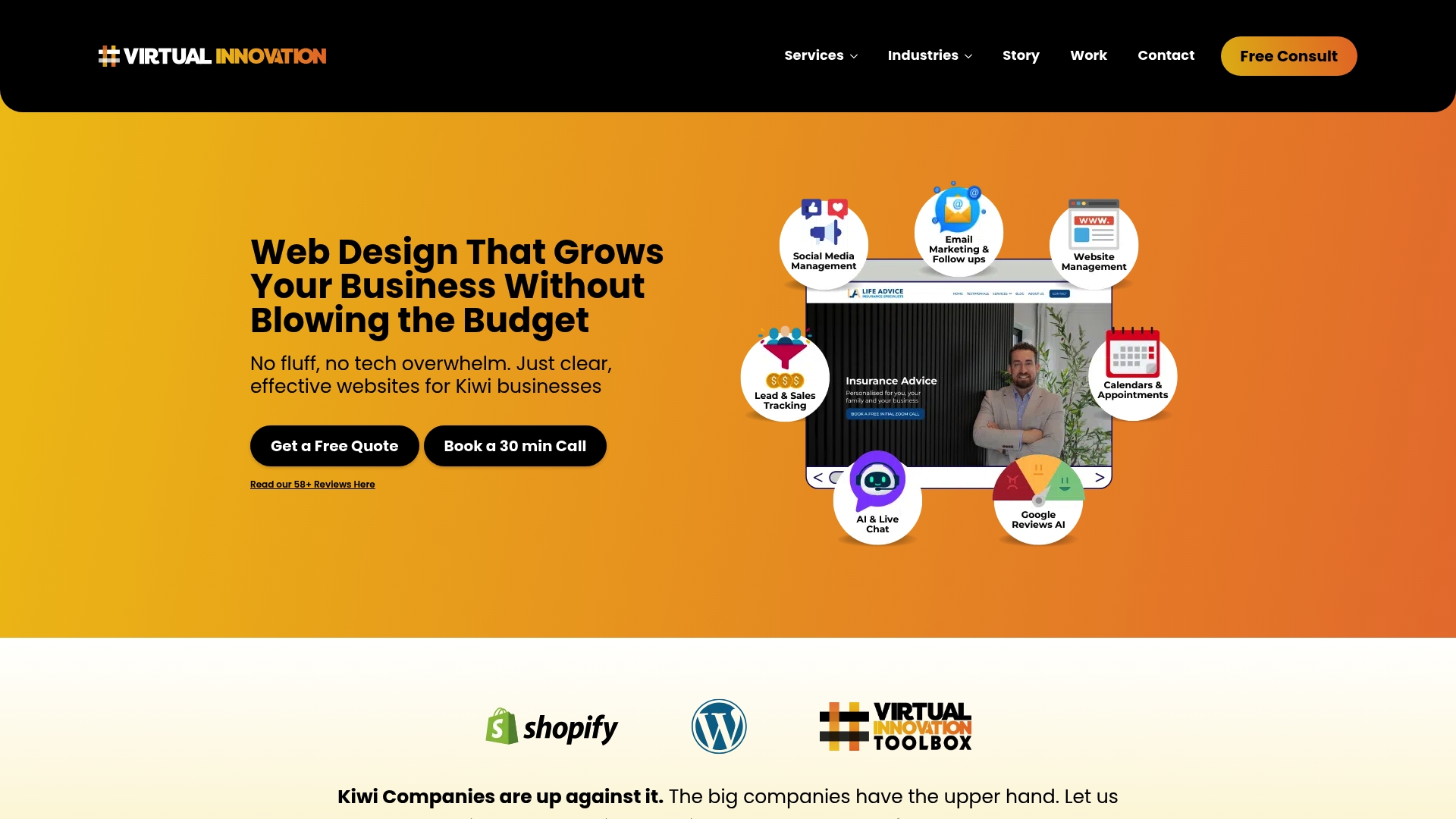
Our phased development approach makes custom websites accessible regardless of budget constraints. We start by understanding your unique challenges and priorities, then build solutions that deliver immediate value whilst creating foundations for future enhancements. Partnering with an expert WordPress developer ensures your investment produces measurable returns through improved efficiency and customer engagement. Our team of friendly Auckland web designers understands the realities of running a small business and creates practical solutions that work in the real world.
Frequently asked questions
What is custom web development and why is it important?
Custom web development creates websites tailored specifically to your business requirements rather than using generic templates. This approach delivers unique features, superior user experiences, and scalability that grows alongside your business. Template solutions force you to adapt operations to predetermined structures whilst custom development adapts to your needs.
How does custom web development improve my small business efficiency?
Custom websites integrate seamlessly with your existing software like CRM, inventory systems, and accounting platforms to automate repetitive processes. This integration reduces manual data entry, speeds up client responses, and improves accuracy. Many businesses reduce administrative overhead by 30-40% through targeted automation.
Is custom web development too expensive for small businesses?
Phased development spreads costs over time by focusing on priority features first. Most NZ SMBs recover their investment within 12 months through efficiency gains and increased revenue. Starting with core functionality and adding features as budget allows makes custom development accessible whilst delivering immediate value.
How long does custom web development take to complete?
Timelines vary based on project scope and complexity. A minimum viable product focusing on essential features typically launches within 6-10 weeks. Phased approaches get you online quickly with planned enhancements added over subsequent months. This strategy allows you to start benefiting from improvements immediately rather than waiting for a comprehensive solution.
Recommended
- CRM for NZ Business: Custom Solutions That Actually Work for Kiwi Companies – Virtual Innovation
- CRM for NZ Business: Custom Solutions That Actually Work for Kiwi Companies – Virtual Innovation
- Cost-saving website features for NZ small businesses
- Why Choose a Web Agency in NZ? 35% More Growth & Efficiency