

Many small businesses across New Zealand believe a website redesign is purely cosmetic, a fresh coat of paint to modernise appearances. This misconception costs them dearly. An outdated website silently erodes efficiency, drives potential customers away, and stunts growth opportunities you might not even realise exist. The truth is, redesign addresses critical technical, functional, and strategic elements that directly impact your bottom line. From mobile responsiveness to streamlined navigation and conversion-focused design, a thoughtful redesign transforms your website from a static brochure into a powerful growth engine that works around the clock for your business.
Table of Contents
- Why Mobile Responsiveness Matters For Your Business
- Boosting Conversions With Clear Calls-To-Action
- Enhancing User Experience And Navigation
- Seo Benefits And Operational Efficiency Gains From Redesign
- Explore Expert Website Redesign Solutions With Virtual Innovation
Key takeaways
| Point | Details |
|---|---|
| Mobile optimisation is essential | Over 70% of Kiwis browse on mobile devices, making responsive design critical for engagement and rankings. |
| Clear calls-to-action boost conversions | Strategic CTA placement guides visitors toward enquiries and purchases, directly increasing revenue. |
| Improved user experience drives growth | Streamlined navigation and intuitive design keep visitors engaged and build trust in your brand. |
| Redesign enhances SEO and efficiency | Updated technical foundations improve search visibility while modern platforms reduce administrative burden. |
Why mobile responsiveness matters for your business
Your potential customers are scrolling through their phones right now, searching for services you offer. If your website looks broken or loads slowly on mobile, they’ll hit the back button before you even knew they were there. Over 70% of New Zealanders access the internet via mobile devices, and that percentage climbs higher every year. Mobile responsiveness isn’t a nice-to-have feature anymore. It’s the foundation of your digital presence.
Google prioritises mobile-friendly websites in search rankings, meaning your outdated site could be invisible to customers actively looking for your services. When someone lands on a non-responsive site, they face tiny text, misaligned buttons, and frustrating horizontal scrolling. Most leave within seconds. That’s not just a missed opportunity; it’s a direct hit to your revenue stream. Every visitor who bounces because of poor mobile experience represents lost business you’ll never recover.
Redesigning with mobile-first principles ensures your site adapts seamlessly across devices. Text remains readable, images scale appropriately, and navigation stays intuitive whether someone visits from a smartphone, tablet, or desktop. This consistency builds trust and keeps visitors engaged longer, increasing the likelihood they’ll contact you or make a purchase.
Consider these mobile optimisation priorities:
- Ensure touch-friendly buttons and links with adequate spacing
- Optimise images and code for fast loading on cellular networks
- Simplify navigation menus for smaller screens
- Test forms and checkout processes on actual mobile devices
Pro Tip: Check your current mobile performance using Google’s Mobile-Friendly Test tool. The results often surprise business owners who assumed their site worked fine on phones.
“Mobile responsiveness transforms your website from a desktop-only resource into an accessible tool that meets customers wherever they are, whenever they need you.”
Investing in top website features designed for mobile users positions your business ahead of competitors still clinging to outdated approaches. The website redesign process addresses these technical requirements systematically, ensuring nothing falls through the cracks.
Boosting conversions with clear calls-to-action
You’ve attracted visitors to your website, but what happens next? Without clear direction, most people browse aimlessly and leave without taking action. Calls-to-action solve this problem by guiding visitors toward specific, valuable steps like requesting a quote, booking a consultation, or making a purchase. Well-placed CTAs can significantly boost conversion rates, yet many small businesses underestimate their importance.
Poorly designed CTAs blend into the background, use vague language like “Click Here,” or appear in illogical places that interrupt the user journey. These mistakes create friction and confusion. Visitors who can’t immediately understand what you want them to do simply won’t do anything. High bounce rates and abandoned carts often trace back to weak or missing calls-to-action rather than lack of interest in your services.
A strategic redesign positions CTAs where they make psychological and practical sense. After explaining a service benefit, offer a relevant next step. Following customer testimonials, invite readers to experience the same results. This contextual placement feels natural rather than pushy, increasing the likelihood visitors will engage. Colour contrast, white space, and action-oriented language all contribute to CTA effectiveness.
Effective CTA strategies include:
- Use specific, benefit-focused language like “Get Your Free Assessment” instead of generic phrases
- Limit choices to avoid decision paralysis; focus on one primary action per page section
- Create visual hierarchy with size, colour, and placement to draw attention naturally
- Test different variations to identify what resonates with your specific audience
Pro Tip: Review your website analytics to identify pages with high traffic but low conversions. These pages need stronger, more strategically placed calls-to-action.
Your website features checklist should prioritise conversion optimisation alongside aesthetic improvements. Understanding essential website features helps you recognise where CTAs fit into your broader business goals. Every element should work together to move visitors smoothly from curiosity to commitment, and well-designed calls-to-action provide the gentle nudges that make this journey feel effortless.
Enhancing user experience and navigation
Imagine walking into a shop where products are scattered randomly, signs point in wrong directions, and staff can’t answer basic questions. You’d leave frustrated and never return. Websites with poor user experience create identical feelings. Complex navigation, confusing menus, and unclear pathways cause visitors to abandon your site in search of competitors who respect their time and intelligence.

Seamless user experience keeps visitors engaged and encourages conversions by removing obstacles between interest and action. When someone can find information quickly, complete tasks without confusion, and enjoy the process, they’re far more likely to trust your business and become customers. Redesign provides the perfect opportunity to rebuild your site architecture around actual user needs rather than internal organisational charts.
Start by mapping typical customer journeys. What questions do new visitors have? What information do returning customers need? How can you reduce clicks between landing and conversion? These insights inform navigation structure, content organisation, and feature prioritisation. Every unnecessary step or confusing label costs you potential business.
Follow these navigation improvement steps:
- Audit your current site to identify pages with high exit rates or low engagement
- Conduct user testing with actual customers to uncover friction points you’ve overlooked
- Simplify menu structures by grouping related content logically and limiting top-level options
- Implement search functionality for content-heavy sites to help visitors find specific information quickly
- Add breadcrumb navigation and clear visual hierarchy to prevent users feeling lost
Pro Tip: Watch real people use your website without guidance. Their struggles reveal usability problems you’ve become blind to through familiarity.
| Navigation Element | Impact on User Experience | Redesign Priority |
|---|---|---|
| Clear menu labels | Reduces confusion and decision time | High |
| Search functionality | Helps users find specific content quickly | Medium |
| Logical page hierarchy | Improves discoverability and flow | High |
| Breadcrumb trails | Prevents users feeling lost on deep pages | Medium |
When you build a business website with user experience as the foundation, every design decision serves visitor needs first. The comprehensive website redesign process ensures these improvements happen systematically rather than haphazardly. Better navigation and user experience aren’t luxuries; they’re fundamental requirements for any website expected to generate business results.
SEO benefits and operational efficiency gains from redesign
Your website’s technical foundation determines whether search engines can find, understand, and recommend your content to potential customers. Outdated code, slow loading speeds, and poor mobile optimisation all damage search rankings, making your business invisible to people actively searching for your services. Redesign provides the opportunity to rebuild these technical elements properly, giving your SEO efforts a solid platform for success.
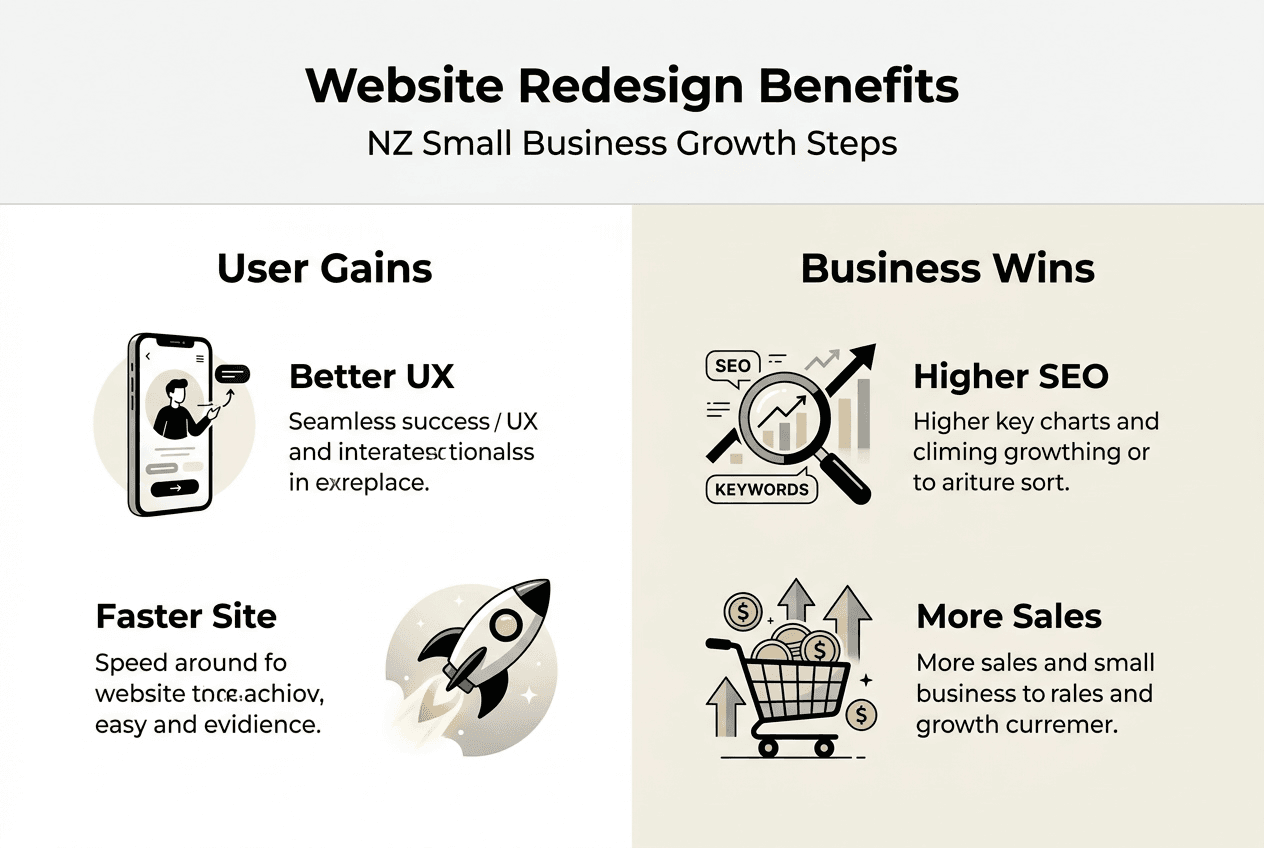
Beyond search visibility, modern website platforms dramatically reduce the time and technical knowledge required for routine updates. Adding new content, updating service information, or adjusting pricing shouldn’t require developer intervention or hours of frustration. Efficient content management systems empower you to maintain your site independently, saving money and enabling faster responses to market changes.
Responsive design impacts search rankings significantly, as Google explicitly prioritises mobile-friendly sites in results. Page speed, another critical ranking factor, improves through modern coding practices and optimised media. These technical improvements work invisibly in the background, consistently attracting organic traffic without ongoing advertising costs.
Key SEO and efficiency improvements include:
- Clean, semantic code that search engines can crawl and index efficiently
- Optimised images and caching strategies that reduce page load times
- Structured data markup that helps search engines understand your content context
- Intuitive admin interfaces that make content updates quick and error-free
Pro Tip: Document your current website management workflows before redesign. This baseline helps you measure efficiency gains and ensures the new system addresses actual pain points.
| Task | Manual/Outdated Site | Redesigned Site |
|---|---|---|
| Adding blog post | 45-60 minutes with developer help | 10-15 minutes independently |
| Updating service pricing | Email developer, wait 2-3 days | 5 minutes direct edit |
| Mobile display fixes | Separate mobile site maintenance | Automatic responsive adaptation |
| SEO meta updates | Code editing required | Simple form fields |
The SEO migration process ensures you preserve existing search rankings while implementing improvements. Platforms like WordPress offer powerful yet accessible tools that balance functionality with ease of use. These efficiency gains compound over time, freeing you to focus on business growth rather than website maintenance headaches.
Explore expert website redesign solutions with Virtual Innovation
Transforming your website from a static placeholder into a growth-driving asset requires specialised expertise and strategic thinking. Virtual Innovation brings deep experience helping New Zealand service businesses optimise their digital presence through tailored WordPress website design and Shopify solutions. We understand the unique challenges Kiwi small businesses face because we work exclusively with companies like yours.
Our friendly, down-to-earth approach recognises you’re experts in your field, not web technology. We translate complex technical requirements into clear business outcomes, ensuring your redesigned site delivers measurable improvements in efficiency, conversions, and customer satisfaction. Explore our comprehensive website redesign process guide to understand how we transform outdated websites into powerful business tools that work as hard as you do.
FAQ
How often should a small business redesign its website?
Most small businesses benefit from a complete redesign every three to five years to keep pace with technology changes and evolving user expectations. However, you should consider redesigning sooner if your business goals shift significantly, your current site performs poorly on mobile devices, or competitors have clearly surpassed your digital presence. Regular minor updates between major redesigns help maintain relevance and performance.
What are the common mistakes to avoid during a website redesign?
Ignoring mobile responsiveness remains the most damaging mistake, as it directly impacts both search rankings and user retention. Overcomplicating design with unnecessary features or confusing navigation reduces usability rather than improving it. Many businesses also fail to implement clear calls-to-action, leaving visitors unsure what steps to take next. Finally, neglecting proper SEO migration can erase years of search ranking progress in a single launch.
How can a website redesign improve my local search visibility?
Redesign updates your technical SEO foundation, fixing issues like slow loading speeds, poor mobile optimisation, and outdated code that hurt search rankings. Optimising site structure around local keywords and implementing proper schema markup helps search engines understand your geographic relevance and service offerings. Modern platforms also make it easier to maintain fresh, locally-focused content that attracts nearby customers. Learn more about protecting your search visibility through our SEO migration process guide.
Will I lose my existing search rankings during a redesign?
Proper planning and execution preserve search rankings during redesign through careful URL mapping, 301 redirects, and content migration strategies. Working with experienced professionals who understand SEO migration prevents the ranking drops that occur when redesigns happen without this technical knowledge. Some temporary fluctuation is normal, but a well-executed redesign typically improves rankings over time as technical improvements take effect.