

TL;DR:
- Professional UI design can generate up to a 9,900% return on investment for small businesses.
- Poor UI causes lost sales, increased support costs, and eventual costly site redevelopment.
- Investing early in clear, mobile-responsive, accessible UI builds trust and boosts growth.
Imagine getting $100 back for every $1 you spend. That’s not a fantasy — UX/UI design delivers a staggering 9,900% return on investment. Yet most New Zealand small business owners still treat design as a nice-to-have rather than a core business driver. The truth is, poor UI design is quietly costing you clients, revenue, and time every single day. This guide cuts through the confusion and shows you exactly what investing in professional UI design can change for your NZ business, from attracting more clients to running a smoother, more efficient operation.
Table of Contents
- What is UI design and why does it matter?
- Business benefits of investing in UI design
- The high cost of poor UI design
- Investing wisely: What great UI design looks like for NZ small businesses
- Why most small businesses underestimate UI design’s real power
- Take your next step: Transform your UI with expert help
- Frequently asked questions
Key Takeaways
| Point | Details |
|---|---|
| UI drives business results | Smart UI design boosts customer satisfaction, sales, and operational efficiency. |
| ROI is massive | Every $1 invested in UI returns up to $100, making it the best value for growth. |
| Poor design is costly | Ignoring UI leads to lost sales, support headaches, and higher rework costs. |
| Practical steps matter | Audit your interface, gather feedback, and invest step-by-step for lasting results. |
What is UI design and why does it matter?
Let’s start with the basics. UI stands for User Interface. It’s everything a person sees and touches when they interact with your website, app, or online tool. Think buttons, menus, colours, fonts, layout, and how content is arranged on screen.
UI design is often confused with UX design (User Experience). Here’s the simple difference: UI is how things look and function on screen. UX is how the whole journey feels for the user, from landing on your site to completing a purchase or booking. They work together, but they’re not the same thing. If you want to go deeper on that distinction, the role of UX in web design matters just as much as the visual side.
For NZ small businesses, the most common UI touchpoints are:
- Your website — the digital front door to your business
- E-commerce product pages and checkout flows — where buying decisions are made
- Online booking or enquiry forms — your first point of conversion
- SaaS dashboards or client portals — if you offer software or subscription services
- Mobile interfaces — an increasing portion of your traffic arrives on smartphones
First impressions happen fast. We’re talking milliseconds. Research confirms that UI design shapes whether a business attracts or loses users at that critical first moment. If your interface looks outdated, cluttered, or confusing, visitors leave. Simple as that.
“Your website is not a brochure. It’s a sales tool, a trust signal, and a service channel all rolled into one. The design is what makes it work — or fail.”
The cascading effects of poor UI go beyond aesthetics. Confused users ask more questions, which increases your support workload. Frustrated users abandon their carts. Sceptical users don’t trust you enough to make contact. Every one of these outcomes costs you money. Getting the design right from the start pays off in ways you can actually measure.
Business benefits of investing in UI design
With an understanding of what UI design involves, let’s turn to the concrete ways it can transform your business outcomes.
The numbers are hard to argue with. Top design performers grow revenue nearly twice as fast as their competitors and outperform the S&P 500 by 228%. That’s not a coincidence — it’s the compounding effect of a better user experience driving more conversions, fewer drop-offs, and stronger customer loyalty.
| Business metric | With strong UI design | Without strong UI design |
|---|---|---|
| Conversion rate | Higher — clear paths to action | Lower — users get lost or confused |
| Customer support costs | Reduced — fewer confused users | Higher — more queries and complaints |
| Bounce rate | Lower — visitors stay and explore | Higher — fast exits from poor layouts |
| Revenue growth | Up to 2x faster than competitors | Slower, stalled growth |
| ROI on design spend | Up to 9,900% return | Ongoing cost of lost sales |
Streamlined UI removes friction. When users can find what they need quickly, complete a booking in three steps instead of eight, or trust your checkout because it looks professional, they convert. That directly reduces your cost per acquisition and lifts your average order value over time.
Consider a local service business that redesigned their booking form. By simplifying it from twelve fields to five, they saw a 34% increase in completed bookings within the first month. No new advertising spend. Just better design.

For businesses offering professional services web design, the link between polished UI and credibility is especially strong. Clients are making trust decisions before they ever read a word of your content.
Pro Tip: Invest in UI design early. Fixing a poorly designed site after launch typically costs three to five times more than building it right the first time. Prioritise it upfront and treat it as infrastructure, not decoration. You can also review website design tips for growth to understand where to focus your budget first.
The high cost of poor UI design
While the benefits are clear, it’s just as important to understand what happens when you ignore your site’s UI.
Here’s a sobering fact: poor design costs businesses $1.6 trillion globally in lost sales every year. That number includes abandoned carts, lost enquiries, and customers who simply left and went to a competitor with a better-looking site.
“Poor design is not just an aesthetic problem. It’s a revenue problem.”
The three biggest losses from poor UI are:
- Abandoned carts and incomplete enquiries. If your checkout or contact form is clunky, people give up. Even a single extra step can cost you a meaningful percentage of conversions.
- Customer complaints and support overload. Confusing navigation and unclear labels generate unnecessary support requests. Your team ends up answering questions that good design would have prevented entirely.
- Costly redevelopment down the track. Many NZ small businesses patch and tweak a poor foundation for years before finally rebuilding. By then, they’ve spent far more than a proper design would have cost upfront.
| Scenario | Invest in UI now | Ignore UI now |
|---|---|---|
| Upfront cost | Moderate, planned investment | Low, savings feel real |
| 12-month outcome | Higher conversions, lower support load | Lost sales, patch jobs, user frustration |
| 3-year outcome | Compounding growth, strong brand trust | Expensive rebuild, lost market position |
Common mistakes we see among NZ SMEs include cutting corners on mobile responsiveness, using generic templates without customisation, and ignoring accessibility for users with disabilities. These aren’t small oversights — they affect real customers every day.
One Auckland-based trades business we spoke with had a contact form that was broken on mobile for over six months. They didn’t know because they never tested it on a phone. Dozens of potential leads simply couldn’t reach them. Reviewing common design workflow pitfalls can help you spot these issues before they cost you. If you want to see how design requirements differ by sector, UI for different industries gives you a useful overview.
Investing wisely: What great UI design looks like for NZ small businesses
Knowing the risks makes it clear you need to act — so let’s explore what smart investment in UI actually involves.
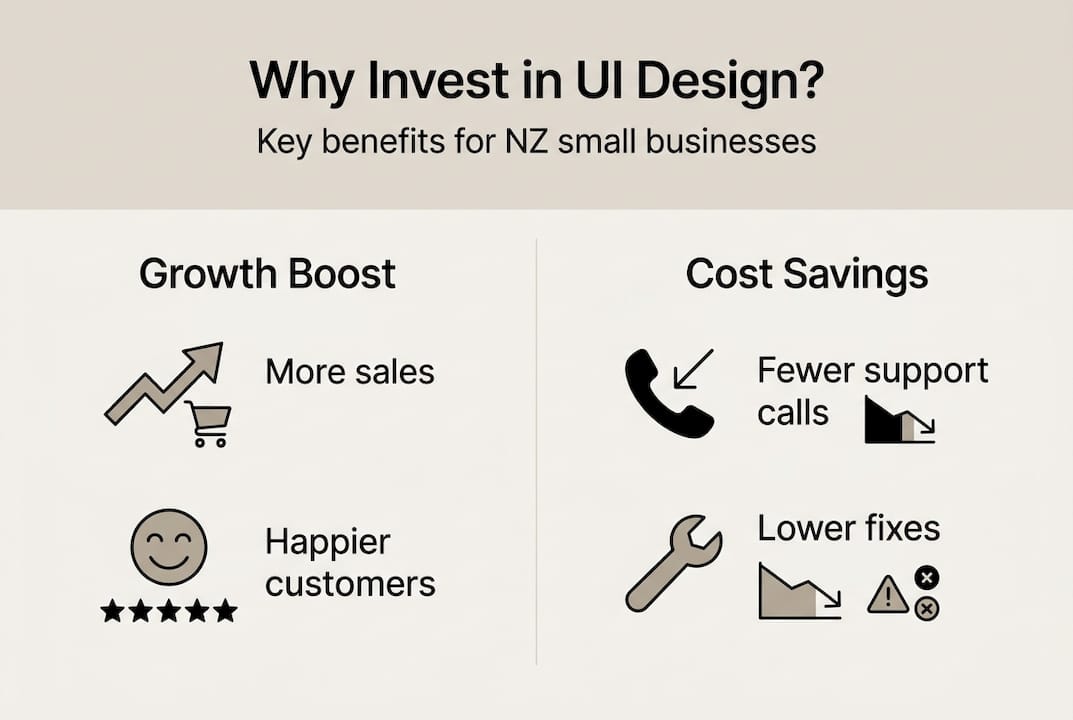
Great UI for a NZ small business doesn’t mean flashy or expensive. It means clear, fast, and trustworthy. The best interfaces get out of the way and let users do what they came to do.
The essential traits of effective UI for small businesses include:
- Clear calls to action — every page should have one obvious next step, whether that’s booking, calling, or buying
- Mobile responsiveness — more than half of web traffic in New Zealand now comes from mobile devices, so your site must work beautifully on a small screen
- Fast load times — users abandon pages that take longer than three seconds to load, and Google penalises slow sites in search rankings
- Accessible design — readable fonts, good colour contrast, and keyboard-navigable layouts serve more users and reflect well on your brand
- Consistent visual language — fonts, colours, and spacing should be uniform across every page to build confidence and recognition
Best practices matter, but don’t follow them blindly. What works for a global e-commerce brand may not suit a Wellington accounting firm. Testing with your actual audience gives you real answers. As design professionals often note, some best practices can be set aside when real user testing points to a better approach for your specific context.
Pro Tip: Don’t redesign based on trends alone. Use Google Analytics, heatmaps, and direct customer feedback to find where users are getting stuck. Fix those spots first. Then iterate.
To get started, audit your current site with fresh eyes. Better still, ask someone who has never seen it before to complete a common task. Watch where they hesitate. That hesitation is money walking out the door. If you want expert guidance, working with qualified business website developers can give you an objective assessment and a clear plan.
Why most small businesses underestimate UI design’s real power
Here’s what we’ve seen after years of working with NZ businesses: most owners treat UI as a cosmetic expense. They budget for ads, staff, and stock, then wonder why their site isn’t converting. The design gets whatever is left over, which is often nothing.
The mindset shift we’d encourage is this: great UI is infrastructure. It works for you 24 hours a day, seven days a week, without a salary. A well-designed interface builds trust faster than any brochure, answers questions before they’re asked, and guides users toward the outcome you want.
Small improvements compound quickly. A 1% lift in conversion at every touchpoint adds up to something significant over a year. You don’t need a complete overhaul to start seeing results. Fix your mobile form. Clarify your headline. Simplify your navigation. Each improvement stacks.
Don’t wait for the perfect moment or the perfect budget. Start now, measure the results, and keep improving. That’s how good design becomes a genuine competitive advantage.
Take your next step: Transform your UI with expert help
If you’re ready to experience the growth that professional UI design delivers, now is a great time to act.
At Virtual Innovation, we specialise in UI-first website design built specifically for NZ small businesses. Whether you need a full redesign or a targeted audit to find what’s holding you back, we’re here to help. Our team works with WordPress website design and a range of platforms to build sites that convert visitors into clients. Based right here in Auckland, our Auckland web designers understand the local market and what Kiwi customers expect. Let’s build something that works as hard as you do.
Frequently asked questions
How quickly can I see results from improving my UI design?
UI improvements can boost engagement and reduce support costs within weeks, but most businesses see the strongest ROI within 6 to 12 months as compounding improvements take effect.
Is UI design really worth the investment for small New Zealand businesses?
Absolutely. Smart UI design can deliver up to 9,900% ROI and reduce the $1.6 trillion in global lost sales that poor design causes every year, including for NZ SMEs.
What’s the main difference between UI and UX design?
UI covers how things look and interact on screen, while UX is about the overall feel and ease of the entire process — a great interface needs both working together.
Can I do UI improvements myself or should I hire an expert?
You can absolutely start with a DIY audit and small changes, but a qualified UI designer will uncover deeper issues and deliver improvements that compound into long-term results.