

If your website isn’t turning visitors into enquiries, the problem is usually the content. Not the design, not the colours, not even the photos. Auckland service businesses lose leads every day because their website content is unclear, disorganised, or simply missing key information. The good news? You don’t need to be a writer or a tech expert to fix it. This guide gives you a practical, step-by-step plan to create website content that builds trust, drives enquiries, and makes your business run more smoothly.
Table of Contents
- Why content matters for Auckland service businesses
- Before you write: planning your website content
- Core website content sections every service business needs
- Step-by-step website content creation process
- Common mistakes (and how to fix them)
- Final check: testing, feedback and launching your content
- Need help or want a done-for-you website?
- Frequently asked questions
Key Takeaways
| Point | Details |
|---|---|
| Content drives results | Well-planned website content leads to more leads and higher customer trust for service businesses. |
| Plan before you write | Mapping your pages and knowing your audience upfront makes content creation simpler and more effective. |
| Start with essentials | Focus first on services, contact, and about pages to boost engagement. |
| Avoid common mistakes | Regularly update key info and use clear calls-to-action to prevent leads slipping away. |
| Test and adapt | Check your content on all devices, ask for feedback, and update as your business evolves. |
Why content matters for Auckland service businesses
Your website is often the first impression a potential customer gets of your business. If the content is confusing or thin, they’ll leave. It’s that simple. Well-structured content leads to a 60% increase in lead growth, which is a number worth paying attention to.
Poor content planning costs you in two ways. First, you lose leads because visitors can’t find what they need quickly. Second, your credibility takes a hit when your site looks patchy or outdated. Neither is good for business.
Understanding the value of service website content is the starting point. For service providers, the must-have content types include:
- Home page: Your first impression and clearest value statement
- Services page: What you do, who it’s for, and why you’re the right choice
- About us page: Your story, your team, and why customers should trust you
- Testimonials: Social proof that reassures new visitors
- Contact page: Easy ways to get in touch or book
These key elements for service providers aren’t optional extras. They’re the foundation of a credible, converting website.
‘Clear, structured content can be the difference between a lead and a lost customer.’
Before you write: planning your website content
Before you type a single word, get organised. Jumping straight into writing without a plan is one of the most common mistakes service businesses make. Organised content planning can drive 60% additional lead growth, so the prep work genuinely pays off.
Start by setting clear objectives. Ask yourself: what do you want your website to do? Book appointments? Generate phone enquiries? Sell a specific service? Your answer shapes everything.
Next, think about your audience. Who are your ideal customers in Auckland? What questions do they ask before hiring someone like you? Write those questions down. Your content should answer them directly.

Then, take a quick look at your competitors. What are other Auckland service businesses doing well? Where are the gaps you can fill? You don’t need a deep dive, just enough to understand the landscape.
Here’s a simple table of tools and resources to have ready before you start:
| Resource | Why you need it |
|---|---|
| Content calendar | Keeps your writing on track and consistent |
| Brand guidelines | Ensures consistent tone, colours, and messaging |
| SEO keyword list | Helps your pages get found on Google |
| Competitor notes | Identifies gaps and opportunities |
| Customer FAQs | Gives you real content ideas from real questions |
Explore content planning strategies to build a framework that suits your business size and goals.
Pro Tip: Don’t overcomplicate the planning phase. A simple one-page outline for each website section is enough to get started. Clarity beats complexity every time.
Core website content sections every service business needs
With your plan in place, it’s time to map out exactly what goes where. Key pages like home, services, about, and contact are non-negotiable for online credibility. Every service business in Auckland needs these.
Here’s how to approach each one:
- Home page: Lead with your strongest benefit. Tell visitors what you do, who you help, and why they should stay on your site within the first few seconds.
- Services page: List each service clearly. Use plain language. Include pricing ranges if you can, because transparency builds trust.
- About us page: Share your story briefly. Highlight your experience, your team, and what makes you different from the next business down the road.
- Testimonials page or section: Use real quotes from real customers. Even two or three strong testimonials can shift a hesitant visitor into an enquiry.
- Contact page: Make it dead simple. Include a form, phone number, email, and your location or service area.
Here’s a quick comparison to show the difference between generic and service-focused content:
| Standard content | Service-focused content |
|---|---|
| ‘We offer a range of services’ | ‘We provide same-day plumbing repairs across Auckland’ |
| ‘Contact us for more info’ | ‘Call us now for a free quote, we respond within 2 hours’ |
| ‘About our company’ | ‘Family-owned Auckland business with 15 years of local experience’ |
| ‘Our team is experienced’ | ‘Our licensed electricians have completed 2,000+ jobs in Auckland’ |
Check out essential website sections and service website page ideas for more inspiration.
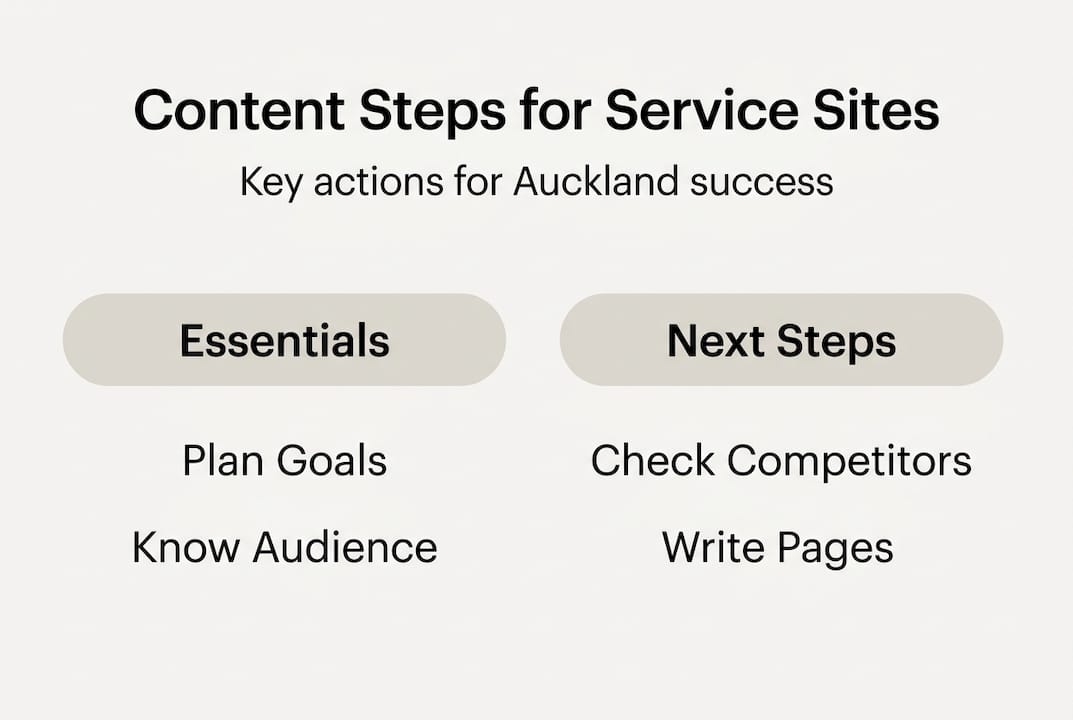
Pro Tip: Start with your services page and contact page first. These two pages drive the most action and give you the clearest return on your effort.
Step-by-step website content creation process
Now that every section is mapped out, here’s how to actually write, revise, and polish your content without getting overwhelmed.
Structured processes make content creation more consistent and valuable, so follow these steps in order:
- Brainstorm and outline: For each page, jot down the three to five key points you want to make. Don’t write full sentences yet, just ideas.
- Write a first draft: Focus on clarity and your customer’s needs. Write like you’re talking to someone sitting across from you. Skip the corporate speak.
- Edit for brevity and consistency: Cut anything that doesn’t add value. Check that your tone is consistent across all pages. Read it out loud if you’re unsure.
- Add visuals: Photos, icons, and even short video content make your pages more engaging and easier to scan. Real photos of your team or work beat stock images every time.
- Review for local relevance: Make sure your Auckland location, service areas, business hours, and contact details are accurate and easy to find.
Always review each page from your customer’s perspective. Ask yourself: if I knew nothing about this business, would this page answer my questions and make me want to get in touch? If not, keep editing.
For a clear overview of how the process fits together, the website content workflow is a great reference.
‘Consistent structure across pages reassures your customers and keeps them moving toward an enquiry.’
Common mistakes (and how to fix them)
Even with the best intentions, service businesses often stumble in the same spots. Neglecting essential content and inconsistent style are frequent problems for small businesses, and they’re easier to fix than you might think.
Here are the most common mistakes and their quick fixes:
- Too much jargon: Your customers aren’t industry insiders. Use plain language and ask a friend or customer to read your content. If they’re confused, simplify it.
- Missing call-to-action: Every page needs a clear next step. ‘Call us,’ ‘Get a free quote,’ or ‘Book online’ should appear on every single page.
- Outdated information: Old pricing, closed services, or wrong phone numbers destroy trust instantly. Set a monthly reminder to check your core pages.
- Poor mobile formatting: Most people browse on their phones. If your content looks broken on mobile, you’re losing customers before they even read a word.
- No testimonials or social proof: People trust other people. Even a handful of genuine reviews or quotes can dramatically improve your conversion rate.
For more ideas on how to improve page results, look at what high-performing Auckland service websites are doing differently.
Pro Tip: Prioritise regular updates. Stale content signals to both Google and your customers that your business isn’t active. A quick monthly review takes less than 30 minutes and keeps everything sharp.
Final check: testing, feedback and launching your content
With your content finalised, don’t rush to hit publish. A quick validation process saves you from embarrassing errors and missed opportunities. Testing content improves engagement and minimises costly errors, so take the time to do it properly.
Follow these steps before you go live:
- Check spelling and grammar: Read every page carefully. Use a tool like Grammarly if you need a second set of eyes.
- Test on mobile: Open your website on your phone and a tablet. Check that text is readable, buttons are tappable, and nothing looks broken.
- Test all forms and enquiry options: Submit a test enquiry through every form on your site. Make sure you receive it and that the confirmation message makes sense.
- Confirm calls-to-action are clear: Every page should have an obvious next step for the visitor. If it’s not immediately clear, add one.
- Get honest feedback: Ask a team member, a trusted customer, or even a friend to browse your site and tell you what’s confusing or missing.
Once you’re happy, launch with confidence. Announce your updated website on social media, in your email newsletter, and to your existing customers. Then commit to a simple upkeep routine, reviewing your contact info and core sections at least once a month. For a final review of last content checks, make sure nothing slips through the cracks.
Need help or want a done-for-you website?
If this process feels like a lot to manage on top of running your business, you’re not alone. Many Auckland service businesses get far better results when they work with a local team who understands their industry.
At Virtual Innovation, we specialise in Auckland web design services built specifically for service businesses like yours. Whether you need a brand-new site or a content revamp, we’ve got you covered. We build on WordPress and Shopify, and we know what works for Kiwi service companies. We’re friendly, straightforward, and we speak plain English, no tech jargon. Get in touch for a free consultation and let’s build something that actually works for your business.
Frequently asked questions
How long should website content be for a small Auckland service business?
Keep each core page concise, aiming for 250 to 400 words and focusing on clarity and relevance. Concise, well-structured content boosts engagement and reduces bounce rate.
How often should website content be updated?
Review and update your service information and core pages at least once every three months. Stale content damages credibility and reduces conversions over time.
Can I write my website content myself, or should I hire a professional?
You can absolutely write your own content if you follow a clear plan. That said, expert guidance ensures your messaging and structure align with your business goals and saves you significant time.
What’s the most important page on my website?
For most service businesses, the services page is critical because it directly drives enquiries and conversions. Services and contact pages create the most leads for service providers.