

TL;DR:
- Local SEO can increase patient appointments by up to 2800% within nine months.
- Being visible in the Google Map Pack is crucial as 70% of clicks go there.
- Consistent online presence and reviews build trust and long-term practice growth.
Referrals are great. But if you’re a surgeon in New Zealand relying solely on word-of-mouth to grow your practice, you’re leaving a significant amount of business on the table. The numbers tell a compelling story: 2800% more patient appointments have been recorded for surgeons who invested in local SEO, while New Zealand clinics reported impression increases of 200 to 1337%. Local SEO, which means optimising your online presence to appear in location-based searches, isn’t just a marketing add-on. For surgeons in 2026, it’s one of the most powerful tools available to attract patients, build trust, and run a more efficient practice.
Table of Contents
- Understanding local SEO: why it matters for surgeons
- How local SEO drives patient appointments for surgeons
- Essential components of effective local SEO for surgeons
- Measuring and sustaining your local SEO success
- Our take: the truth most surgeons miss about local SEO
- Next steps: enhance your local presence with expert help
- Frequently asked questions
Key Takeaways
| Point | Details |
|---|---|
| Local SEO drives growth | Surgeons using local SEO have seen appointments increase as much as 2800%. |
| Patients search locally | Most patients will discover you through Google within their region rather than national searches. |
| Google profiles matter | A complete and verified Business Profile can lead to five times more clicks over incomplete ones. |
| Reviews build trust | Positive online reviews are critical for converting web searchers into booked patients. |
| Ongoing tracking required | Measuring impressions and calls monthly helps ensure your SEO stays effective over time. |
Understanding local SEO: why it matters for surgeons
Local SEO is the process of making your practice easy to find when someone nearby searches for services like yours on Google. For a surgeon in Auckland, Wellington, or Christchurch, this could mean appearing at the top of results when a patient types “knee surgeon near me” or “plastic surgeon Auckland.” It sounds straightforward, but the way it works under the surface is genuinely powerful.
When patients need a specialist, most of them start with Google. They’re not waiting for a friend to recommend someone. They search, compare, and contact within hours. In fact, why local SEO matters for any service provider is rooted in this shift in patient behaviour. Your potential patients are looking right now, and the question is whether they’re finding you or your competitor.
The Google Map Pack, those three business listings that appear at the top of local search results with a map, is prime real estate. 70% of clicks go to Map Pack results. If your practice isn’t there, you’re invisible to most searchers.
Here’s what local SEO covers for surgeons:
- A fully completed and optimised Google Business Profile
- Consistent contact details across all online directories
- Patient reviews that build credibility
- Location-specific content on your website
- Mobile-friendly, fast-loading web pages
“Local SEO outperforms paid ads long-term with three times the efficiency, reducing patient acquisition costs while improving discovery within your local area.”
This means local SEO isn’t just a visibility tactic. It’s a long-term investment that compounds over time, unlike paid ads that stop the moment your budget runs out.
How local SEO drives patient appointments for surgeons
Now that we understand why being visible locally is crucial, how does local SEO actually convert web searches into patient appointments?
The results in the real world are striking. Surgeons saw up to 2800% more appointments within just nine months of improving their local SEO. That’s not a small tweak, that’s practice transformation. And 76% of patients contacted a clinic within 24 hours of finding them through a local search. People act fast when they find what they’re looking for.
A big part of this is trust. A well-maintained Google Business Profile with genuine patient reviews signals to new visitors that you’re credible and approachable. A sparse or outdated profile does the opposite.
Here’s how to set up and maximise your Google Business Profile:
- Claim and verify your listing at Google Business Profile.
- Fill in every field, including services, opening hours, and your practice address.
- Upload high-quality photos of your clinic and team.
- Write a clear, keyword-rich business description.
- Actively request reviews from satisfied patients.
- Respond to all reviews, both positive and negative, promptly.
| Metric | Before local SEO | After local SEO |
|---|---|---|
| Monthly impressions | Baseline | Up to 1337% increase |
| Patient appointments | Baseline | Up to 2800% increase |
| Profile views | Low | Significantly higher |
| Patient contact rate | Low | 76% within 24 hours |
Understanding your local SEO workflow will help you see where the effort goes and why consistency matters. Following a solid Google local SEO NZ guide ensures you’re not missing any critical steps.
Pro Tip: Your website plays a huge role in converting visitors into patients. Pair your local SEO work with medical web design for clinics that instils confidence and makes booking easy.
Essential components of effective local SEO for surgeons
Understanding the big-picture opportunities is vital, but what specific factors matter most when setting up local SEO as a surgeon?
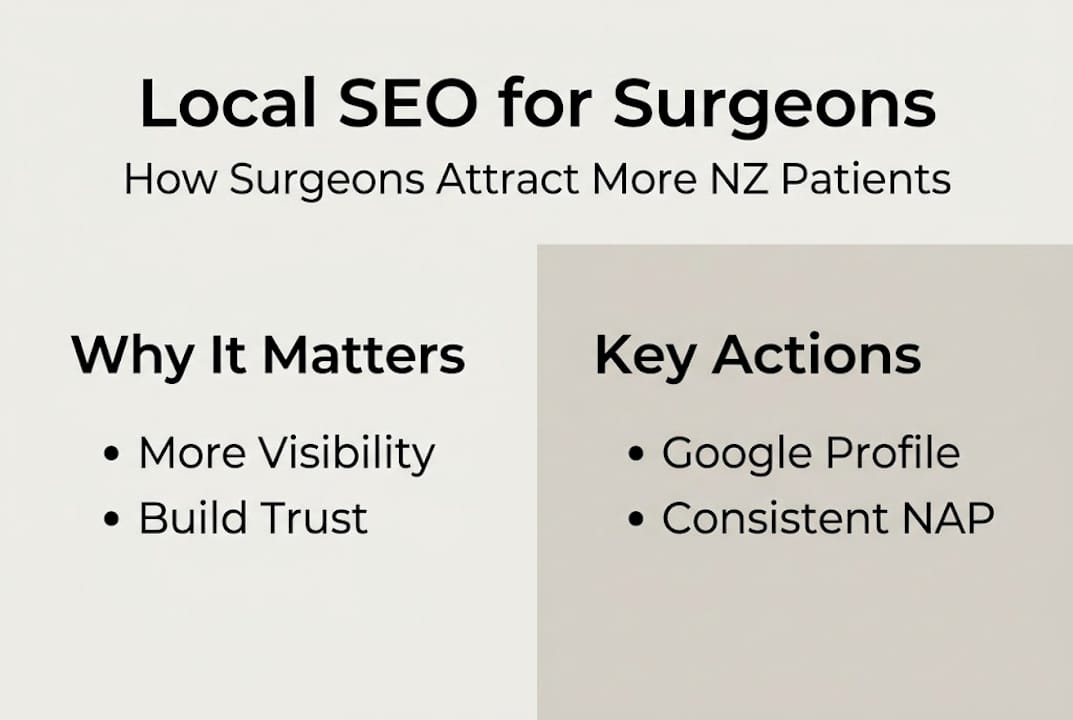
The core building blocks are well known, but the execution makes all the difference. NZ medical providers saw 200 to 1337% more impressions when they built well-structured local SEO pages. That’s not luck. It comes from doing the fundamentals consistently and correctly.
Here are the key components every surgeon’s practice needs:
- Google Business Profile: Complete, accurate, and regularly updated.
- On-site SEO: Location-specific pages, title tags, and meta descriptions.
- Local directories: Consistent listings on Healthpoint, Yellow, and other NZ directories.
- Patient reviews: Actively collected and responded to.
- Mobile responsiveness: Over 60% of local searches happen on mobile devices.
| Local SEO task | Impact level |
|---|---|
| Complete Google Business Profile | High |
| Consistent NAP (name, address, phone) | High |
| Patient reviews with responses | High |
| Location pages on website | High |
| Social media activity | Medium |
| Blog posts about procedures | Medium |
| Generic directory listings | Low |
NAP stands for name, address, and phone number. One of the most common mistakes surgeons make is updating their contact details on one platform and forgetting the rest. Inconsistent NAP details confuse Google and reduce your ranking. Audit every directory listing and keep them all aligned.
Pro Tip: Add a frequently asked questions section to your website that addresses common patient queries about your procedures. This targets long-tail search phrases, meaning specific multi-word questions patients actually type, and builds authority with Google. You can find more guidance in our article on basic SEO for small businesses and through our healthcare medical web design service.
Measuring and sustaining your local SEO success
Once your local SEO basics are in place, it’s critical to measure success and maintain your edge.
Local SEO isn’t a set-and-forget strategy. The practices that sustain their results are the ones that check their metrics regularly and make small improvements over time. Sustained 200 to 1337% increases in impressions were recorded for NZ medical services that kept up with their SEO consistently. That kind of compounding growth doesn’t happen by accident.
Here’s a simple monthly tracking process:
- Log in to your Google Business Profile and check the Insights tab.
- Review the number of searches, profile views, and call clicks.
- Open Google Analytics and track traffic to your location pages.
- Count new reviews received and note your average star rating.
- Check your Map Pack ranking for your top two or three target search terms.
- Make one or two small improvements based on what you find.
76% of patients who find a surgeon through local search make contact within 24 hours. That’s a short window. If your profile or website isn’t converting visitors, you’re losing bookings that should be yours.
Here are the signals that indicate strong local SEO health:
- Growing number of profile views each month
- Increasing call clicks and direction requests
- Rising number of new patient reviews
- Strong position in the Map Pack for local search terms
- Website traffic increasing from organic local searches
- Low bounce rate on your location and service pages
For ongoing inspiration and ideas on how to keep your web presence performing, explore our service website design inspiration resources. Small, consistent improvements build into significant long-term growth.
Our take: the truth most surgeons miss about local SEO
Here’s an uncomfortable reality. Many surgeons still operate as though 2010 rules apply. Referrals come in, the waiting list fills up, and digital presence gets pushed to the back burner. It feels safe. Until the referral network shifts, a competitor invests in SEO, and suddenly the phone goes quiet.
In 2026, your digital presence is as much a trust signal as your clinical reputation. Patients research you before they ever call. They check your reviews, look at your photos, and decide whether you feel trustworthy, all before speaking with your receptionist. A sparse online presence signals neglect, not exclusivity.
What we find genuinely exciting is that local SEO levels the playing field. A well-optimised smaller practice can absolutely outrank a large hospital for specific search terms in a local area. It rewards effort and consistency, not just budget. Following solid local SEO guidance gives you a competitive edge that paid advertising simply cannot replicate at the same cost.
Ignoring local SEO in 2026 is now a bigger risk than investing in it. The window to act before competitors dominate your local search results is narrowing. The good news is that even modest, consistent improvements compound into serious results over time.
Next steps: enhance your local presence with expert help
Armed with an understanding of what works, here’s how you can get tangible, expert support for your next SEO leap.
At Virtual Innovation, we work with New Zealand service businesses, including medical practices, to build fast, professional websites and implement local SEO strategies that genuinely deliver results. We’re a friendly Auckland-based team who get that you’re an expert surgeon, not a digital marketer, and that’s perfectly fine.

Whether you need a WordPress site for surgeons built from scratch or want to transform your existing online presence, our medical web design experts can help. Reach out today for a free website audit and let’s map out a local SEO plan that brings more patients through your door.
Frequently asked questions
What is the main benefit of local SEO for surgeons?
Local SEO makes your practice highly visible to patients searching nearby, directly increasing appointments and building trust. 70% of clicks go to Map Pack results, and surgeons have seen up to 2800% more appointments after optimising their local presence.
How fast do surgeons see results from local SEO?
Results can be dramatic and relatively quick, with some surgeons recording 2800% more appointments within nine months of starting local SEO optimisation.
Which elements are most important for my local SEO?
A complete Google Business Profile, consistent contact details across all directories, genuine patient reviews, and a mobile-friendly website are the four most critical components to prioritise first.
Does local SEO cost more than paid ads?
No, local SEO is significantly more cost-effective over time. It is three times more efficient than paid advertising for surgeons and continues to deliver results without ongoing ad spend.