

This morning I put a picture on LinkedIn of an elf surrounded by AA batteries. If that seems like an odd way to start an article about innovation, fair enough. But it got me thinking about one of my favourite questions: what could you add a clock radio to that would make it better?
That’s a slightly ridiculous question. It’s also useful. A clock and a radio make sense on a bedside table because you can wake up to something other than a buzzer. Once you start looking for combinations like that, you see them everywhere.
My definition of innovation is creativity in action. I don’t know if that’s the dictionary answer, but it’s how I see it. A creative idea might make for a great chat over coffee. I’d call it innovation when someone actually tries it and it changes something useful. The OECD’s formal definition has a similar test: the improvement has to be put into use or made available for people to use.
Why we called ourselves Virtual Innovation
We picked both words on purpose. Virtual was because Bryce and I never wanted an office for the sake of having an office. We wanted the team to work from home, go out and see clients and, if there was a good coffee and a table available, work from there too. It’s a way of working that’s still important to us.
Innovation gave us room to change what we did. In roughly a decade of building Virtual Innovation, we’ve worked on websites, apps, custom software, digital projects and training. Some of those would have been hard to picture when we started. I’m glad the name didn’t lock us into what we were doing in year one.
Websites will still be a big part of our business. Over the next couple of years, I think we’ll be known just as much for helping people rethink how the work behind the website gets done.
Borrow from a completely different industry
We’ve worked with more than 200 client businesses across a pretty wide mix of industries. That gives us a view most owners don’t get. We might see a clever way to handle bookings in one business on Tuesday, then hear a client in a totally different industry describe a problem on Thursday that the same idea could solve.
My dyslexic, ADHD brain tends to make those jumps anyway. If that sounds familiar, you probably know the feeling of bringing up something in a meeting that seems wildly off topic, then explaining the connection and watching it click.
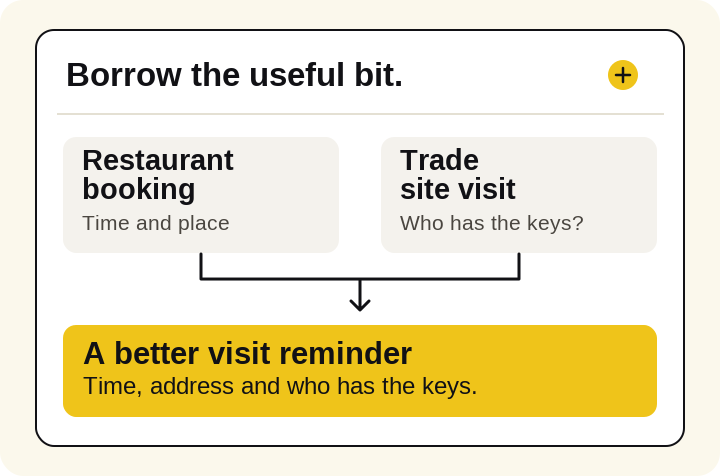
Think about a restaurant booking confirmation. It gives you a date, an address and a way to change your booking. A trades business could use the same pattern for a site visit and add the one thing the technician needs before turning up: who’s there to let them in. The software doesn’t have to be impressive. Not wasting a trip is the win.
A real example from our work is Davis. Enquiries were coming in from different places. We gave the team a single place to see what had come in and what still needed follow-up. It’s the same basic idea as a shared job board: you shouldn’t have to ask three people to find out who’s doing the next thing.
I’ve seen ideas make clients real money over the years. Sometimes it comes from winning work they used to miss. Sometimes it’s simply getting hours back each week. In both cases, someone had to put the idea into use before we knew whether it was any good.
AI gets us to the first try faster
I’d back our team against anyone in New Zealand for how seriously we’re putting AI to work for clients. What excites me is that we can now get from “What if we tried this?” to something a team can actually click on much faster.
That gives us more time to see where the first version is wrong. Does it fit how people work on a busy Friday? Who takes over if the automation can’t handle something? Is the new way honestly less effort than the old one? That’s where the work gets interesting.
It’s also why we talk about innovation, implementation and infrastructure together. Work out what would help. Build it with the people who’ll use it. Give it somewhere reliable to run. Leave out any one of those and you’re likely to end up with a nice demo that nobody opens again.
Try it on one thing this week
Pick a job your team does every week that always seems harder than it should be. Ask who does a similar job well, even if they’re in a completely different industry. Borrow one piece of what they do and run a small test. Then ask the person doing the work whether they’d keep it.
That counts. It doesn’t have to change the whole business. It just has to make something better in the real world.
If you’ve got one of those jobs in mind, tell us what keeps getting in the way. That’s usually a much more interesting place to start than “we need some AI”.