
Why website speed matters: boost conversions and trust
Discover why website speed matters for NZ small businesses. Learn how faster load times boost conversions, build trust, and improve your Google r...

TL;DR:
- Blogging increases local search visibility and attracts more website visitors.
- Consistent, helpful blogs build trust and convert readers into customers.
- Tracking results helps refine content strategy and maximize ROI for small businesses.
Businesses with blogs attract 55% more website visitors than those without. That’s a significant edge for any small business, yet blogging remains one of the most underused growth tools among Kiwi business owners. Many assume it’s reserved for large companies or industry publications. It’s not. Whether you run a plumbing business in Palmerston North or a law firm in Auckland, a well-planned blog can help you reach more local customers, build genuine trust, and grow your online presence without spending a fortune. This guide covers the real value of blogging, how to get started, and practical strategies tailored to New Zealand small businesses.
| Point | Details |
|---|---|
| Blogging drives traffic | Businesses with a blog attract up to 55% more website visitors, boosting visibility. |
| Quality over quantity | Consistent, audience-focused posts outperform frequent, generic content for local businesses. |
| Measure and refine | Tracking blog metrics helps small businesses continually improve results and ROI. |
| Address real questions | Blogs that answer real customer questions or highlight NZ expertise build more trust and engagement. |
There’s a common misconception that blogging is something only big brands or media companies do. Plenty of Kiwi business owners think, “My customers don’t read blogs” or “I don’t have time for that.” But here’s the thing: blogging isn’t about publishing think-pieces for a global audience. It’s about showing up when your local customers search online for answers to their problems.
When someone in Christchurch types “best electrician near me” or “how to choose a web designer in Auckland,” Google serves up results from websites it considers trustworthy and relevant. A regularly updated blog signals to search engines that your site is active, helpful, and worth ranking. That’s why SEO for small business and blogging go hand in hand.
“A business blog is not a diary. It’s a customer magnet. Every post you publish is another door into your business.”
The numbers back this up clearly. 82% of bloggers report a positive return on their blogging investment, according to HubSpot’s 2026 data. That’s not a small sample. And the return isn’t just traffic. It’s inquiries, bookings, and real revenue.
Here’s what a business blog does for a small business in New Zealand:
Blogging is also one of the most cost-effective marketing tools available. Paid ads stop the moment your budget runs out. A well-written blog post keeps working for you for months, even years. That’s a meaningful advantage for small businesses managing tight marketing budgets.
Blogging is often reduced to an SEO tactic. But its real value goes much deeper. When done well, a business blog positions you as a trusted expert in your field. That trust is what turns a casual reader into a paying customer.

Think about it from your customer’s perspective. They’re searching for a solution. They land on your blog post, which answers their question clearly and confidently. They leave feeling helped. Who do you think they call when they’re ready to buy? The business that helped them, every time.
HubSpot’s 2026 data confirms that blogs and SEO rank among the top impactful digital marketing channels for business growth. And the results are consistent across industries.
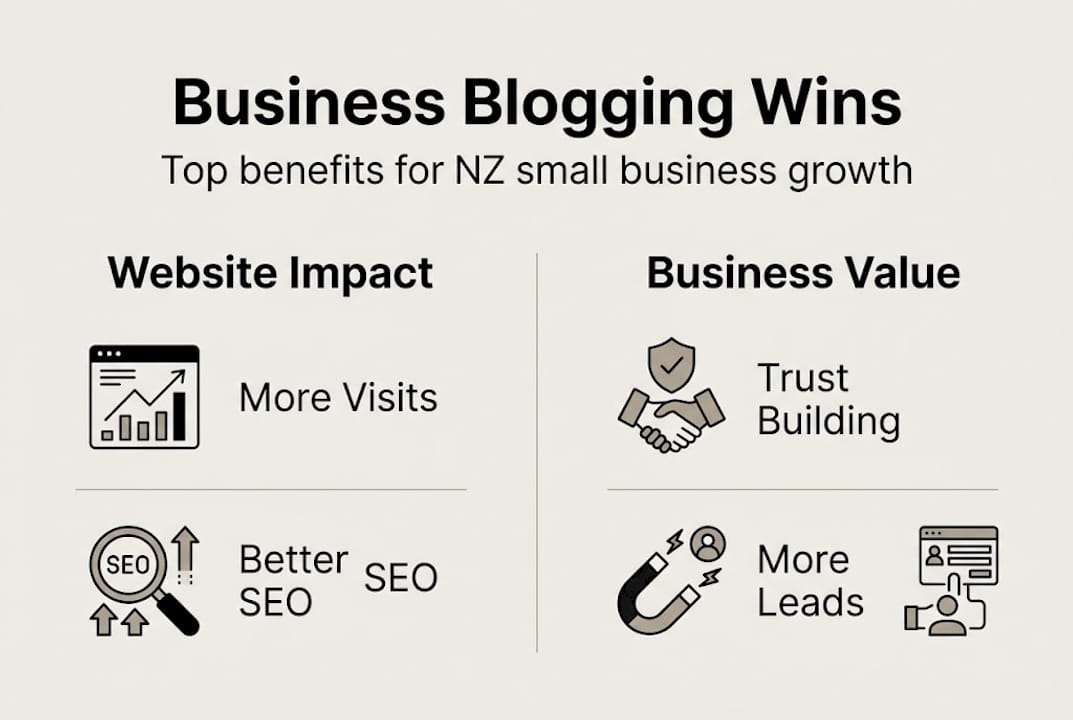
Here’s a quick look at how businesses with and without blogs compare:
| Feature | With a blog | Without a blog |
|---|---|---|
| Website traffic | Significantly higher | Stagnant or slow-growing |
| Search ranking | Improves over time | Limited without paid ads |
| Customer trust | Established before first contact | Built only through direct interaction |
| Lead generation | Ongoing via content | Relies on referrals or ads |
| Social media content | Readily available | Needs separate creation |
Key business goals your blog can help you achieve:
You can also explore blog strategy tips and use your blog to support measuring content ROI over time.
Pro Tip: Keep a running list of questions your customers ask you in person or via email. Those questions are your blog topic goldmine. Answering them online means you’re helping future customers 24 hours a day, seven days a week.
Creating blog content doesn’t need to be complicated. You don’t need to be a professional writer. You just need a clear plan and a bit of consistency. Here’s how to get started.
Identify your ideal reader. Picture your best customer. What do they worry about? What questions do they ask before buying? Write for that specific person, not for everyone.
Pick topics that match real searches. Think about what your customers type into Google. “How much does a website cost in New Zealand?” or “What should I look for in a bookkeeper?” are real searches that local businesses can own.
Use keywords naturally. A keyword (the phrase your customer searches for) should appear in your title, first paragraph, and a few times throughout the post. Don’t stuff them in awkwardly. Write for people first, search engines second. Good design for professional services also helps your blog look credible when visitors land on it.
Create a simple content calendar. Decide how often you’ll publish, whether that’s weekly, fortnightly, or monthly. Block time in your diary and stick to it. Even one post a month compounds over time.
Measure your results. Use Google Analytics or your website platform’s built-in stats to track which posts bring in the most visitors. Double down on what works. Strong SEO for NZ businesses combined with consistent blogging is a powerful combination.
Here’s a rough guide on how publishing frequency relates to traffic growth:
| Posting frequency | Average traffic increase over 6 months |
|---|---|
| Once a month | Up to 30% increase |
| Twice a month | Up to 55% increase |
| Once a week | Up to 100% increase or more |
Remember, 55% more visitors is the average for businesses that blog consistently. Getting there doesn’t require daily publishing.
Pro Tip: Consistency beats frequency. One quality post per month published reliably will outperform four posts published in a rush and then nothing for three months. Build the habit first, then scale up.
Publishing blog posts without checking results is like planting seeds without ever looking at the garden. You need to know what’s growing so you can do more of it.
The most important metrics to watch are:
Useful tools to track your blog’s performance:
Tracking your results also lets you refine your approach. If a post about local case studies gets five times more traffic than a general tips post, that’s your market telling you exactly what they want. Give them more of it. Explore calculating blog ROI to understand the financial return on your content investment.
The evidence is clear. 82% of bloggers report positive inbound ROI from their efforts. That figure holds whether you’re a one-person tradie or a ten-person professional services firm. The key is to measure, learn, and adjust rather than set-and-forget.
We’ve worked with a lot of small businesses across New Zealand, and we see the same pattern repeatedly. Business owners assume blogging is about publishing as frequently as possible. So they push out a flurry of posts, get underwhelmed by the early results, and stop.
The real missed opportunity is simpler than most realise. Every conversation you have with a customer is a potential blog post. When a client asks you the same question for the tenth time, that’s your content plan right there. Write the answer clearly. Publish it. Now that question gets answered automatically, builds trust, and ranks on Google.
What actually drives results for Kiwi small businesses is local relevance combined with genuine helpfulness. A post titled “How Auckland homeowners can prepare for a bathroom renovation” will consistently outperform “5 home renovation tips” because it speaks directly to real people in a real place.
We’ve seen clients double their website enquiries within six months simply by shifting from generic content to posts that answer specific local questions. Explore effective blog strategies to see what’s working for businesses like yours right now.
If you’ve read this far, you already understand why blogging matters. The next step is making it happen without it consuming your whole week.
At Virtual Innovation, we help New Zealand small businesses build modern, high-converting websites backed by smart content strategies. We know what it takes to compete online in a Kiwi market, and we keep things practical and straightforward. Whether you’re starting from scratch or want to get more from an existing site, our WordPress website design and website design Auckland services are built to grow with your business. Get in touch for a friendly, no-pressure chat about your goals.
Aim to publish at least one quality post per month. Consistency drives results more than volume for small businesses just getting started.
Focus on your customers’ most common questions, local industry trends, and topics specific to Kiwi consumers. Blogs and SEO work best together when content matches real local searches.
Track website visits, contact form submissions, and engagement over time. 82% of bloggers report positive ROI, so results are typically clear within a few months of consistent publishing.
Absolutely. Blogging remains one of the strongest tools for local customer acquisition and building online credibility. 55% more visitors is still the average for businesses that blog consistently versus those that don’t.