Your website forms first impressions in just 0.05 seconds, making web design a critical factor in how customers perceive your brand. For small service businesses across New Zealand, from healthcare providers to trade professionals, this instant judgement determines whether visitors trust you enough to become clients. This guide shows how strategic web design strengthens your brand identity, builds credibility, and drives measurable business growth through smart visual choices and user-centred design.
Table of Contents
- Introduction To Web Design And Branding
- First Impressions And Trust Building
- Role Of Colour And Visual Identity In Branding
- Brand Consistency And User Experience
- User Experience And Conversion Optimisation
- Common Misconceptions About Web Design And Branding
- Emerging Trends In Web Design And Branding
- Business Impact And Practical Applications For Small Service Businesses
- Enhance Your Brand With Expert Web Design Services
- Frequently Asked Questions
Key takeaways
| Point | Details |
|---|---|
| First impressions matter instantly | Website visitors form opinions in 0.05 seconds based on visual design, directly impacting trust and conversion rates. |
| Colour drives recognition and decisions | Strategic colour use increases brand recognition by up to 80% and influences 85% of purchasing decisions. |
| Consistency builds revenue | Brands with consistent presentation see 33% higher recall rates and up to 23% revenue growth. |
| Mobile optimisation is essential | With 73% of e-commerce revenue from mobile devices, responsive design directly affects your bottom line. |
| UX impacts conversions dramatically | Great user experience design can increase conversion rates by up to 400% while poor design drives 38% of visitors away. |
Introduction to web design and branding
Web design encompasses the visual layout, structure, and interactive elements that shape how your website looks and functions. Branding defines your business identity through consistent messaging, visual style, and the emotional connection you create with customers. When these two elements align effectively, your website becomes a powerful tool that communicates professionalism and builds trust within seconds of a visitor landing on your page.
For service businesses in New Zealand, first impressions form instantly when potential clients visit your site. Whether you operate a dental practice in Auckland or run a plumbing business in Wellington, your website often serves as the first interaction customers have with your brand. This initial digital handshake determines whether they’ll trust you with their business or click away to a competitor.
Effective web design creates immediate brand visibility by presenting a cohesive visual story. Your logo placement, colour palette, typography, and imagery work together to signal quality and reliability. When potential clients see professional, well-organised design, they instinctively associate these qualities with your service delivery.
Good web design for branding includes several essential elements:
- Clear visual hierarchy guiding visitors to important information
- Consistent colour schemes reflecting your brand personality
- Readable typography that enhances rather than distracts
- Strategic use of whitespace creating breathing room
- Professional imagery showcasing your work and team
- Intuitive navigation making information easy to find
The connection between web design essentials and brand identity isn’t purely aesthetic. Every design choice either reinforces or undermines the brand message you’re trying to convey. A healthcare provider needs design elements that communicate care and trust, while a construction company might emphasise strength and reliability through bolder visual choices.
Aligning your web design with brand identity requires understanding both who you are as a business and what your clients need to see. This alignment creates authenticity that visitors recognise immediately, building the foundation for lasting customer relationships.
First impressions and trust building
The psychology behind website first impressions operates at lightning speed. Research shows users form opinions in 0.05 seconds, with 94% of these initial judgements relating directly to visual design elements. Your website doesn’t get a second chance to make that crucial first impression.
This instant evaluation process happens subconsciously. Visitors don’t deliberately analyse your site’s design, they simply feel whether it looks trustworthy. Clean layouts, professional imagery, and cohesive colour schemes trigger positive associations, while cluttered pages, inconsistent branding, or outdated design elements immediately raise red flags about your business credibility.
Trust building through design relies on visual cues that signal professionalism and attention to detail. When your website displays consistent branding, clear information architecture, and polished visual elements, visitors unconsciously transfer these quality indicators to your services. They reason that if you care enough to present a professional digital presence, you’ll likely deliver quality work.
“A website’s design quality directly influences perceived business credibility. Visitors associate visual professionalism with service excellence, making design investment crucial for trust building.”
The consequences of poor design extend beyond lost opportunities. When potential clients encounter slow-loading pages, confusing navigation, or inconsistent branding, they question whether your business can deliver reliable service. Mobile users encountering desktop-only layouts may assume you’re out of touch with current customer needs. These negative impressions form as quickly as positive ones, often resulting in immediate site abandonment.

Basic design principles that enhance trust include maintaining visual consistency across all pages, using high-quality images that represent your actual work, ensuring fast page load times, and creating clear calls to action that guide visitors naturally through your site. White space shouldn’t intimidate you, it actually improves readability and creates a sense of organisation that visitors find reassuring.
For service businesses, authenticity matters enormously in trust building. Visitors can spot generic stock photos and templated content instantly. Showing real team members, actual project photos, and genuine client testimonials creates authenticity that polished stock imagery never achieves. This honest representation builds deeper trust than any amount of visual polish alone.
Role of colour and visual identity in branding
Colour psychology influences customer decisions more powerfully than most business owners realise. Colour choices increase brand recognition by up to 80% and influence 85% of purchasing decisions, making your palette selection far more than an aesthetic choice. The colours you choose communicate specific messages about your brand personality and values before visitors read a single word.
Different colours trigger distinct psychological responses. Blue conveys trust and professionalism, explaining why financial institutions and healthcare providers favour it. Green suggests growth, health, and environmental responsibility, making it popular among wellness services and eco-friendly businesses. Red creates urgency and excitement but can overwhelm if overused. Orange projects friendliness and approachability, whilst purple communicates creativity and luxury.
For New Zealand service businesses, your colour strategy should reflect both your brand personality and your target audience’s expectations. A law firm might choose conservative blues and greys to signal reliability, while a creative agency could embrace bold, energetic colours demonstrating innovation. The key lies in authenticity, your colours should genuinely represent who you are rather than following trends that don’t fit your identity.
Maintaining consistent visual identity across all customer touchpoints amplifies your brand recognition dramatically. When visitors see the same colours, fonts, and design elements on your website, social media, business cards, and service vehicles, they develop stronger brand recall. This consistency creates familiarity that builds trust over time, as customers recognise your brand instantly across different contexts.
Practical tips for choosing and applying brand colours effectively:
- Select a primary colour representing your core brand message
- Choose two to three complementary colours for variety without chaos
- Ensure sufficient contrast between text and backgrounds for readability
- Test colours across devices as screens display differently
- Document exact colour codes for consistent reproduction
- Apply your palette systematically across all digital and print materials
Inconsistent or confusing colour use undermines brand recognition and creates a disjointed experience. When your website uses different colours than your social media, or when colour choices change between pages, visitors struggle to form a coherent impression of your brand. This inconsistency suggests disorganisation that potential clients may associate with your service delivery. Understanding branding statistics 2025 helps you appreciate how critical visual consistency is for business success.
Brand consistency and user experience
Brand consistency means presenting unified visual identity, messaging, and experience across every customer interaction. Positive user experience ensures visitors can navigate your site intuitively, find information quickly, and complete desired actions without frustration. When these elements combine effectively, they create memorable experiences that turn casual visitors into loyal clients.
Data demonstrates the business impact clearly. Consistent branding results in 33% higher recall, with up to 23% revenue growth linked to brand consistency. These aren’t abstract benefits, they translate directly to more customers remembering your business when they need your services and being willing to pay premium prices for the consistency and quality your brand represents.
| Consistency Element | Impact on Business | Implementation Priority |
|---|---|---|
| Visual identity | 80% recognition increase | High |
| Messaging tone | 33% higher recall | Medium |
| User experience | 400% conversion potential | High |
| Cross-platform presence | 23% revenue growth | Medium |
Ensuring brand consistency across your website and marketing requires systematic approaches. Create templates for common content types, establish clear guidelines for logo usage and spacing, define approved colour combinations with exact codes, and maintain a consistent voice in all written content. These might seem like small details, but collectively they build the recognisable brand presence that drives business growth.
User experience elements supporting brand coherence include intuitive navigation that matches how customers think about your services, consistent button styles and interactive elements throughout the site, predictable page layouts that don’t force visitors to relearn navigation, and seamless transitions between different site sections maintaining visual continuity.
The role of branding in websites extends beyond pretty pictures to functional elements shaping how customers interact with your business. When your contact forms look professional and work reliably, when your service pages present information logically, and when your mobile site functions as smoothly as desktop, these UX factors reinforce your brand’s promise of quality service.
Pro tip: Create a simple brand style guide documenting your colours, fonts, logo usage, and tone of voice. This living document ensures anyone updating your website or creating marketing materials maintains consistency. Even a two-page PDF beats relying on memory, which inevitably leads to inconsistencies that dilute your brand impact.
User experience and conversion optimisation
User experience directly determines whether website visitors become paying customers. Great UX design can increase conversion rates by up to 400%, transforming your website from a digital brochure into an active business development tool. This dramatic impact comes from reducing friction in the customer journey, making it effortless for visitors to understand your services and take the next step.
The contrast between poor and good UX reveals stark business implications:
| Poor UX Impact | Good UX Impact |
|---|---|
| 38% of visitors leave immediately | 400% higher conversion potential |
| High bounce rates damage SEO | Lower bounce rates improve search rankings |
| Frustrated visitors share negative experiences | Satisfied users recommend your services |
| Lost revenue from abandoned journeys | Streamlined paths to conversion |
| Brand damage from perceived unprofessionalism | Enhanced brand reputation through quality experience |
Mobile-first responsive design has shifted from optional to essential. Mobile devices account for 73% of all e-commerce revenue and over 64% of global web traffic, meaning most of your potential clients first encounter your brand on smartphones. If your site doesn’t function beautifully on mobile, you’re actively turning away the majority of your market.
Key steps for optimising user experience:
- Test your website on actual mobile devices regularly, not just browser simulators
- Simplify navigation to three to five main menu items maximum
- Ensure buttons and clickable elements are large enough for touch interaction
- Optimise images to load quickly without sacrificing quality
- Place your most important information and calls to action above the fold
- Remove unnecessary form fields that create barriers to contact
- Implement clear visual hierarchy guiding visitors to key actions
Poor web design drives 38% of users away, representing a massive opportunity cost for businesses with outdated or poorly optimised sites. Every visitor who abandons your site due to poor UX is a potential customer who’ll likely visit a competitor instead. In service industries where customers often comparison shop, UX quality frequently determines who wins the business.
Different types of web design for small businesses serve various purposes, but all must prioritise user experience to succeed. Whether you need a simple brochure site or a complex booking system, the underlying principle remains constant: make it effortless for customers to understand your value and take action.
Pro tip: Set a recurring calendar reminder to test your website on your own mobile device monthly. Click through your main customer journeys as if you were a potential client. You’ll spot issues regular monitoring misses and maintain empathy for your users’ experiences. Understanding the digital marketing web design report provides valuable context on evolving user expectations.
Common misconceptions about web design and branding
Many business owners believe visual attractiveness alone ensures website success, but visual appeal does not guarantee business results. Functional usability and brand coherence matter equally. A beautiful website that confuses visitors or fails to load on mobile devices will underperform an aesthetically modest site with excellent usability every time.
The mobile optimisation misconception remains surprisingly common in 2026. Some businesses still treat mobile design as secondary, creating desktop-first sites that barely function on smartphones. This approach ignores reality: most customers now browse exclusively on mobile devices. Neglecting mobile users doesn’t just limit your reach, it actively damages your brand by suggesting you’re out of touch with customer needs.
Another persistent myth suggests brand consistency represents minor polish rather than fundamental strategy. Business owners treating branding as superficial decoration miss how consistency builds the recognition and trust that drive revenue growth. Your brand isn’t just your logo, it’s every interaction customers have with your business, and inconsistency in these interactions erodes confidence.
Common myths and factual corrections:
- Myth: Expensive custom design always outperforms templates. Reality: Well-implemented templates with strong branding often outperform poorly executed custom designs.
- Myth: More features and options improve user experience. Reality: Simplicity and focus typically convert better than overwhelming choice.
- Myth: Design trends should dictate your website appearance. Reality: Timeless design aligned with your brand outlasts trendy approaches.
- Myth: Technical perfection matters more than content quality. Reality: Both matter, but clear, relevant content on a functional site beats perfect code with weak messaging.
- Myth: Once launched, websites need minimal updates. Reality: Regular content updates and design refinements maintain relevance and search rankings.
Integrating aesthetics with usability and branding requires balanced thinking. Start with user needs and business goals, then apply design elements supporting these objectives rather than pursuing visual impact for its own sake. Your website should look professional, but that professionalism must serve functional purposes like guiding visitors to contact you or book services.
The most successful websites balance three elements: attractive design that reflects brand personality, intuitive usability that respects visitor time and intelligence, and consistent branding that builds recognition across all touchpoints. When these elements work together, they create experiences that feel both professional and effortless. Review web design statistics 2025 to understand how these factors impact real business outcomes.
Emerging trends in web design and branding
Artificial intelligence has transformed web design workflows dramatically. 93% of web designers use AI tools, with near 90% of sites using mobile-first responsive design. These technologies speed up design processes and improve quality by automating repetitive tasks, but they work best when guided by human understanding of brand strategy and customer needs.
AI tools help designers generate layout options quickly, optimise images automatically, and even suggest colour palettes based on brand descriptions. For small service businesses, this democratisation of design technology means professional-quality websites become more accessible without enterprise budgets. However, AI cannot replace the strategic thinking required to align design with your unique brand identity and business goals.
Mobile-first responsive design has evolved from emerging trend to industry standard. Designers now create mobile layouts first, then adapt them for larger screens rather than the reverse. This approach ensures the mobile experience receives primary attention, reflecting where most users actually interact with your brand. The shift acknowledges that desktop browsing, while still important, represents secondary usage for most service businesses.
Ongoing challenges include maintaining accessibility for users with disabilities, ensuring brand coherence across rapidly multiplying digital touchpoints, and balancing design innovation with the familiarity users need for comfortable navigation. Service businesses must also navigate the tension between following design trends that signal modernity and maintaining timeless brand elements that build lasting recognition.
Emerging technologies and design trends relevant to small service businesses:
- Voice search optimisation as more customers use smart assistants
- Micro-interactions providing feedback for user actions
- Dark mode options reducing eye strain and battery usage
- Minimalist design emphasising clarity over decoration
- Personalised content adapting to individual user preferences
- Sustainable web design reducing energy consumption and carbon footprint
Keeping pace with wordpress website design trends helps your business stay current without chasing every passing fad. The goal isn’t adopting every new technology, but rather selecting innovations that genuinely improve your customers’ experience whilst strengthening your brand presence.
Pro tip: Adopt new technologies cautiously, always asking whether they serve your brand strategy and customer needs. Just because a design trend looks impressive doesn’t mean it suits your service business. Test new approaches on small sections of your site before full implementation, measuring whether they actually improve user engagement and conversions before committing fully.
Business impact and practical applications for small service businesses
Strong web branding and design deliver measurable business growth through increased visibility, enhanced credibility, and improved conversion rates. Small service businesses benefit from clear, consistent brand messaging supported by simple websites improving efficiency and customer acquisition. These improvements translate directly to revenue growth as more qualified leads contact you and existing customers refer others more frequently.
Practical steps for improving your branding and efficiency:
- Audit your current website identifying inconsistencies in colours, fonts, and messaging
- Create a simple brand style guide documenting your visual identity
- Optimise your mobile experience through responsive design implementation
- Simplify navigation reducing menu items to essential categories
- Update imagery showcasing real team members and actual project work
- Implement clear calls to action on every page guiding visitor next steps
- Set up analytics tracking which pages convert visitors into customers
- Schedule regular content updates maintaining search engine relevance
- Test website speed and address any performance issues slowing load times
- Collect customer feedback on website usability and address pain points
New Zealand service businesses applying these principles see tangible results. Consider a typical scenario: an Auckland-based healthcare provider updated their outdated website with consistent branding, mobile optimisation, and clearer service descriptions. Within three months, they experienced 45% more appointment bookings through their website and 30% fewer phone calls asking basic questions already answered online. The efficiency gains freed staff time whilst increasing patient acquisition.
The case study of Bakers Delight demonstrates how strategic web design transforms customer experience and business operations. Their improved online presence streamlined ordering whilst reinforcing brand consistency across all customer touchpoints. These measurable benefits came from systematic application of the principles outlined throughout this guide.
Simple updates often yield significant improvements. Website design for company growth doesn’t require complete overhauls in most cases. Focused improvements addressing your biggest weaknesses typically deliver better returns than elaborate redesigns. The 2025 web design industry report confirms that strategic, incremental improvements often outperform expensive complete rebuilds.
Ongoing measurement and adjustment ensure continuous growth. Track which pages visitors spend time on, where they exit your site, which calls to action they click, and which search terms bring qualified traffic. This data guides refinements that compound over time, steadily improving your website’s business contribution. The easy website updates NZ service firms can implement maintain momentum without requiring constant professional intervention.
Enhance your brand with expert web design services
Virtual Innovation specialises in WordPress website design for New Zealand service businesses like yours. We understand the unique challenges you face building brand visibility in competitive local markets. Our team creates websites that don’t just look professional but actively support your business growth through strategic design aligned with your brand identity.
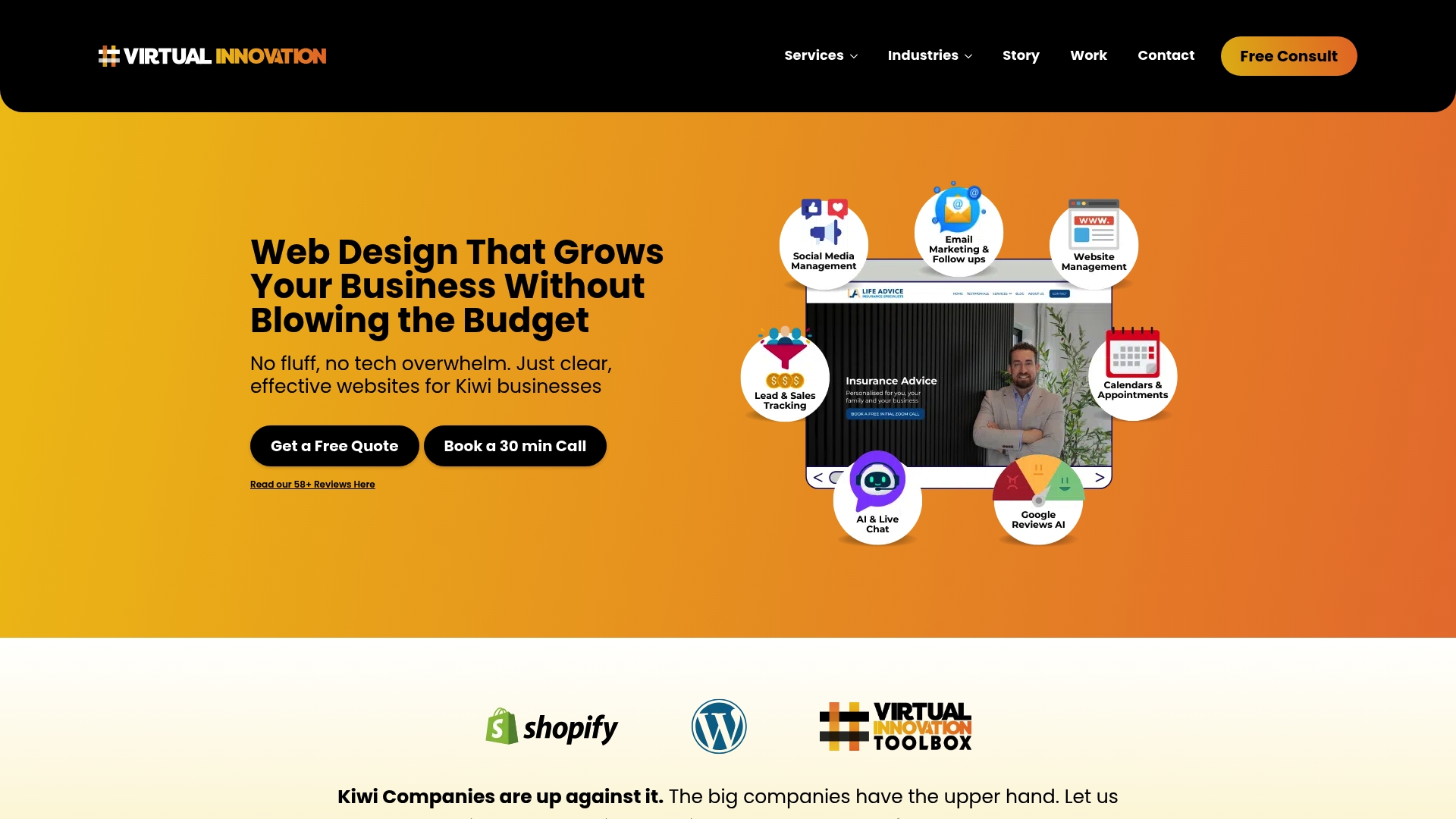
Our approach combines technical expertise with genuine understanding of how service businesses operate. We’ve helped healthcare providers, trades professionals, and other service companies across Auckland and beyond transform their online presence into powerful business development tools. The proven results we achieved with clients like Bakers Delight demonstrate our commitment to delivering measurable improvements, not just attractive designs.
When you work with a WordPress designer near me NZ, you gain a partner who understands local market dynamics and customer expectations. We create customised solutions that enhance your brand visibility whilst improving the user experience that converts visitors into clients. Every project starts with understanding your business goals, target audience, and brand personality, ensuring the final website authentically represents who you are.
Pro tip: Select designers who take time to understand your brand values and business objectives before proposing solutions. The best partnerships begin with listening, not pitching. Agencies pushing identical approaches for every client likely won’t deliver the customised branding your business needs to stand out.
Ready to strengthen your brand through strategic web design? Contact Virtual Innovation today to discuss how we can create a website that truly represents your business whilst driving the growth you need. Let’s build something that makes you proud whilst delivering real business results.
Frequently asked questions
What is the role of web design in branding?
Web design shapes brand identity by creating the visual and functional experience customers associate with your business. It builds trust through professional presentation, reinforces brand recognition through consistent visual elements, and influences customer decisions within the first 0.05 seconds of site visits. Good web design translates your brand values into tangible user experiences that differentiate you from competitors. For service businesses, design quality signals service quality, directly impacting whether visitors choose to contact you or move to competitors.
How can small service businesses improve brand consistency online?
Use consistent logos, colours, and fonts across your website, social media, and all marketing materials. Create a simple brand style guide documenting exact colour codes, approved fonts, logo usage rules, and tone of voice examples. Regularly audit your online presence to identify and correct inconsistencies. Update content systematically to maintain aligned messaging that reflects your current brand position and service offerings.
Why is mobile-friendly web design important for branding in 2026?
Most users browse on mobile devices, with 73% of e-commerce revenue coming from mobile traffic. Mobile-first design improves user experience and conversion rates by ensuring your brand presents professionally regardless of device. Google prioritises mobile-optimised sites in search rankings, whilst customers increasingly judge business credibility based on mobile experience quality.
What common mistakes should NZ small businesses avoid in web design?
Neglecting mobile optimisation remains the biggest mistake, alienating the majority of potential customers. Inconsistent branding and colours confuse visitors and weaken brand recognition. Focusing solely on aesthetics instead of usability creates beautiful sites that don’t convert. Other frequent errors include overcomplicated navigation, slow page load times, and failing to update content regularly.
How quickly do website visitors form first impressions?
Visitors form opinions about your website in just 0.05 seconds based primarily on visual design elements. This instant judgement determines whether they trust your brand enough to explore further or immediately leave. The speed of this process means you have no opportunity to overcome poor design through content quality, making professional web design essential for business success.
What measurable benefits can web design improvements deliver?
Great user experience design can increase conversion rates by up to 400%, whilst consistent branding results in 33% higher recall and up to 23% revenue growth. Strategic colour use improves brand recognition by 80% and influences 85% of purchasing decisions. These improvements translate to more customer enquiries, higher conversion rates, and increased revenue for service businesses investing in strategic web design aligned with brand goals.