

A potential client arrives on your website and decides within moments whether they trust you. For Auckland businesses competing online, your first impression shapes everything from engagement to repeat business. Branding creates valuable mental associations that go far beyond logos or colour schemes, shaping how clients recognise your expertise, assess your reliability, and decide to connect. Understanding key branding concepts will help you turn your website into a powerful trust signal.
Table of Contents
- Branding In Websites – Key Concepts Explained
- Types Of Website Branding For Small Business
- Visual Identity And Customer Experience Online
- Branding’s Impact On Client Engagement And Trust
- Common Website Branding Mistakes To Avoid
Key Takeaways
| Point | Details |
|---|---|
| Branding is a Holistic Experience | Your website’s brand encompasses visual identity, voice, messaging, consistency, and values, creating immediate trust with visitors. |
| Importance of Consistency | Consistent branding across all pages builds confidence; inconsistencies can confuse and undermine trust. |
| Engagement Drives Loyalty | Strong branding fosters client engagement, which is crucial for building emotional connections and ensuring repeat business. |
| Regular Audits are Essential | Regularly auditing your website for consistency and updates helps maintain a strong brand presence and reflects professionalism. |
Branding in Websites – Key Concepts Explained
Your website brand is more than just a logo or colour scheme. It’s the entire experience that tells people who you are and why they should trust you.
When a potential client lands on your site, they’re making snap judgements within seconds. Are you professional? Reliable? Do you get their problems? Your brand answers all of this before they read a single word.
What is branding really?
Branding creates valuable mental associations that help customers recognise your business, assess your quality, and connect with your values. It’s not just visual—it’s how you communicate, the language you use, and the promises you keep.
Think of branding like a handshake with every visitor. Your website is that handshake made permanent.
Here are the core elements that make up your website brand:
- Visual identity: Logo, colours, typography, imagery that represent your business
- Voice and tone: How you speak to clients—are you formal or friendly? Professional or approachable?
- Messaging: The words you choose to explain what you do and why it matters
- Consistency: Using the same brand elements across every page and interaction
- Values: What your business stands for beyond making money
When these work together, they create something powerful. Clients remember you. They trust you. They come back.
Why websites make branding different
Your website isn’t a brochure. It’s a live conversation. Unlike a printed flyer, your site shows personality through how it looks, feels, and responds to users.
Getting your messaging right is crucial because every word either builds trust or creates doubt. A service provider who says “We’ll sort your problem” feels different from one who says “We solve complex business challenges.” Same meaning, different trust level.
Your website brand should reflect your actual business values and how you treat clients. If you promise responsiveness but take weeks to reply, your brand promise breaks. People notice this disconnect instantly.
The trust factor
Branding acts as a quality signal that customers rely on when deciding whether to work with you. In an online space where people can’t meet you face-to-face, your brand becomes your reputation.
Consistency breeds confidence. When your branding feels polished and intentional—not cobbled together—clients assume your work quality matches that standard.
Strong branding on your website reduces decision friction. A prospect who trusts your brand is far more likely to contact you.
Key branding elements that build client trust:
- Clear visual hierarchy that guides attention
- Professional photography and design that matches your industry
- Testimonials and proof of previous work displayed prominently
- Simple navigation that respects visitor time
- Messaging that addresses specific client pain points
Pro tip Audit your website today by visiting it fresh, as though you’re a potential client seeing it for the first time. Does your brand feel intentional? Does it match your actual service quality? If not, that’s your starting point for improvement.
Types of Website Branding for Small Business
Not all branding strategies work the same way for small businesses. Your approach depends on what you’re selling, who you’re selling to, and what makes you different from competitors.
Small business owners often face a unique challenge: your personal reputation and your business brand are often intertwined. That’s actually an advantage if you use it well.
Personal branding
Many service providers in Auckland build their entire brand around themselves. You’re the face of the business, so your credibility becomes the business’s credibility.
This works brilliantly for consultants, tradespeople, accountants, and coaches. Your website becomes a showcase for your expertise and experience.
Personal branding elements include:
- Your professional bio and background story
- Client testimonials that reference you by name
- Your photo displayed prominently throughout the site
- Articles or case studies demonstrating your knowledge
- Your personality coming through in messaging and tone
Visual identity branding
Consistent visual branding across your website creates recognition and professionalism. This includes your logo, colour palette, typography, and imagery style.

When potential clients see your branding repeated across every page, they develop trust through familiarity. Inconsistency signals carelessness—even if your work quality is excellent.
Visual branding elements to control:
- Logo placement and sizing on every page
- Consistent colour scheme throughout the site
- Matching fonts for headings and body text
- Photography style that feels cohesive
- Spacing and layout patterns that repeat
Messaging-based branding
Your words matter enormously. Different branding types emphasise how you communicate your value through language, tone, and the problems you solve.
A plumber might position themselves as “emergency repair specialists” versus “affordable maintenance pros.” Same service, completely different brand message.
Your messaging should clarify:
- What specific problems you solve
- Who your ideal clients are
- Why you’re different from competitors
- What clients can expect when working with you
Small businesses succeed when their website brand feels authentic to how they actually operate. Trying to seem bigger or more corporate than you are backfires with today’s savvy clients.
Experiential branding
This is how your website feels when someone uses it. Fast loading, easy navigation, and quick response mechanisms all contribute to your brand experience.
If you promise quick turnarounds but your contact form takes days to respond to, you’ve broken your brand promise. Every interaction reinforces or damages your brand.
Pro tip Choose one branding type that fits your business model, then commit fully to it across every page. Mixing inconsistent approaches confuses visitors and weakens trust.
Here is a summary comparing four key types of website branding for small businesses:
| Branding Type | Main Focus | Best For | Unique Advantage |
|---|---|---|---|
| Personal Branding | Building reputation and trust | Consultants, trades, coaches | Turns owner into the brand itself |
| Visual Identity | Cohesive look and feel | All businesses | Makes business memorable quickly |
| Messaging-Based | Communicating unique value | Service providers, specialists | Attracts specific ideal clients |
| Experiential Branding | Positive user interactions | Businesses prioritising service | Reinforces promises through actions |
Visual Identity and Customer Experience Online
Your website’s visual identity isn’t just about looking nice. It’s the entire sensory experience that shapes how clients feel about your business before they’ve even spoken to you.
When someone lands on your site, colours, fonts, spacing, and imagery all work together to create an impression. That impression either builds trust or creates doubt.
How visual identity shapes trust
Visual identity creates emotional connections between your brand and potential clients. A polished, intentional design signals competence. A messy, dated site signals the opposite—regardless of how good your actual work is.
Small business owners in Auckland often underestimate this. You might be brilliant at what you do, but if your website looks amateur, clients assume your work quality matches that appearance.
The colour and typography factor
Your colour palette influences how visitors feel on your site. Blues suggest trust and professionalism. Warm oranges feel friendly and approachable. Greys can feel corporate or, if overused, dull.
Typography matters equally. Clean, readable fonts build confidence. Fancy, hard-to-read fonts create frustration. And yes, I’ve learned this the hard way.
Visual identity elements that impact customer experience:
- Colour scheme consistency across all pages
- Readable font sizes and font families
- White space that doesn’t feel cramped
- High-quality images over stock photos
- Clear visual hierarchy showing what matters most
- Mobile-responsive design that works on phones
Creating emotional resonance
Dynamic visual design enhances consumer experiences by making your brand memorable and relatable. This doesn’t mean flashy animations—it means strategic, purposeful design choices.
When your visual identity reflects your actual business personality, clients feel the authenticity. A laid-back tradesman shouldn’t have a corporate-looking site. A professional accountant shouldn’t look like a nightclub.
Consistency between your visual identity and actual service delivery creates trust. When your website promises one thing but your business delivers another, clients notice immediately.
Customer experience through design
Every design choice affects how easily visitors move through your site. Slow loading times frustrate people. Unclear navigation confuses them. Poor contrast makes text hard to read.
These aren’t just cosmetic issues—they’re trust killers. A prospect who struggles to find your contact information will assume you’re hard to work with.
Key experience factors to optimise:
- Page load speed under 3 seconds
- Navigation menus that make sense
- Clear calls-to-action telling visitors what to do next
- Forms that don’t ask for unnecessary information
- Mobile design that works smoothly on small screens
Pro tip Test your website on your phone right now. If navigation feels clunky or text is tiny, your visual identity is failing half your potential clients who browse on mobile.
Branding’s Impact on Client Engagement and Trust
Strong branding doesn’t just make your website look good. It actively drives how clients interact with your business and whether they’ll become loyal customers.
When your branding is consistent, authentic, and professional, potential clients spend more time on your site, explore more pages, and are far more likely to contact you. That’s engagement.
The engagement-trust connection
Customer engagement significantly influences brand trust and loyalty. When clients actively engage with your content—reading case studies, watching testimonials, exploring your services—they build emotional connections to your brand.
This isn’t passive. Engagement means your messaging resonates. Your visuals appeal to them. Your story makes sense to their situation.
Building emotional bonds through branding
People do business with brands they feel connected to, not just brands that solve problems. A plumber who shares before-and-after photos of solved emergencies builds emotional connection. An accountant who explains tax changes clearly shows they care about client understanding.
These moments of connection come through consistent branding applied thoughtfully across your website.
Ways branding drives engagement:
- Storytelling in your “About Us” section that clients relate to
- Case studies showing real problems you’ve solved
- Testimonials and video reviews from actual clients
- Clear explanations of complex processes
- Regular updates showing you’re active and current
- Responsive design proving you respect visitor time
Trust as the foundation of loyalty
Brand trust particularly enhances engagement and creates lasting customer relationships. Trust isn’t built overnight, but it’s destroyed in seconds through inconsistency or broken promises.
When your website brand matches your actual service delivery, clients notice. When you promise fast response times and actually respond quickly, trust deepens. When your pricing is transparent on your site and remains transparent in quotes, loyalty follows.
Consistent branding across every interaction—website, email, phone calls, in-person meetings—is what converts casual visitors into trusted, repeat clients.
Elements that deepen trust through branding:
- Professional credentials and certifications clearly displayed
- Transparent pricing or clear process for quotes
- Client testimonials with names and photos, not generic praise
- FAQ sections addressing common concerns
- Regular blog content proving your expertise
- Easy, obvious ways to contact you
The business impact
Clients who trust your brand spend more, refer friends, and stick around longer. Engagement metrics like time on site and pages visited increase when branding is strong. Conversion rates improve because trust removes friction from the decision-making process.
For small service businesses in Auckland, this matters enormously. You’re competing against larger firms with bigger budgets. Strong branding levels the playing field by building personal connection and trust that big corporates struggle to create.
Pro tip Audit your website for consistency this week. Do your colours, fonts, messaging tone, and imagery feel cohesive across every page? Inconsistency leaks trust without you realising it.
Common Website Branding Mistakes to Avoid
Most small business owners don’t set out to damage their brand. But small, consistent mistakes add up quickly and erode client trust without you realising it’s happening.
The good news? Once you know what to avoid, fixing these issues becomes straightforward.
Inconsistency across pages
Lack of brand consistency undermines credibility and confuses visitors about who you actually are. Your logo changes size. Your colour scheme shifts between pages. Your messaging tone swings from formal to casual.
Clients notice these details even when they can’t articulate why they feel uncertain about working with you.
Common consistency mistakes:
- Different logo versions on different pages
- Inconsistent colour palette across sections
- Font sizes and styles varying without purpose
- Photography style changing from professional to casual
- “About Us” messaging that contradicts your homepage
- Contact information displayed differently on each page
Poor visual hierarchy
When everything on your page feels equally important, nothing is. Visitors don’t know where to look first or what action you want them to take.
A strong brand guides attention intentionally. Your most important message appears prominently. Call-to-action buttons stand out clearly. Secondary information sits in the background.
Outdated design and broken promises
Outdated websites undermine brand perception and signal that your business itself might be stale. An old design doesn’t need to be replaced entirely—thoughtful updates keep your brand feeling current.
Why visitors leave your site quickly often traces back to design that feels neglected or confusing.
Your website is like a storefront window. If it looks dusty and outdated, customers assume your service quality matches that appearance.
Ignoring your actual target audience
You might be designing your branding to impress yourself or competitors instead of the actual clients you need. This creates disconnect.
A tradies service shouldn’t look like a luxury brand. A professional consultant shouldn’t look like a nightclub. Your branding should speak directly to the people you want to work with.
Common audience mismatches:
- Using industry jargon instead of plain language
- Visual style that appeals to you, not your clients
- Messaging focused on features, not client benefits
- Testimonials that don’t represent your ideal client
- Navigation structure that confuses your actual users
- Overly complex design when simplicity serves better
Neglecting regular updates
Your website isn’t a static brochure—it’s a living representation of your business. Outdated case studies, old dates, and broken links all signal that you’re not actively engaged.
Small, regular updates show you’re current and professional. They also improve search engine rankings, which means more people find you.
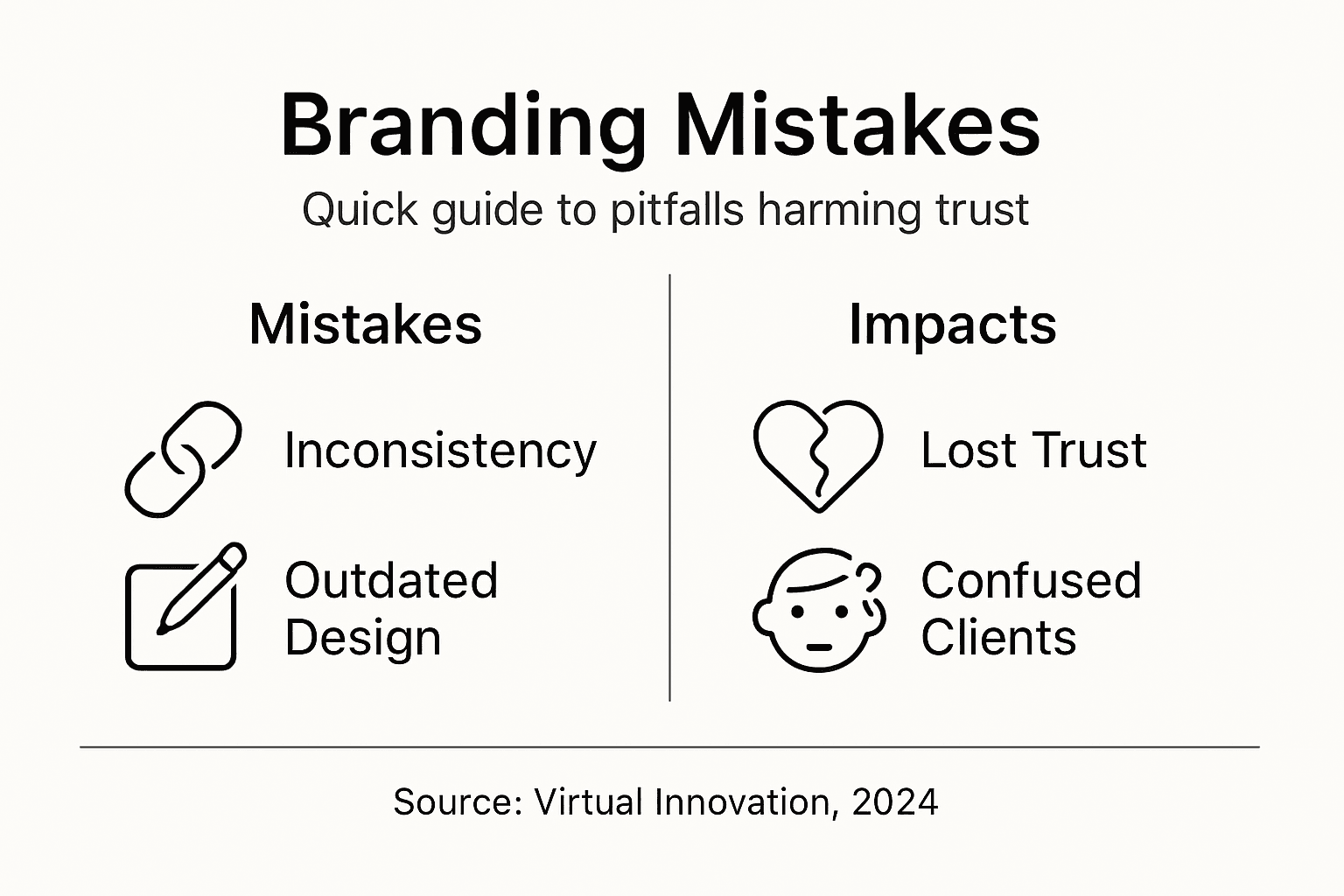
The following table highlights common website branding mistakes and their business impacts:
| Mistake Type | Typical Symptom | Impact on Business Trust |
|---|---|---|
| Inconsistent Design | Varying logos, colours, fonts | Clients doubt professionalism |
| Outdated Appearance | Old layout, broken links | Suggests business is neglected |
| Audience Mismatch | Branding ignores client needs | Confuses or deters prospects |
| Lack of Updates | Stale content, no new posts | Implies you are not active |
Pro tip Spend 30 minutes this week auditing your website as a stranger would. Take screenshots of each page and look for inconsistencies in colours, fonts, messaging tone, and design quality. That list is your improvement roadmap.
Elevate Your Website Branding to Build Real Client Trust
Struggling to create a website brand that truly reflects your business values and builds trust from the first click You are not alone. This article highlighted how inconsistency in visual identity and messaging can break trust before potential clients engage deeply. Small businesses in Auckland especially face the challenge of balancing personal authenticity with polished professional branding. Key pain points include unclear messaging poor visual hierarchy and a website experience that falls short of promised service quality.
At Virtual Innovation, we specialise in helping service companies harness the power of consistent branding through tailored WordPress and Shopify design and software solutions. Our friendly down-to-earth approach means we listen carefully to your unique needs then deliver websites that communicate your value clearly and build trust with every visitor. Start by exploring insights and tips in our General Archives to see how consistent branding shapes client engagement.
Don’t let inconsistencies or outdated design hold your business back any longer. Take the next step to strengthen your website brand with Virtual Innovation today. Visit and discover how we get Kiwi companies noticed and trusted online. Your brand deserves more than a handshake—make it a lasting first impression that turns visitors into loyal clients.
Frequently Asked Questions
What is the importance of branding on a website?
Branding on a website is crucial as it creates valuable mental associations that help customers recognise your business, assess its quality, and connect with its values. It defines the overall experience for visitors and influences their trust and willingness to engage with your services.
How can branding affect client trust during online interactions?
Branding acts as a quality signal that customers rely on when deciding whether to work with you. A consistent and professional brand design conveys competence and reliability, thus fostering trust and reducing decision friction for potential clients.
What are the key elements of effective website branding?
The key elements of effective website branding include visual identity (logo, colours, typography), voice and tone (how you communicate), messaging (clear explanations of your services), consistency across all pages, and aligning brand values with actual business practices.
How does visual identity impact customer perception?
Visual identity shapes customer perception by creating emotional connections with your brand. A polished and intentional design signals professionalism, while a messy or outdated site can lead visitors to question the quality of your services. Consistency in visual design helps to establish trust and familiarity with clients.