
More than half of New Zealanders search online before selecting a local service, yet countless small businesses remain invisible in search results. If you run a service business in New Zealand, you’re missing out on clients who are actively looking for what you offer. SEO isn’t just for big brands with massive budgets. It’s a practical tool that helps small businesses attract more clients, build trust, and grow steadily. This guide breaks down exactly what SEO means for your business and how you can use it to get found by the right people at the right time.
Table of Contents
- Understanding SEO for small businesses in New Zealand
- How SEO helps service businesses attract more clients
- Key elements of an SEO strategy for small business
- Common SEO hurdles for New Zealand small businesses
- Ongoing SEO: measuring results and staying ahead
- Ready to put SEO to work for your small business?
- Frequently asked questions
Key Takeaways
| Point | Details |
|---|---|
| SEO builds local visibility | Optimising your site helps your business show up where NZ clients search most. |
| Service businesses benefit most | Tailored SEO brings customers who are ready to book or enquire—especially for local services. |
| Start small, stay consistent | Basic SEO steps and regular improvements add up to big returns over time. |
| Track and adapt | Measuring your SEO efforts helps you see what’s working and what to change next. |
| Expert support accelerates results | Partnering with experienced digital professionals can help you leapfrog the competition. |
Understanding SEO for small businesses in New Zealand
Now that you know why visibility matters, let’s break down exactly what SEO means for a small business in New Zealand.
SEO stands for search engine optimisation, which improves your website’s visibility in search results. When someone searches for a plumber in Auckland or a landscaper in Wellington, search engines like Google decide which businesses to show based on hundreds of factors. Your goal is to make sure your business appears near the top.
For service businesses and websites, SEO matters because it connects you with people who need your services right now. Unlike traditional advertising that interrupts people, SEO puts you in front of customers who are already searching. That’s powerful.
Search behaviour in New Zealand has unique characteristics. Kiwis trust local businesses and often include location terms in their searches. They’re looking for “electrician near me” or “accountant in Christchurch.” Understanding this behaviour helps you optimise for the exact phrases your potential clients use.
Search engines rank business websites based on three main factors:
- Relevance: Does your website content match what people are searching for?
- Authority: Do other reputable websites link to yours?
- User experience: Is your site fast, mobile-friendly, and easy to navigate?
“SEO is about making your business visible to people who are already looking for what you offer. It’s not about tricking search engines, it’s about being genuinely helpful.”
The beauty of SEO for small businesses is that you don’t need to compete with everyone. You just need to show up for your local area and your specific services. That’s entirely achievable.
How SEO helps service businesses attract more clients
Once you understand the basics, it’s clear why SEO is especially powerful for service businesses that rely on local clients.
Local SEO connects businesses with ready-to-buy clients. When someone searches for a service in their area, they’re not browsing casually. They have a problem that needs solving, and they’re comparing options. If you’re not visible, you’re not even in the running.

The statistics are striking. Local searches often result in quick action, with over 60% of users contacting a business within a day. That’s not a long sales cycle. That’s immediate opportunity.
Optimising for local keywords and your Google Business Profile can drive new business consistently. Here’s what the impact looks like for different service types:
| Service Type | Average Monthly Searches (Auckland) | Conversion Rate | Potential New Clients |
|---|---|---|---|
| Plumber | 2,400 | 8% | 192 |
| Electrician | 1,800 | 7% | 126 |
| Accountant | 1,200 | 12% | 144 |
| Landscaper | 900 | 10% | 90 |
These numbers represent real opportunities. Every month, hundreds of people in your area are searching for services like yours.
Let’s look at a practical example. A plumber in Auckland optimised his website for local search terms like “emergency plumber Auckland” and “blocked drain repair.” He claimed and completed his Google Business Profile, added photos of his work, and encouraged satisfied customers to leave reviews. Within four months, his website traffic tripled, and he was getting five to seven new enquiries every week just from search.
The key tactics that worked for him work for most service businesses:
- Claiming and optimising your Google Business Profile
- Using location-specific keywords throughout your website
- Getting positive reviews from real customers
- Creating content that answers common questions in your industry
- Ensuring your website works perfectly on mobile devices
Pro Tip: Focus on your Google Business Profile first. It’s free, takes less than an hour to set up properly, and often appears above regular website listings in local searches. Add photos, your service area, business hours, and respond to every review.
For businesses in specific Auckland areas, local optimisation makes an even bigger difference. Whether you’re targeting local web design in Saint Johns, web design in Browns Bay, or web design in Bayswater, appearing in neighbourhood-specific searches connects you with nearby clients who prefer working with local providers.
Key elements of an SEO strategy for small business
So how do you actually put SEO to work for your business? It comes down to a few core tactics every NZ service business should know.
On-page optimisation, business listings, and local reviews are the most impactful for service industries. Let’s break down what each means and how they work together.
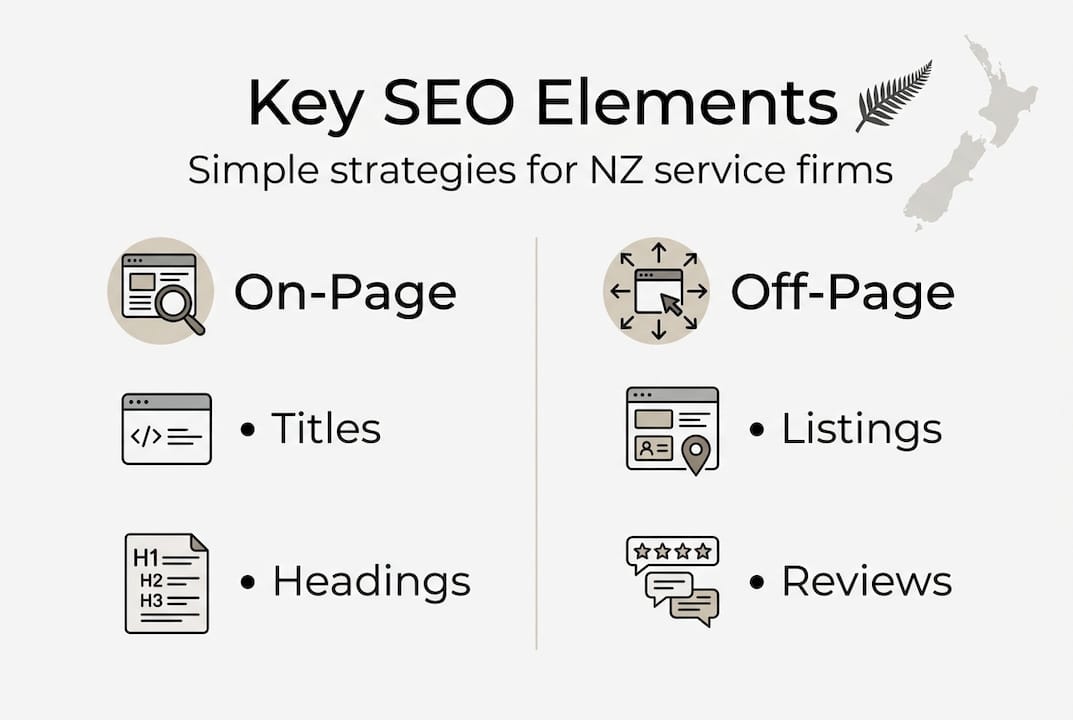
On-page SEO refers to everything you control on your website. This includes your page titles, headings, content, images, and how fast your site loads. Every page should target specific keywords that your customers actually use.
Off-page SEO is about building your reputation beyond your website. This mainly involves getting other reputable websites to link to yours and building citations (mentions of your business name, address, and phone number) across the web.
Local SEO combines both with a focus on geographical relevance. It’s about making sure search engines know exactly where you operate and what you offer in those areas.
Here’s your practical action plan:
-
Conduct keyword research: List the services you offer and the areas you serve. Use tools like Google’s autocomplete to see what people actually search for. Focus on phrases with clear intent like “hire a” or “book a” rather than general terms.
-
Optimise your Google Business Profile: Claim it, complete every section, choose the right categories, add high-quality photos, and post updates regularly. This is your most powerful local SEO tool.
-
Build local citations: Get your business listed on relevant directories like Finda, NoCowboys, and industry-specific platforms. Ensure your name, address, and phone number are identical everywhere.
-
Encourage and respond to reviews: Ask satisfied customers to leave Google reviews. Respond to every review, positive or negative, professionally and promptly.
-
Optimise for mobile: More than 70% of local searches happen on mobile devices. Your website must load quickly and work perfectly on phones.
Here’s how local SEO priorities differ from traditional SEO:
| Local SEO Focus | Traditional SEO Focus |
|---|---|
| Google Business Profile optimisation | Broad keyword rankings |
| Local citations and directories | Backlinks from high-authority sites |
| Customer reviews and ratings | Content depth and breadth |
| Location-specific content | Topic authority |
| Mobile optimisation for on-the-go searches | Desktop user experience |
For web design for professional services, these elements need to work together seamlessly. Your website should clearly communicate what you do, where you do it, and why clients should choose you.
Pro Tip: Create a dedicated page for each service area you cover. If you’re a plumber serving multiple Auckland suburbs, create separate pages for “Plumber in Ponsonby,” “Plumber in Parnell,” and so on. Include genuine local content, not just keyword stuffing.
Common SEO hurdles for New Zealand small businesses
Even with a solid game plan, small businesses can hit bumps in the road. Here are the most common speed bumps and how to manoeuvre around them.
Limited time and resources top the list. Most small businesses cite time, expertise, and unclear ROI as main barriers to ongoing SEO effort. You’re running a business, not a marketing agency. SEO can feel like another job on top of everything else.
The solution is to start small and build habits. Dedicate 30 minutes each week to one SEO task. Week one, optimise your Google Business Profile. Week two, ask three customers for reviews. Week three, update one page on your website with better keywords. Small, consistent actions compound over time.
Difficulty measuring SEO results frustrates many business owners. Unlike paid ads where you see immediate clicks, SEO builds gradually. You might not notice changes week to week, but over months the impact becomes clear.
Track these simple metrics:
- How many people visit your website each month
- Which search terms bring people to your site
- How many contact form submissions or phone calls you receive
- Your Google Business Profile views and actions
Common mistakes can undermine your efforts:
- Keyword stuffing: Cramming keywords unnaturally into your content. Write for humans first, search engines second.
- Ignoring mobile users: If your site doesn’t work on phones, you’re losing more than half your potential clients.
- Inconsistent information: Having different phone numbers or addresses across various platforms confuses search engines and customers.
- No clear call to action: Visitors should know exactly how to contact you or book your services.
“The biggest SEO mistake small businesses make is giving up too soon. SEO is a marathon, not a sprint. The businesses that win are the ones that keep showing up.”
Affordable ways to get started exist even with tight budgets. Many effective SEO tactics are free, they just require time. Your Google Business Profile costs nothing. Writing helpful blog posts costs nothing but your time. Asking customers for reviews is free.
If you need help, consider working with specialists who understand service businesses. Whether you’re in web design in Stonefields, web design in Birkdale, or web design in Burswood, local expertise makes a difference.
Ongoing SEO: measuring results and staying ahead
Once your SEO efforts are underway, how do you know it’s working and what should you do next?
Tracking simple metrics like Google rankings and website traffic gives business owners actionable feedback. You don’t need fancy analytics dashboards. Focus on what matters for your business.
What to measure:
-
Search rankings: Where do you appear for your most important keywords? Check monthly and track trends over time.
-
Website traffic: How many people visit your site each month? Is it growing? Which pages do they visit most?
-
Enquiries and conversions: How many contact forms, phone calls, or bookings do you receive? This is the metric that actually matters for your bottom line.
-
Google Business Profile insights: How many people view your profile? How many click to your website or call you? What actions do they take?
How often should you review your results? Monthly is ideal for most small businesses. Set a recurring calendar reminder to spend 20 minutes reviewing your numbers. Look for trends, not daily fluctuations.
Adjusting your approach keeps you improving. If certain keywords aren’t bringing traffic, try different ones. If a particular service page gets lots of visits but few enquiries, improve your call to action. SEO is iterative.
Small wins matter. Celebrate progress, not just perfection. Moving from page three to page one for a key search term is huge. Getting your first five-star review is worth acknowledging. Doubling your website traffic over six months deserves recognition.
Pro Tip: Set up Google Search Console and Google Analytics. Both are free and provide valuable insights into how people find and use your website. Spend 15 minutes learning the basics, it’s time well invested.
The importance of an optimised website grows every year. As more Kiwis search online first, your digital presence becomes your primary storefront. Keep it current, keep it relevant, and keep improving.
Ready to put SEO to work for your small business?
You now have the key steps to improve your online presence. Here’s how you can get expert help if you want to take things further.
SEO works, but it takes time and expertise to do it right. If you’re ready to accelerate your results and ensure your website is optimised for maximum local impact, working with specialists makes sense.
Virtual Innovation helps New Zealand service businesses build websites that actually bring in clients. We specialise in expert WordPress website design that’s optimised for search from day one. Our Auckland web design services focus on what matters: getting you found by the right people and turning visitors into customers. We’re a local team that understands Kiwi businesses. We know you’re busy running your company, not studying SEO. That’s where we come in. Whether you need a complete website rebuild or just want to optimise what you’ve got, we can help. Explore our web design in Auckland services to see how we’ve helped other service businesses grow their online presence and attract more clients.
Frequently asked questions
How much does SEO cost for a small business in New Zealand?
Many small businesses invest $300 to $1,000 monthly in ongoing SEO. DIY approaches cost only your time, while professional services deliver faster, more reliable results.
Can I do SEO myself for my small business?
Yes, many DIY SEO tools are available, but experts can maximise results in tough markets. Start with basics like your Google Business Profile, then consider professional help for competitive keywords.
How long does it take to see results from SEO?
SEO results typically appear in 3 to 6 months for small businesses. Quick wins like Google Business Profile optimisation can show results within weeks, while competitive keyword rankings take longer.
Is SEO still worth it in 2026 for small businesses?
Absolutely. SEO is still highly effective for small businesses in 2026. It remains one of the most cost-effective ways to build a steady stream of online enquiries without ongoing ad spend.
What’s the difference between SEO and paid ads?
SEO delivers organic visitors through free search results, while paid ads appear at the top for a fee. SEO builds steady, long-term visibility, whereas ads stop working when you stop paying.