

Running a service business in New Zealand means juggling a dozen priorities every day. You know your website needs fresh, relevant content to attract customers, but finding 3 to 5 hours weekly to plan and create it feels impossible. Without a clear strategy, your content efforts scatter across random blog posts and outdated pages that fail to convert visitors into paying clients. This guide provides a proven, step by step framework to transform your website content planning from reactive chaos into a strategic system that drives measurable online visibility and operational efficiency.
Table of Contents
- Prerequisites: What You Need Before You Start
- Step by Step Website Content Planning Process
- Common Mistakes and How to Fix Them
- Expected Timelines, Costs, and Measurable Outcomes
- Tradeoffs and Choosing Your Approach: DIY vs Professional Help
- Measuring Success: Monitoring and Optimizing Your Content Plan
- Conclusion and Next Steps
- Explore Expert Website Solutions at Virtual Innovation
Key Takeaways
| Point | Details |
|---|---|
| Strategic alignment drives results | Content planning linked to SMART goals and KPIs delivers measurable growth in traffic and leads. |
| Prerequisites set the foundation | Audience research, goal setting, and content audits prepare you for effective planning. |
| Seven step cyclical process | Define goals, research audience, audit content, create clusters, publish, distribute, and measure continuously. |
| Avoid common pitfalls | Skipping research, inconsistent publishing, and ignoring metrics waste time and opportunities. |
| Measure and optimize relentlessly | Track organic traffic, leads, and engagement to refine your strategy for continuous improvement. |
Introduction to Website Content Planning
Effective website content planning follows a sequence of defining goals, researching audience, auditing content, creating topic clusters, publishing, distributing, and measuring for continuous improvement. This systematic approach ensures your website attracts the right visitors and converts them into customers who value your services.
For New Zealand service businesses, strategic content planning directly impacts your bottom line. When you align your website content with specific business objectives, you create a predictable pipeline of qualified leads rather than hoping random visitors stumble onto your site. Your website design workflow for service businesses becomes more efficient because every piece of content serves a defined purpose in your customer journey.
Consider these core benefits of structured content planning:
- Attracts your ideal customers through targeted topics and keywords
- Builds authority in your service niche with consistent, valuable information
- Streamlines your marketing workflow by eliminating guesswork
- Provides measurable data to refine your approach continuously
This guide walks you through each planning step, from identifying prerequisites to measuring success with key performance indicators. You’ll learn how to avoid costly mistakes and choose between DIY execution or professional support based on your unique situation.
Prerequisites: What You Need Before You Start
Before diving into content creation, you need solid groundwork. Start by developing detailed buyer personas that represent your target customers. Talk to existing clients, review support tickets, and identify the specific challenges your services solve. These personas guide every content decision you make.
Next, set SMART goals (Specific, Measurable, Achievable, Relevant, Time bound) to align website content plans with measurable business outcomes such as new leads, traffic, and conversions. For example, aim to increase organic traffic by 15 percent within six months or generate 20 qualified leads monthly through blog content.
Gather the right tools for efficient planning:
- Content calendar templates to schedule topics and publication dates
- Keyword research tools focused on New Zealand search patterns
- Analytics platforms to track performance metrics
- Content audit spreadsheets to inventory existing pages
Conduct a thorough audit of your current website content. Identify high performing pages that already attract visitors and convert leads. Note gaps where customer questions go unanswered. Review competitor websites to spot opportunities they’ve missed in your local market. This complete content planning guide provides detailed frameworks for systematic audits.

Pro Tip: Interview three recent customers to understand exactly what information they searched for before choosing your service. Use their actual questions as content topics.
Step by Step Website Content Planning Process
Transform your prerequisites into actionable content by following this proven seven step framework. Each stage builds on the previous one to create a cohesive, results driven strategy.
- Define your content goals using the SMART framework, linking each objective to specific business KPIs like lead volume or conversion rate.
- Research your audience deeply through surveys, interviews, and analytics data to understand their pain points and search behavior.
- Audit existing content systematically, categorizing pages by performance and identifying gaps in your topic coverage.
- Create topic clusters around core service offerings, grouping related subtopics that support your main pages.
- Develop an editorial calendar specifying content types, publication frequency, and responsible team members.
- Publish and distribute content across channels including email, social media, and industry forums.
- Measure performance against KPIs and iterate based on data to improve continuously.
This 7 step content planning process creates a sustainable cycle where each piece of content informs and improves the next. Your step by step website planning process integrates seamlessly with this content framework.
| Planning Stage | Time Investment | Key Deliverable |
|---|---|---|
| Goal definition | 2-3 hours | SMART objectives document |
| Audience research | 4-6 hours | Detailed buyer personas |
| Content audit | 3-5 hours | Inventory spreadsheet with gaps |
| Topic clustering | 4-6 hours | Content map with keywords |
| Calendar creation | 2-3 hours | 90 day publishing schedule |
| Distribution planning | 2-3 hours | Channel strategy document |
| Measurement setup | 2-3 hours | KPI dashboard |
Your complete content planning approach should reflect your specific service offerings and customer journey. A plumbing business needs different content than a consulting firm, even though both follow the same planning process.
Pro Tip: Start with just three core topics that directly address your most common customer questions. Master these before expanding to broader subject areas.
Integrate local web design insights specific to New Zealand markets to ensure your content resonates with regional audiences and search patterns.
</div>Common Mistakes and How to Fix Them
Even experienced business owners stumble over predictable content planning pitfalls. Skipping audience research, irregular publishing, neglecting SEO keywords, and ignoring performance metrics result in low visitor engagement and poor lead generation.
The most damaging mistake is creating content based on what you want to say rather than what your customers need to know. You might write detailed technical explanations when prospects simply want to understand pricing or timelines. Fix this by validating every content idea against your buyer personas and actual customer questions.
Inconsistent publishing destroys your momentum. Search engines favor websites that update regularly, and visitors lose trust when they find outdated information. Commit to a realistic publishing schedule, even if it’s just two posts monthly. Consistent quality beats sporadic brilliance.
Other critical errors to avoid:
- Ignoring keyword research, hoping your natural writing will somehow rank
- Publishing without internal links to guide visitors through your site
- Skipping performance tracking, making optimization impossible
- Copying competitor content instead of offering unique perspectives
- Attempting complex strategies without necessary skills or tools
Many New Zealand businesses list themselves in top NZ business directories but neglect their own website content, missing opportunities to control their messaging. Learn from common website content mistakes that Auckland businesses make to avoid repeating them.
When you notice declining traffic or leads, review your content against this checklist before investing in new tactics. Often, fixing foundational issues delivers better results than launching entirely new campaigns.
Expected Timelines, Costs, and Measurable Outcomes
Small businesses often underestimate time requirements for website content planning, with typical planning phases taking 2 to 4 weeks and content creation requiring 3 to 5 hours per week. Understanding realistic timelines helps you allocate resources effectively and set achievable milestones.
Your initial planning investment includes audience research, content auditing, and strategy development. Budget 15 to 20 hours spread across two to four weeks for this foundation work. Rushing this phase leads to misaligned content that wastes future effort.
Ongoing content creation demands consistent weekly time:
- Research and outlining: 1 to 2 hours
- Writing and editing: 2 to 3 hours
- Publishing and distribution: 30 to 60 minutes
- Performance monitoring: 30 minutes
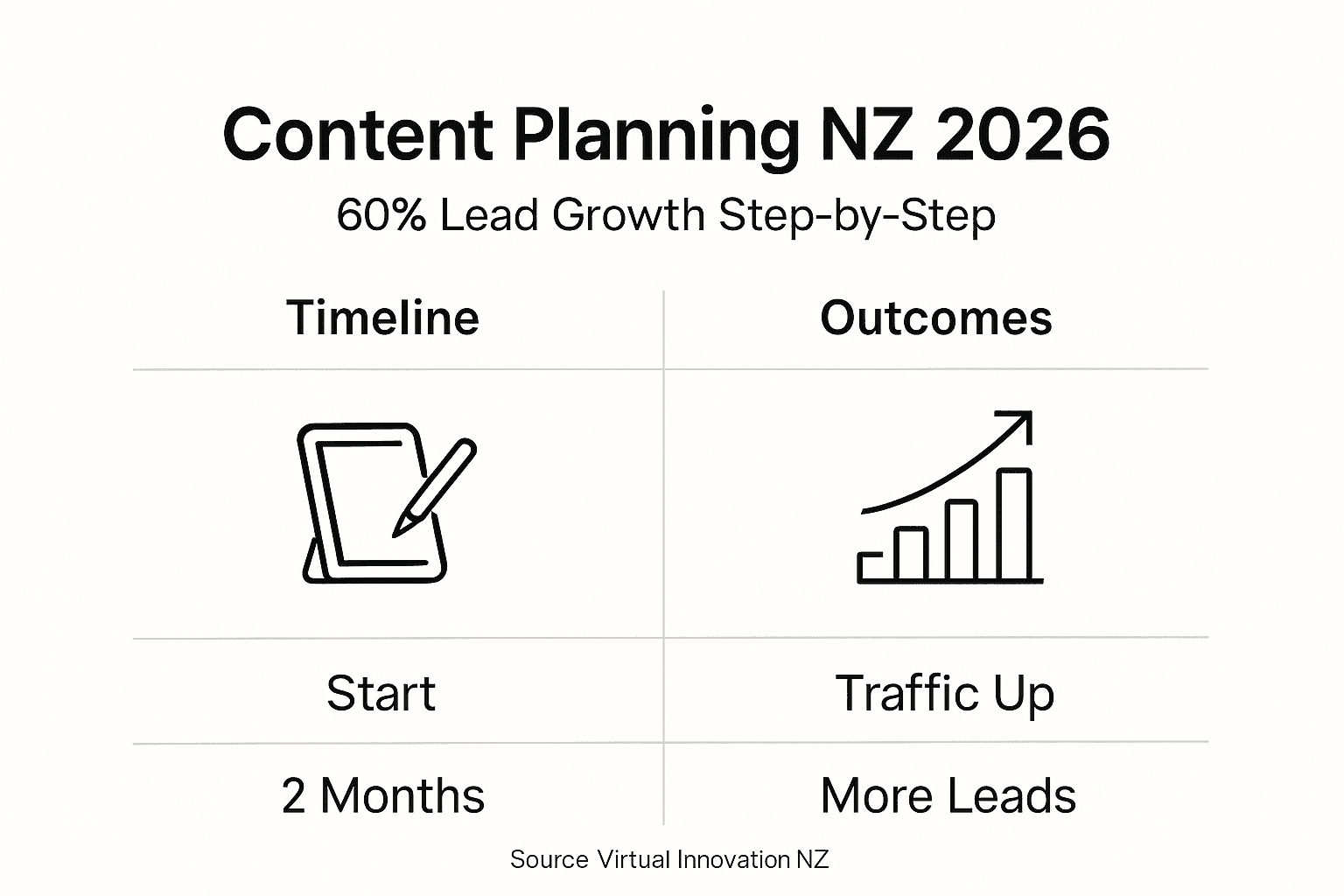
A complete content planning project from strategy through initial results typically spans two to three months. You’ll see early traffic increases within four to six weeks, with meaningful lead generation emerging after eight to twelve weeks of consistent publishing.
| Timeline Milestone | Duration | Expected Outcome |
|---|---|---|
| Planning completion | 2-4 weeks | Strategy document and 90 day calendar |
| First content batch | 4-6 weeks | 4-8 published pieces |
| Initial traffic growth | 6-8 weeks | 10-15% increase in organic visits |
| Lead generation impact | 8-12 weeks | 15-20% increase in qualified inquiries |
| Optimization cycle | 12+ weeks | 20-25% improvement in conversion rates |
Costs vary based on your approach. DIY content planning requires only your time investment, while professional services for WordPress website design NZ range from initial strategy fees to ongoing content creation packages.
Pro Tip: Track your actual time spent weekly for the first month to establish realistic ongoing capacity. Most business owners overestimate their available hours initially.
Tradeoffs and Choosing Your Approach: DIY vs Professional Help
Deciding whether to handle content planning internally or hire professionals depends on your specific situation. DIY suits simple websites with straightforward service offerings when you have 5 to 7 hours weekly available. Professional help makes sense for complex sites where online lead generation directly impacts revenue.
Consider these DIY advantages:
- Lower upfront costs with no agency fees
- Complete control over messaging and timing
- Deep understanding of your own business challenges
- Flexibility to adjust strategy instantly
However, DIY demands significant learning investment. You need to master keyword research, SEO basics, content strategy, and analytics interpretation. These skills take months to develop through trial and error. Your opportunity cost matters as much as direct expenses.
Professional services provide immediate expertise and efficiency. Experienced teams deliver higher quality content faster because they’ve solved similar challenges dozens of times. They bring proven frameworks, established workflows, and objective perspectives your business lacks. Professional website design services integrate content planning with technical optimization for maximum impact.
| Factor | DIY Approach | Professional Help |
|---|---|---|
| Upfront cost | Time only | $2,000-$8,000+ |
| Ongoing cost | 5-7 hours weekly | $500-$2,000 monthly |
| Time to results | 3-6 months | 1-3 months |
| Learning curve | Steep | Minimal |
| Strategy quality | Variable | Consistently high |
| Technical execution | Self taught | Expert level |
Many successful businesses adopt a hybrid model. Start with professional content planning help to establish your foundation strategy and first content pieces. Once you understand the framework, transition to internal execution with periodic professional reviews.
Pro Tip: If online leads represent more than 30 percent of your business, professional help usually pays for itself within three to six months through increased conversion rates.
Measuring Success: Monitoring and Optimizing Your Content Plan
Measuring key performance indicators such as organic traffic, lead volume, conversion rate, and engagement metrics (time on page, scroll depth) is essential for optimizing website content performance. Without data, you’re guessing which content works and which wastes effort.
Start by tracking these fundamental metrics monthly:
- Organic search traffic to measure visibility growth
- Lead form submissions to quantify conversion success
- Pages per session to assess content relevance
- Average time on page to gauge engagement depth
- Bounce rate by page to identify content mismatches
Set up Google Analytics goals for key conversion actions like contact form submissions, quote requests, or resource downloads. These goals transform abstract traffic numbers into concrete business outcomes you can evaluate.
Benchmark your current performance before implementing new content strategies. Record baseline metrics for organic traffic, lead volume, and engagement rates. Compare monthly progress against these baselines rather than arbitrary industry standards that may not reflect your specific market.
Analyze trends over rolling 90 day periods rather than month to month comparisons. Content marketing delivers compounding returns where early pieces support later ones through internal linking and topic authority. Short term fluctuations often mislead if you react too quickly.
Successful service businesses see 15 to 25 percent increases in qualified leads within six months of implementing strategic content planning. Your specific results depend on starting position, competition intensity, and execution consistency. Regular content updates for NZ service firms maintain momentum as market conditions evolve.
Review your top performing content quarterly to understand what resonates with your audience. Identify patterns in topics, formats, and calls to action that drive conversions. Double down on proven approaches while testing new angles systematically.
Conclusion and Next Steps
Strategic website content planning transforms your online presence from a static brochure into a dynamic lead generation engine. By following this step by step framework, you create systematic workflows that attract qualified prospects, demonstrate your expertise, and convert visitors into customers. The seven stage planning process provides a repeatable system that improves with every iteration.
Start by completing your audience research and content audit this week. Define three SMART goals that align content efforts with specific business outcomes. Build your 90 day editorial calendar around topics that directly address customer questions and pain points. Commit to consistent publishing even if you begin with just two pieces monthly.
Remember that content planning is not a one time project but an ongoing strategic process. Your initial investment in research and strategy pays dividends for years as your content library grows and compounds its impact. Small, consistent efforts deliver better results than sporadic campaigns that start and stop.
Whether you choose DIY execution or professional web design services in NZ, the principles remain the same. Focus on your audience needs, maintain publishing consistency, and optimize based on performance data. Your website content becomes your hardest working marketing asset when you approach it strategically.
Explore Expert Website Solutions at Virtual Innovation
Building an effective content strategy takes time and expertise that many service business owners simply don’t have while running their operations. Virtual Innovation specializes in WordPress website design services tailored specifically for New Zealand service businesses like yours. We understand the unique challenges of balancing daily operations with online growth.
Our team combines technical website development with strategic content planning to create sites that actually generate leads. We provide reliable WordPress hosting and support to keep your content fresh and your site performing optimally. When you partner with us, you work with designers who understand the New Zealand market and speak your language.
We’re not interested in complicated jargon or overselling services you don’t need. Our approach focuses on practical solutions that make your business more efficient and bring in more customers. Whether you need a complete website overhaul or strategic content guidance, we help service businesses throughout Auckland and beyond succeed online. Explore how finding a WordPress designer in New Zealand who understands your business can accelerate your growth.
Frequently Asked Questions
What is the most important prerequisite before starting website content planning?
Understanding your target audience through detailed buyer personas is the critical foundation. Without knowing who you’re writing for, their challenges, and search behavior, your content will miss the mark. Combine audience research with clear SMART goals that define specific, measurable outcomes you want your content to achieve.
How long should small businesses expect to spend on website content planning each week?
Most small service businesses invest 3 to 5 hours weekly on content creation and updates after completing the initial planning phase. The upfront planning typically requires 15 to 20 hours spread across 2 to 4 weeks. This time investment decreases as you develop efficient workflows and reusable templates.
When is it better to hire a professional for website content planning?
Hire professional help when your website serves as a primary lead generation channel or when you lack time to learn content strategy fundamentals. Complex service offerings, competitive markets, or the need for rapid results all favor professional support. If online leads represent more than 30 percent of your business, expert guidance typically pays for itself quickly through improved conversion rates.
Which KPIs best indicate success in website content planning?
Track organic search traffic to measure visibility growth, lead form submissions to quantify conversions, and engagement metrics like time on page and scroll depth to assess content quality. Monitor these KPIs monthly over 90 day rolling periods to identify meaningful trends. Successful service businesses typically see 15 to 25 percent increases in qualified leads within six months of strategic content planning implementation.