
Building the right website for your small business in Auckland can feel confusing when options range from basic brochures to interactive online stores. Choosing the wrong approach leads to wasted time, extra costs, and a site that does nothing for your customers. But understanding what each web design type offers can put you back in control, even if technology is not your thing.
This guide spells out practical solutions tailored for busy owners like you. With each method, you’ll uncover benefits that match real-world business needs—from simple updates and fast enquiry forms to sites that are easy for clients to use on any device. Discover which websites work best for New Zealand tradies and surgeons, and learn how smart design decisions can make a difference for your bottom line.
Table of Contents
- 1. Static Website Design: Simple And Cost Effective
- 2. Responsive Design: Looks Great On All Devices
- 3. E-Commerce Design: Boosting Online Sales
- 4. CMS-Based Design: Easy Updates For Busy Owners
- 5. Custom Web Applications: Streamline Business Tasks
- 6. Landing Page Design: Drive Customer Enquiries Fast
Quick Summary
| Key Insight | Detailed Explanation |
|---|---|
| 1. Static websites are cost-effective and simple. | Ideal for small businesses needing an online presence without complicated features, static sites reduce maintenance costs and hassle. |
| 2. Responsive design is essential for modern websites. | Websites must adapt to various devices to enhance user experience and prevent loss of potential customers due to poor navigation. |
| 3. E-commerce platforms drive online sales. | Customised e-commerce sites improve customer experience and allow businesses to reach wider markets, even outside regular hours. |
| 4. Content Management Systems simplify updates. | With a CMS, business owners can easily update content without developer help, keeping their site relevant and fresh for search engines. |
| 5. Landing pages increase conversion rates. | Focused landing pages eliminate distractions and clearly guide visitors towards taking action, significantly improving the chances of enquiries. |
1. Static Website Design: Simple and Cost Effective
A static website is exactly what it sounds like: a site that displays the same content to every visitor without changing based on user interaction or database pulls. Think of it like a digital brochure that sits on your server, ready to be viewed whenever someone visits.
For small business owners in Auckland, particularly tradies and surgeons, static websites offer something increasingly rare: simplicity without compromise. No complicated backend systems, no security headaches from constantly updating plugins, and no monthly maintenance fees that pile up like unpaid invoices.
Why static websites make sense for your business
Static sites load incredibly fast. Your pages are pre-built and just sit there, waiting to be served to visitors. There’s no database querying, no server-side processing, no waiting around. Speed matters more than most business owners realise, especially since slower sites lose customers before they even scroll.
The cost structure is refreshingly straightforward. You pay for hosting (often under $50 annually), a domain name, and a one-time design fee. That’s it. No ongoing WordPress plugin updates, no security patches every other week, no surprise hosting bill jumps because you got a traffic spike.
What you get with static design
Consider what actually matters for your business:
- Fast page load times that keep customers engaged
- Rock-solid security because there’s less to attack
- Predictable costs with no surprise expenses
- Reliable uptime without complex server requirements
- Clean, professional appearance that doesn’t feel dated
Static websites prove that simplicity often outperforms complexity, especially for businesses that just need an effective online presence without the overhead.
Practical examples
A local surgeon needs a site showcasing credentials, services offered, and booking information. A static website handles this perfectly. A tradie needs to display portfolio photos, contact details, and service areas. Again, static design gets the job done without unnecessary bells and whistles.
The key is understanding what your business actually needs. If you’re selling digital products that require instant updates, complex user accounts, or real-time inventory management, static might not be ideal. But if you’re establishing credibility, providing information, and making it easy for customers to contact you, static websites punch well above their weight.
The modern static advantage
Static websites aren’t the clunky 1990s sites you might imagine. Modern WordPress website tips for Auckland businesses show that even dynamic platforms can feel constrictive. Static design today means responsive layouts that work beautifully on phones, professional designs that look current, and sites that actually perform.
You’re also not locked into a specific platform or technology. Static sites built with HTML and CSS age gracefully. Your site from five years ago still works today without modification. That’s unusual in web development.
Pro tip: _Start with a static website if you’re unsure about your long-term online strategy. You can always add complexity later, but getting something professional live and fast is better than waiting for the perfect platform.
2. Responsive Design: Looks Great on All Devices
Responsive design means your website automatically adjusts its layout, images, and text to fit whatever screen someone is viewing it on. Whether a customer is browsing on their phone whilst walking down Queen Street or checking your site on a desktop at home, everything looks perfect.
This matters more than you might think. Your potential clients aren’t sitting at a desk anymore. They’re on their phones, tablets, and various devices throughout the day. If your site doesn’t adapt to their screen, they’ll simply bounce to a competitor’s site that does.
Why this approach works for your business
Responsive websites provide a seamless experience across all devices, which research shows significantly increases usability and user preference. When customers can easily navigate your site regardless of how they’re viewing it, they stay longer and are more likely to contact you.
You’re also investing in one website rather than managing multiple versions. No need to build a separate mobile site or desktop version. One codebase handles everything, which means lower maintenance costs and fewer headaches down the track.
How responsive design actually functions
Responsive sites use flexible grids and fluid images that automatically resize based on screen width. Media queries (bits of code) tell your site how to behave on small phones versus large desktop monitors. The content reflows intelligently, ensuring nothing breaks or becomes unreadable.
Think of it like pouring water into different shaped containers. The water adapts to each vessel without losing its essential properties. Your content does the same across devices.
Real-world benefits you’ll notice
Consider these advantages that directly impact your bottom line:
- Customers can easily book appointments or call you from any device
- Your site ranks better in search results (Google favours responsive sites)
- One investment covers all device types instead of building multiple sites
- Why your mobile site matters has become critical in today’s market
- Reduced bounce rates because people aren’t frustrated by tiny text or sideways scrolling
- Professional appearance that signals credibility to potential patients or clients
Responsive design isn’t a luxury anymore—it’s the baseline expectation for any business website in 2024.
Practical implementation
When you hire someone to build your website, ask if it’s responsive. Most professional designers build this in as standard. For surgeons and tradies in Auckland, this means clients can view your portfolio, read testimonials, and contact you seamlessly whether they’re on their phone or computer.
The technical side involves flexible layouts, scalable images, and breakpoints that adjust design at different screen sizes. You don’t need to understand the code—just know that proper responsive design feels invisible to users. They simply experience a site that works beautifully on their device.
Pro tip: Test your current website on multiple devices (phone, tablet, desktop) to see how it performs; if text is hard to read or buttons are hard to tap on mobile, you need a responsive redesign.
3. E-Commerce Design: Boosting Online Sales
An e-commerce website is a shop that lives on the internet, allowing customers to browse your products or services and purchase them without leaving their homes. Unlike a static brochure site, e-commerce design is specifically built to turn visitors into paying customers.
For small business owners, e-commerce opens doors you might not have considered. A tradie with a product line can reach customers across Auckland. A surgeon might sell skincare or wellness products alongside their services. Your physical location no longer limits your market.
What makes e-commerce design different
E-commerce sites need more than just pretty visuals. They require smooth navigation so customers find what they want quickly. Product photos need to be clear and zoomable. Descriptions must be compelling and accurate. Payment processing must feel secure and straightforward.
The whole experience is designed around reducing friction between interest and purchase. Every button, every page, every image serves the goal of moving someone closer to completing a transaction.
Core elements that drive sales
Successful e-commerce design includes several critical components:
- Clear product categories and search functionality for easy browsing
- High-quality product photos from multiple angles
- Detailed descriptions that answer customer questions before they ask
- Trust signals like customer reviews and security badges
- Simple checkout process that doesn’t require unnecessary steps
- Multiple payment options including credit cards and digital wallets
- Clear return and refund policies displayed prominently
E-commerce design is about understanding customer psychology and removing obstacles that prevent purchases.
Why this matters for your business growth
When you craft a user-friendly online store experience with effective navigation and secure payment processes, you’re not just selling products—you’re building customer confidence. Research shows that small businesses using e-commerce specialists to optimise their conversion rates and enhance their web traffic see measurable growth in sales performance.
You’re also capturing sales outside your regular hours. A customer can browse and buy at 11pm on a Sunday. No staff needed. The system handles the transaction, sends confirmation, and you fulfill the order later.
Practical examples for your business
Imagine a tradie selling tools, safety equipment, or branded merchandise. An e-commerce site lets customers order online and collect from your workshop, or have items shipped. For a surgeon, perhaps you’re selling supplements or skincare products that complement your services. Starting a Shopify website provides a practical path for Auckland businesses looking to enter e-commerce without building from scratch.
The beauty is flexibility. You can start small with a few products and expand as demand grows. Your site learns what works through customer behaviour and sales data.
Pro tip: Focus on reducing checkout friction by allowing guest purchases without requiring account creation, and display your return policy upfront to ease customer concerns about buying online.
4. CMS-Based Design: Easy Updates for Busy Owners
A Content Management System, or CMS, is software that lets you update your website without needing a developer or coding knowledge. You log in, make changes, and they go live. That’s it.
For busy surgeons and tradies juggling appointments, jobs, and everything else, a CMS is a lifesaver. Your website stays current without hiring someone to manage it. You control the narrative about your business, your services, and your expertise.
Why this approach works for small business owners
Traditional websites require a developer to make any change, which means time delays and costs adding up. A CMS flips that on its head. You become the publisher of your own content. Need to update your service prices? Done in minutes. Want to add photos from a recent project? Upload and go.
This matters because businesses that keep their content fresh rank better in search results. Regularly updating your website content signals to Google that your site is active and relevant, which helps potential customers find you more easily.
How a CMS makes your life easier
Most CMS platforms use a visual editor that works like word processors. You see what you’re creating as you create it. No confusing code, no technical jargon. Add text, insert images, format headings, publish.
You can also set up user-friendly interfaces that let you manage different sections of your site without accidentally breaking anything. Some systems support multiple languages, email newsletters, event calendars, and media galleries all in one place.
Real benefits you’ll experience
Consider what you gain with a CMS:
- Update content whenever you want, without waiting for a developer
- Maintain brand consistency across all pages automatically
- Schedule posts to go live at specific times
- Track who made which changes and when
- Manage multiple pages or sections from one dashboard
- Add testimonials, case studies, or project photos easily
- Keep your site looking professional without technical knowledge
A CMS puts control of your online presence directly in your hands, saving money and keeping your site current.
Practical applications for your business
A surgeon can update before and after photo galleries, add new treatment information, or announce new services without project requests. A tradie can showcase completed jobs, update service areas, or highlight seasonal offerings in real time.
WordPress is the most popular CMS for small businesses because it’s flexible, affordable, and straightforward. You can start simple and add features as your business grows.
Pro tip: Schedule content updates for consistent publishing rather than updating sporadically, as regular activity improves your search visibility and keeps customers informed of changes.
5. Custom Web Applications: Streamline Business Tasks
A custom web application is software built specifically for your business. Unlike a standard website, it performs tasks, automates processes, and solves problems unique to how you work. Think of it as having a tool designed exclusively for your business needs.
For surgeons managing patient records, scheduling, and follow-ups, or tradies juggling job quotes, invoicing, and scheduling, custom applications eliminate manual work and reduce errors. Your team spends less time on paperwork and more time on what they do best.
The difference between websites and web applications
A website displays information. A web application lets users do things. You can read a surgeon’s website to learn about services, but a web application lets patients book appointments, fill out intake forms, and access their records online.
Custom applications solve specific business workflow challenges that off-the-shelf software can’t address. They’re built around how your business actually operates, not how a generic platform thinks you should operate.
Why this matters for your Auckland business
Manual processes waste time and introduce mistakes. A tradie writing quotes by hand, then invoicing from spreadsheets, then manually tracking payments is inefficient. A custom application automates this entire workflow. Data flows through the system, reducing double entry and human error.
You also gain data security tailored to your business. Patient information stays secure. Client details remain confidential. Interactive task-specific functions create solutions that align precisely with your business needs and workflows.
Real-world applications for your business
Consider these practical examples:
- Patient management system for surgeons tracking consultations and follow-ups
- Job quoting and invoicing system for tradies managing projects
- Staff scheduling application that optimises rosters and communicates changes
- Customer portal where clients can view project status in real time
- Automated appointment reminders reducing no-shows
- Integrated payment processing for faster cash flow
Custom web applications transform how your business operates by automating repetitive tasks and providing insights you couldn’t access before.
Starting with custom applications
You don’t necessarily need massive investment to begin. Many businesses start with a simpler solution and upgrade as they grow. A software development company in Auckland can assess your specific workflows and recommend the right approach.
Some applications can be built on modern platforms like WordPress with custom plugins, while others require full custom development. The key is understanding your pain points first, then building solutions around those specific challenges.
Pro tip: Map out your most time-consuming manual processes first, then prioritise which one would save you the most hours if automated, starting your custom application journey with the highest-impact task.
6. Landing Page Design: Drive Customer Enquiries Fast
A landing page is a single webpage designed with one clear purpose: get someone to take action. Unlike your main website, which might showcase everything about your business, a landing page focuses ruthlessly on converting visitors into enquiries or customers.
For surgeons and tradies, landing pages work brilliantly for specific campaigns. Running a special promotion? Create a landing page. Launching a new service? Direct people to a landing page. You’re not asking visitors to navigate your entire site—you’re guiding them down a clear path to contact you.
Why landing pages outperform regular website pages
A landing page removes distractions. No navigation menu pointing elsewhere. No links to other parts of your site. Just one offer, one message, one call to action. This focus dramatically increases conversion rates because visitors know exactly what you want them to do.
They’re also easy to create without design skills. Professional landing page builders offer customisable templates optimised for conversion, mobile responsiveness, and analytics tracking so you can see what’s working.
How landing pages drive enquiries
A surgeon creates a landing page for a specific procedure with before and after photos, patient testimonials, and a “Book Consultation” button. A tradie creates one for seasonal services like gutter cleaning with pricing and a contact form. Each page has one job: convert interest into action.
The page includes everything someone needs to make a decision. Clear benefits. Social proof through testimonials. Trust signals. A simple form or call button. That’s it. No fluff, no confusion.
Key elements of effective landing pages
Successful landing pages share common features:
- Single, compelling headline that matches the visitor’s expectation
- Clear explanation of benefits and what makes you different
- High-quality images or videos showing your work
- Customer testimonials building trust and credibility
- A prominent call to action button or form
- Mobile-optimised design for smartphone visitors
- Fast loading speeds that don’t frustrate people
- Optimised contact forms capturing leads effectively
Landing pages convert visitors at two to three times the rate of regular website pages because they eliminate distractions and focus entirely on one goal.
Practical examples for Auckland businesses
Imagine a surgeon running a winter special on cosmetic procedures. A landing page appears in their Google ads with patient results, pricing, and a booking button. Visitors arrive already interested and find exactly what they need.
A tradie offers discounted roof inspections in spring. A landing page explains the inspection process, shows previous work, includes reviews, and displays a contact form. People don’t get lost on the main website—they go straight to conversion.
Pro tip: Test different headlines, images, and call-to-action buttons on your landing page, then track which version gets more enquiries; small changes often dramatically improve your results.
The following table summarises the concepts and benefits covered in the article regarding various website design approaches for businesses.
| Design Type | Features | Primary Benefits | Example Applications |
|---|---|---|---|
| Static Website Design | – Fixed, unchanging content. – Minimal maintenance requirements. |
– Cost-effective and fast loading. – High security and reliable performance. |
A tradie showcasing portfolio photos. A surgeon providing credentials and booking info. |
| Responsive Design | – Automatic adjustment to all device screens. – Fluid grids and media queries ensure proper scaling. |
– Enhanced usability and user engagement. – Improved search engine rankings. |
Optimised websites for mobile and desktop use. |
| E-Commerce Design | – Integrated payment and shopping platforms. – Clear product listings and efficient navigation. |
– Expanded customer reach and increased sales. – Streamlined purchasing process. |
Selling products or services online, e.g., tools for tradies or skincare for surgeons. |
| CMS-Based Design | – Easily updated by owners via an intuitive interface. – Supports scheduled and multilingual posting. |
– Eliminates developer dependency for updates. – Ensures content remains fresh and relevant. |
Updating healthcare service details or new project portfolios. |
| Custom Web Applications | – Tailored software for unique business needs. – Automates processes like scheduling and invoicing. |
– Streamlined business operations. – Reduced errors and time-saving processes. |
Patient management systems, client portals for updates. |
| Landing Page Design | – Focused single-page format aiming at conversion. – Minimal distractions and clear call to actions. |
– Higher conversion rates for specific campaigns. – Increased lead and customer generation. |
Campaign promotions or service-specific advertisements. |
Discover the Right Web Design Solution for Your Small Business Today
Choosing the right type of web design can feel overwhelming especially when your goal is to boost efficiency and attract more customers. This article highlights key challenges like maintaining fast site speeds with static design, ensuring your site looks great on all devices using responsive design, and streamlining tasks with custom web applications. If you want a website that truly works for your business without confusing technology or surprise costs, finding a partner who understands New Zealand small businesses is vital.
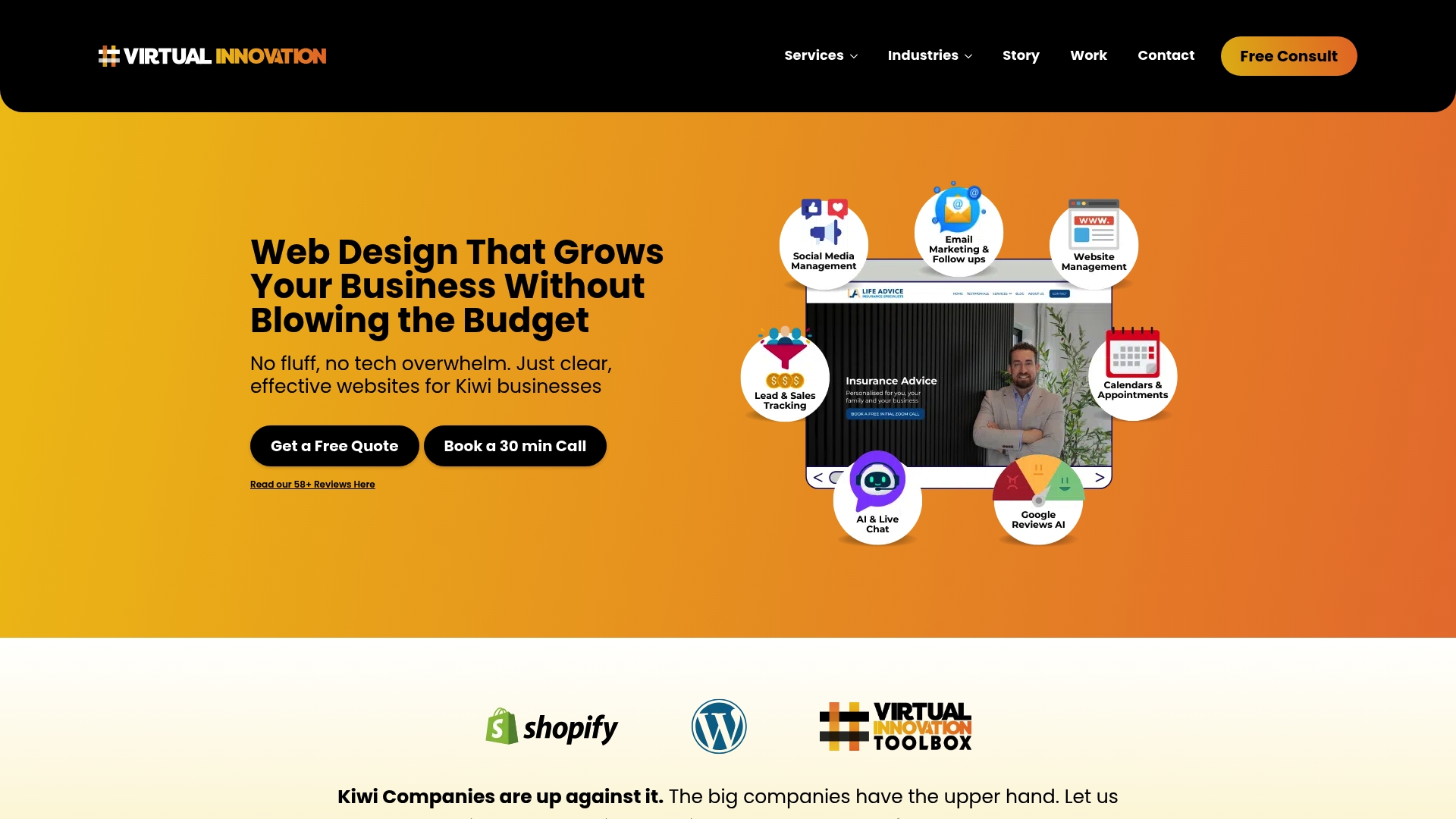
At Virtual Innovation, we specialise in WordPress, Shopify and custom software development tailored to service companies just like yours. Whether it’s launching an e-commerce store that drives sales or building a flexible CMS you can easily update yourself, we take the complex and make it simple and effective. Check out our success stories in the Projects Archives – Virtual Innovation and get inspired by real results. Ready to take control of your web presence?
Don’t wait for the perfect moment. Get expert guidance that respects your unique needs and budget. Visit Virtual Innovation to start your journey towards a website that delivers results. Explore insights and tips from our Hidden Archives – Virtual Innovation to see how we bring web design ideas to life for New Zealand’s service businesses.
Frequently Asked Questions
What is a static website, and how can it benefit my small business?
A static website displays the same content to every visitor and is ideal for small businesses that want an effective online presence without ongoing costs. To benefit from a static site, identify your core business information and get started with a simple design that showcases your services.
How does responsive design improve user experience on my website?
Responsive design ensures that your website automatically adjusts to fit any device’s screen size, providing a seamless experience for users. Invest in responsive design to keep potential customers engaged and reduce bounce rates significantly.
What are the key features of an effective e-commerce design?
An effective e-commerce design includes easy navigation, high-quality product images, clear descriptions, and a secure checkout process. To enhance your online sales, focus on these elements while building your e-commerce site to encourage customer purchases.
How can a Content Management System (CMS) help me manage my website?
A Content Management System allows you to update your website easily without technical skills, giving you control over your content. Start by selecting a simple CMS that fits your needs so you can keep your website current and engaging.
What tasks can a custom web application automate for my business?
Custom web applications can automate specific workflows unique to your business operations, such as scheduling, invoicing, or patient management. Identify your most time-consuming processes and map them out to create a custom solution that reduces manual work and increases efficiency.
How do landing pages increase customer enquiries?
Landing pages are designed with a single purpose: to prompt visitors to take action, such as filling out a contact form. Create targeted landing pages for your promotions or services to enhance conversion rates and drive more customer enquiries immediately.