Why website speed matters: boost conversions and trust
Discover why website speed matters for NZ small businesses. Learn how faster load times boost conversions, build trust, and improve your Google r...

What if your website is quietly killing your sales?
It might look amazing. Your branding could be on point. Your products and services could be exactly what customers need. But if your website is slow to load, none of that matters.
A slow website is often the invisible reason behind high bounce rates, low conversions, and declining revenue. And many business owners in New Zealand have no idea how serious the problem is.
In this guide, we will unpack how the slow website impact on sales could be costing you thousands each year, and show you exactly what to do about it.

According to Google Web Performance, 53 percent of mobile users will leave a website that takes longer than three seconds to load. That means more than half your audience could vanish before they even see your content or offer.
And it is not just mobile users. Desktop visitors are also becoming increasingly impatient. In today’s digital landscape, users expect pages to load instantly. Anything longer than two or three seconds can feel like a lifetime.
The financial impact is just as alarming. A one-second delay in load time can cause a 7 percent drop in conversions. For a business generating $10,000 a month online, that equates to a $700 loss every single month. Multiply that across a year, and you are looking at $8,400 in missed revenue. All because your site loads too slowly.

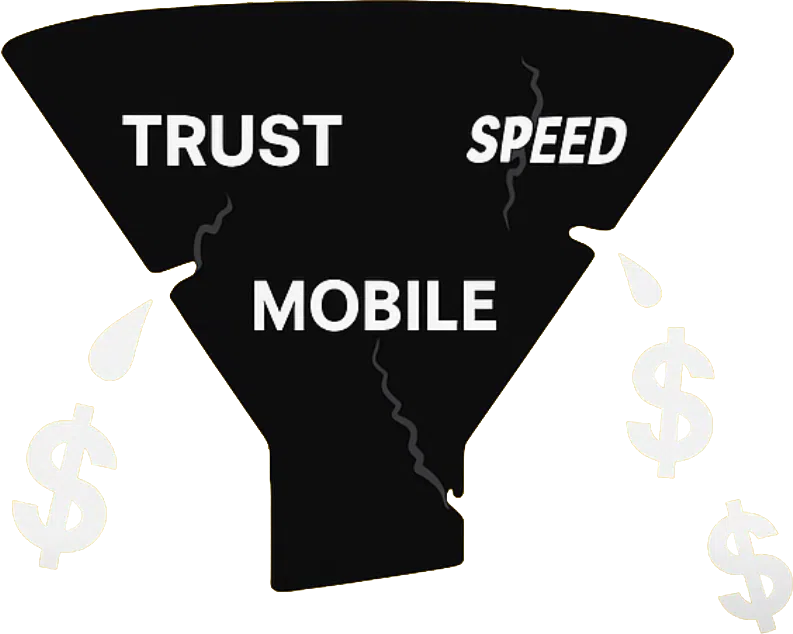
A slow website causes a ripple effect across your entire online presence. Here is what typically happens:
1. Increased Bounce Rate
Visitors do not wait. If the page takes too long to load, they click back and find a competitor instead.
2. Lower Trust
People associate speed with professionalism. A slow site makes your business look outdated, unreliable, or even unsafe.
3. Fewer Conversions
Even if users stay, their patience wears thin. They are less likely to complete a form, book a call, or make a purchase.
4. Poor Google Rankings
Google uses page speed as a ranking factor. A slow site can push your content down in search results, reducing your organic traffic.
5. Damaged Reputation
First impressions count. If your site is slow, it can harm your reputation and brand perception long-term.
We cover this in more detail in our article on why visitors leave your website. Speed is one of the top reasons users bounce.

Google’s Core Web Vitals are now a critical part of the search algorithm. These vitals measure things like load time, interactivity, and layout shift. If your site performs poorly in these areas, you may find it harder to rank on page one.
This means that even if your content is amazing, a slow site could be pushing you out of the top spots in search results. Fewer impressions. Less traffic. Lower visibility. Reduced revenue.
Fixing your speed issues not only helps you keep users engaged, but it can also lead to improved rankings, especially in competitive local searches.
In New Zealand, over 60 percent of web traffic now comes from mobile devices. Unfortunately, many business websites are still built primarily for desktop. This often means bloated graphics, poor image optimisation, and long load times for mobile users.
The slower your site is on mobile, the higher your bounce rate will be. People browsing on phones expect fast, seamless experiences. If your mobile load speed is poor, they will leave and find a competitor who does it better.
We recently discussed this issue in our post on whether your website needs a redesign. In many cases, speed is the number one reason a rebuild is necessary.
There are several common culprits that drag down your website’s performance:
These issues can usually be fixed without a complete rebuild, but they need to be addressed strategically.
One of our clients came to us with a beautifully designed site that was loading in just under 7 seconds. Traffic was strong, but sales were flat. Bounce rates were rising, and customers were not sticking around.
We conducted a full speed audit and discovered oversized images, missing caching, and a slow hosting setup. After compressing images, improving hosting, and implementing caching, we brought the load time down to just under 2 seconds.
The results?
This is a clear example of how fixing your speed can deliver real business results.
Improving your website speed doesn’t have to be complicated. Here are five proven ways to get faster results today:
1. Compress Your Images
Use tools like TinyPNG or convert images to WebP format. This can dramatically reduce file sizes without sacrificing quality.
2. Implement Caching
A good caching plugin (like WP Rocket or LiteSpeed Cache) stores a version of your site so it loads faster for repeat visitors.
3. Choose Quality Hosting
Opt for local, high-performance servers. Hosting makes a huge difference in load time and reliability.
4. Minify CSS and JavaScript Files
Removing unnecessary code from your website reduces the load time significantly.
5. Run Speed Tests
Use tools like Google PageSpeed Insights or GTmetrix to identify bottlenecks and get performance suggestions.
Your website is often the first touchpoint between you and your customer. If it is slow, you may never get a second chance to make an impression.
A fast website:
Speed is no longer optional. It is a strategic asset. And fixing it could be the single most profitable upgrade you make this year.
At Virtual Innovation, we specialise in helping New Zealand businesses improve their website performance, visibility, and conversions.
If you are tired of watching potential customers leave your site before they engage, it is time to act.
???? Contact us today and let’s get your site performing at its full potential
???? Need help with your digital presence?
We offer:
???? Contact us today to elevate your brand online.
???? [Book a Call Now] with our Auckland-based WordPress development team.